

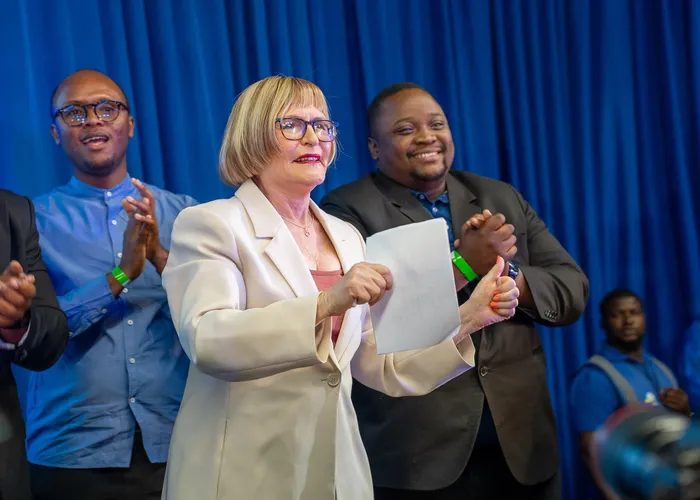
Helen Zille in Soweto, where she was announced as the Democratic Alliance's Joburg mayoral candidate for the 2026 local government elections.
Image: Helen Zille / X
The Democratic Alliance’s (DA) renewed push to abolish Broad-Based Black Economic Empowerment (BBBEE), affirmative action, and other redress policies is more than just a political manoeuvre — it’s a clear signal that the party has never truly come to terms with the structural violence and enduring legacy of apartheid.
In advocating for the removal of these policies, the DA reveals an unwillingness to acknowledge the devastating impact of centuries of colonial dispossession, racial capitalism, and white minority rule in South Africa. The argument often made by the DA and its supporters is cloaked in the language of fairness and meritocracy. They argue that redress measures are “race-based” and discriminatory, and that opportunities should be awarded purely on the basis of merit. But this perspective ignores the very foundation upon which our society is built — a foundation of racial injustice, land theft, and economic exclusion. To pretend that we can move forward by treating everyone equally now, without addressing how we arrived at such deep inequality, is not only naïve but dangerous.
For over 300 years, black South Africans were dispossessed of land, denied education, locked out of the economy, and governed by laws that restricted their movement, their labour, and their dignity. Under apartheid, these injustices were further codified into law, ensuring that the majority of the population would remain poor and powerless while a minority accumulated wealth and privilege. This was not accidental — it was deliberate, systemic, and brutal. Today, we are still living with the consequences of that system. The child of a farm worker in the Eastern Cape or Limpopo is not starting life on equal footing with the child of a wealthy farm owner in Stellenbosch or the Midlands.
The former inherits poverty, under-resourced schools, limited access to quality healthcare, and few job opportunities. The latter inherits wealth, land, social capital, and access to networks of privilege that smooth the path to university, employment, and success. When the DA demands that we “do away with race-based policies” and insists that everyone should compete on the basis of “merit,” they are effectively asking the historically disadvantaged to pull themselves up by their bootstraps — all while ensuring that the advantaged retain their boots, and the road ahead remains steep and uneven. That is not meritocracy. It is the preservation of inequality, wrapped in the rhetoric of fairness.
Redress measures like BBBEE and affirmative action were never meant to be permanent. But they were — and still are — necessary tools to begin to dismantle the structural barriers that continue to keep black South Africans on the margins of the economy. They are imperfect tools, yes. They have been misused and corrupted in some instances. But the failures in implementation should not be used to justify their abolition. Instead, we should be demanding better implementation, stricter oversight, and more inclusive models of empowerment that benefit a broader base of black South Africans, especially those in rural and working-class communities. To do away with redress measures now, before the playing field has been meaningfully levelled, is to abandon the vision of justice that underpins our democratic Constitution.
It is to declare that we are satisfied with the status quo — a country where wealth remains overwhelmingly concentrated in white hands, where black unemployment and poverty remain at crisis levels, and where land reform continues to stall. This does not mean we must blindly defend every aspect of BBBEE or affirmative action as they currently stand. South Africa needs a genuine conversation about how to build a more inclusive economy. But that conversation must begin with an honest reckoning with our history — and a recognition that the present is deeply shaped by that history. Any policy that ignores this reality, or seeks to pretend that racial inequality is no longer a structural problem, is not only misguided but unjust.
Moreover, those who benefited from apartheid — either directly or through intergenerational privilege — have a moral and political responsibility to support efforts aimed at redress. This is not about guilt. It’s about accountability. It’s about justice. It’s about ensuring that the future of South Africa belongs to all who live in it, not just those who have been historically advantaged. If we are serious about building a more just and equal society, then we must reject the idea that redress is a form of reverse racism or that it penalises excellence. True excellence — true merit — can only be recognised in a society where everyone has an equal chance to succeed, where the scars of the past are actively healed, not ignored. The DA’s stance may win favour among a segment of voters who feel threatened by transformation. But history will not look kindly on those who sought to dismantle the few tools we have to build a more equitable society — especially when so much work remains to be done. South Africa deserves a future where all children — whether born in a township, a rural village, or a leafy suburb — can dream of success and have a fair shot at achieving it. That future cannot be built on denial. It must be built on justice.
Mayalo is an independent writer and the views expressed here are not necessarily those of IOL or Independent Media