

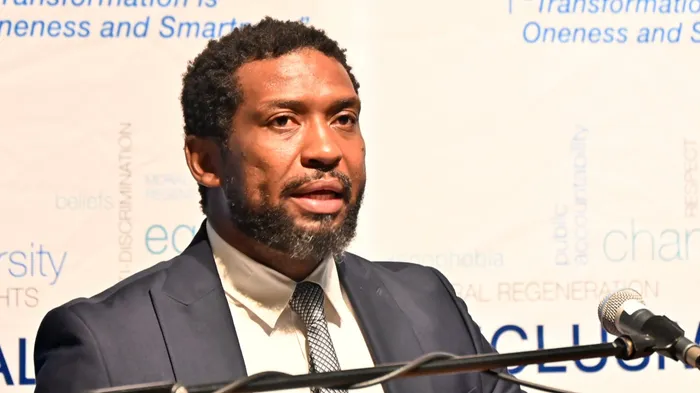
South Africa is not just anticipating the digital revolution; it is living it. The writer interviewed Minister Buti Manamela ahead of his address before Parliament on Tuesday where he was expected to emphasise that digitisation is essential for shaping the future workforce and preventing youth unemployment.
Image: Ayanda Ndamane / IOL
South Africa is not waiting for the digital revolution – it is already living inside it.
That is the message Minister of Higher Education and Training Buti Manamela was expected to take to Parliament on Tuesday when he tables his Budget Vote speech, an address he says will be anchored in one central idea: digitisation is no longer optional; it is the backbone of the country’s future workforce.
In an interview ahead of the Budget Vote, Manamela was blunt about the scale of the transition. “The digital revolution is not approaching South Africa. It is already restructuring our economy, our workplaces, and our labour markets,” he said.
“Artificial intelligence, automation, and digital platforms are not abstract threats or distant possibilities – they are already reshaping call centres, logistics, mining, banking, manufacturing, retail, and even public administration,” he added.
Manamela will table the 2026/27 Budget Vote speech in the National Assembly on Tuesday, with digitisation hailed as the key driver of South Africa's skills revolution.
“When young people leave our institutions, they should not leave into unemployment. People need to know that when they walk into our institutions, it must translate into something else during and beyond that. That's why we're focusing on workplace-integrated learning apprenticeships … so the budget invests in programmes that will ultimately translate into employment, livelihoods, and so on,” he said.
Expanding access to places of learning, says Manamela, is another key priority, though he adds that it is not just about numbers but also about the quality of the education provided throughout the system. The budget leans towards enabling access through the National Student Financial Aid Scheme, ensuring sustainability, and supporting infrastructure and digitisation. Already, universities, TVETS and SETAs are digitising.
Underpinning his digitisation push, Manamela says he observed during the COVID-19 pandemic that the use of university online platforms increased relative to attendance, making it necessary to amend legislation to enable institutions, especially public institutions, to expand.
“It’s already happening in the private sector; it has reduced the cost of learning and teaching, so digitalisation is the future of access to quality education in South Africa, and that's where this budget is speaking to,” he says.
While addressing current challenges, Manamela says a third consideration is preparing for the future economy by using digital skills and artificial intelligence, advancing the green economy (for example, research capacity), and strengthening international partnerships.
He said a recent visit to China saw him return with two partnership agreements that will cost the country nothing but assist in developing new skills in hydrogen and energy, for example.
Thus, Manamela says that while the education system is preparing for today's jobs, it must be about shaping the future, because it is not about being stuck “where we are, but we should begin to be moving also to prepare for the now and also prepare for the future”.
“This is the centre of the budget. We're building a single system that's currently in silos; we must stop seeing education as a social expense. We must see education as a socio-economic and developmental spend. And this is where this budget is leaning towards,” he added.
For Manamela, the question is no longer whether South Africa participates in this transition. “We already are participants,” he said. The real question is whether the country will shape the transition deliberately and inclusively — or be shaped by it on terms set elsewhere.
A Budget Built on Digital Urgency
Manamela’s Budget Vote will outline the department’s strategic allocations for the 2026/27 financial year, with digitisation described as the “key driver of South Africa’s skills revolution”. The minister says the budget is designed to rebuild the broken link between education and employment.
“When young people leave our institutions, they should not leave into unemployment,” he said. “People need to know that when they walk into our institutions, it has to translate into something else during and beyond that.”
The budget therefore leans heavily into workplace-integrated learning, apprenticeships, and programmes that “translate into employment, livelihoods, and so on”. It also prioritises expanding access — not just in numbers, but in quality — through a strengthened NSFAS, infrastructure investment, and a system-wide digital overhaul.
Universities, TVET colleges, and SETAs are already digitising. The pandemic accelerated this shift dramatically. Manamela notes that during COVID-19, “the use of university online platforms increased relative to attendance”, proving that digital expansion is not only feasible but necessary; thus, legislation should enable it to occur on a wider scale at public institutions.
“Digitalisation is the future of access to quality education in South Africa, and that's where this budget is speaking to,” he said.
But Manamela is keen for the budget to steer South Africa onto a better path. It is a philosophical and political argument about the future of work — and the future of South Africa’s institutions.
He argues that South Africa’s core problem is widely misunderstood. “We do not primarily have a skills shortage. We have a workforce transition-capacity problem.”
A skills shortage implies the country needs more graduates, more artisans, more engineers. A transition-capacity problem runs deeper: South Africa’s institutions are not configured to move people from where they are to where the economy is headed.
“We still run too much of our education and training system as if careers are static, qualifications are permanent, and technological change is gradual. But none of that is true any more.”
He noted that workers now require reskilling across their lifetimes. Qualifications must evolve continuously. Occupational pathways are shifting rapidly. Digital literacy is no longer optional. Adaptability itself has become an economic capability.
This, Manamela argues, makes institutional agility the central challenge of the moment.
“Can universities adapt curricula fast enough? Can TVET colleges respond dynamically to labour market demand? Can SETAs move beyond compliance administration toward real workforce planning? Can quality councils modernise qualification development cycles?”
These are not administrative questions. They are strategic national questions — and South Africa’s institutional architecture, he warns, was not built for this pace of change.
The Triple Collision: Technology, Institutional Lag, Inequality
South Africa enters this transition carrying deep structural inequalities. Millions of young people remain outside employment, education, or training. Many schools lack basic digital infrastructure. Entire communities remain disconnected from the productive economy.
This is where the crisis becomes existential.
“Technological acceleration, institutional lag, and social inequality are now intersecting simultaneously,” Manamela warns. “When these three forces converge, they do not produce inclusion automatically. They produce exclusion. Quietly. Incrementally.”
The digital divide is no longer just a communications issue. It is becoming a development divide, a citizenship divide, a participation divide.
And nowhere is this contradiction more visible than in the Post-School Education and Training (PSET) system itself. South Africa has built a system disproportionately oriented toward the minority who enter university, while the majority navigate their futures through TVET colleges, CET colleges, occupational programmes, and workplace learning.
These sectors carry the burden of workforce transition — yet they remain under-resourced and undervalued. “That is not merely a social injustice. It is a strategic economic mistake.”
A Call for Systemic Repositioning
Before the interview, in an address to the University of Johannesburg on Friday, in a critique of government, Manamela said South Africa was not short of policies, strategies, or plans.
“What it lacks is coordination, execution, and accountability.
Too frequently, he said, institutions operate in silos while the economy moves as an integrated system. “Too frequently, policy cycles move more slowly than technological cycles.”
The department is therefore pursuing what he calls systemic repositioning, anchored in five commitments:
A National Partnership, Not a Government Project
Manamela admits the government cannot deliver this transition alone. Universities must become more agile and interdisciplinary. TVET and CET colleges must expand access and support lifelong learning. SETAs must shift from compliance to outcomes. Industry must co-invest in skills development and workplace learning.
“The countries that will benefit most from the digital revolution will not necessarily be those with the most advanced machines. They will be those with the most capable people.”
South Africa, he insists, has the capacity to lead, but capacity without action changes nothing.
The Stakes Could Not Be Higher
The digital revolution will not pause while South Africa debates its readiness. The transition is already underway. The question is whether South Africans will be equipped to lead within it — or whether too many will remain excluded from it.
Manamela believes the country can rise to the challenge. But belief, he says, must now be matched by urgency.
“What remains necessary is collective will … because the digital revolution will not pause while we debate whether we are ready.”
* This article was first published in ednews.africa, a higher education news and opinion portal.
©Higher Education Media Services. – ednews.africa.