

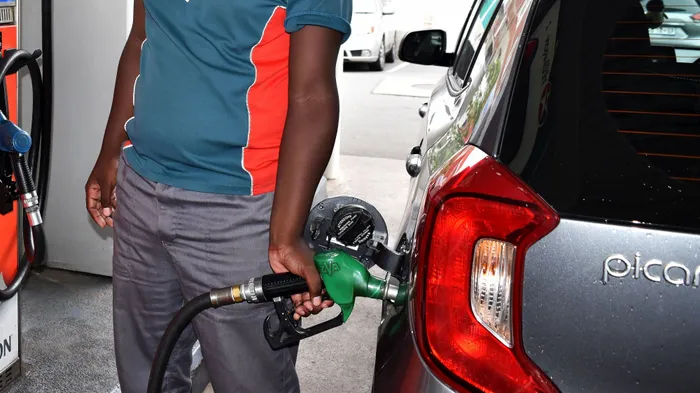
Fiasa CEO Fani Tshifularo explained that the BFP currently accounts for about 43% of the petrol price in South Africa.
Image: Tumi Pakkies/Independent Newspapers
The basic fuel price (BFP), the single largest component of South Africa’s petrol price, has come under renewed scrutiny as the government and industry stakeholders warn that global oil market volatility is set to drive significant fuel price increases in April.
During a briefing hosted by the Department of Mineral and Petroleum Resources (DMPR) and the Fuels Industry Association of South Africa (Fiasa) on Wednesday, stakeholders unpacked how the BFP—largely influenced by international factors—continues to shape what motorists ultimately pay at the pump.
Fiasa CEO Fani Tshifularo explained that the BFP currently accounts for about 43% of the petrol price in South Africa. Tshifularo said the BFP represents the theoretical cost of importing refined fuel into the country and includes a range of international cost drivers such as global oil prices, freight, shipping, insurance, and port charges.
“The basic fuel price is the largest component of the South African fuel price and reflects international market dynamics,” Tshifularo said, noting that recent geopolitical developments have significantly pushed this component higher.
The latest spike in global oil prices has been largely attributed to escalating tensions in the Middle East, including disruptions to key supply routes such as the Strait of Hormuz. These developments have created volatility in global energy markets, placing upward pressure on fuel import costs.
The BFP is directly influenced by global supply and demand, decisions by major oil producers, and movements in the rand-dollar exchange rate. As South Africa imports the majority of its fuel, these external factors leave little room for domestic control over price movements.
A detailed breakdown presented during the session showed that the bulk of the BFP—about 89%—is made up of the international product price, often referred to as the free-on-board cost. Freight accounts for around 9%, while smaller components include insurance, storage, handling, and financing costs.
In Gauteng, for example, the BFP for 95 unleaded petrol currently sits at around R8.66 per litre within a pump price of R20.30 currently. The remaining portion consists of local costs such as taxes, levies, and distribution margins, which together amount to about R11.63 per litre.
Despite the significant role of domestic taxes, Tshifularo stressed that it is the BFP that is currently driving the sharp increases expected in April.
Currently, the latest data from the Central Energy Fund is forecasting a R4.67 per liter increase for petrol 93, R5.20 for petrol 95, R8.95 for diesel 0.05%, and R9.08 per litre increase for diesel 0.005%.
In addition to rising international costs, motorists will also face higher levies. Government has announced increases in the general fuel levy and the Road Accident Fund levy, alongside adjustments to carbon taxes and transport tariffs. These changes will be layered on top of already elevated BFP levels.
Compounding the pressure is the so-called “under-recovery” mechanism within the fuel pricing system. Because fuel prices are adjusted only once a month, local retailers may end up paying more for fuel during the month than the regulated pump price allows them to recover.
“In the current environment, importers are paying more than what they are recovering at the pump, which results in under-recovery,” said Xoliswa Macingwane, head of fuels taxes and regulated prices at Fiasa.
These under-recoveries are then passed on to consumers in the following month through price adjustments. However, not all cost differences are immediately transferred. Some are absorbed into the “slate mechanism,” a balancing system designed to smooth out price shocks over time.
The slate account tracks cumulative over- and under-recoveries and adjusts fuel prices incrementally to ensure industry sustainability without sudden spikes for consumers.
Tshifularo also warned against premature price hikes by wholesalers, particularly in the diesel market, where pricing is not strictly regulated.
Tshifularo said such actions could distort the slate mechanism and lead to what was described as “double-dipping,” where costs are recovered twice.
While concerns have been raised about rising demand—particularly for diesel—Tshifularo attributed this largely to consumers trying to fill up ahead of anticipated price hikes, rather than a structural increase in consumption.
"We've had those cases, which are isolated of people who have already adjusted prices. So those are not helping because people are more and more worried about [whether will their] supplier also change the price before [they] can buy," he said.
"But there's nothing really that's unusual in terms of maybe there's something that has happened that is causing this, except what people are trying to play the markets."
Despite isolated reports of service stations running dry, the DMPR maintained that overall fuel supply in South Africa remains stable, supported by diversified import sources and ongoing monitoring of shipments.
BUSINESS REPORT