

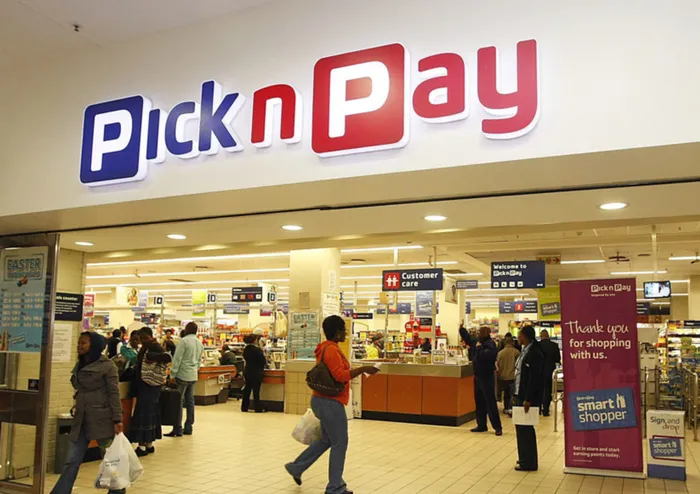
Customers at Pick n Pay in Carlton centre in Johannesburg. Photo: Leon Nicholas. Customers at Pick n Pay in Carlton centre in Johannesburg. Photo: Leon Nicholas.
Pick n Pay has, once again, denied that it was in talks with UK retail giant Tesco after speculation of a deal resurfaced last week.
Tamra Veley, Pick n Pay’s spokeswoman, said on Friday: “We are not talking to Tesco. We have repeatedly said this and we’ll say it again.
“We are not in any negotiations with Tesco.”
Cosatu said last week, following a meeting of its central executive committee, that affiliate union the SA Commercial, Catering and Allied Workers’ Union (Saccawu) had confirmed that the company had been talking to Tesco about the efficiencies the UK firm would expect from Pick n Pay.
In June Pick n Pay chairman Gareth Ackerman reportedly said that in the wake of the Walmart-Massmart deal “all the global retailers are coming to South Africa to see what’s happening”.
Tesco had visited Pick n Pay, but Ackerman stressed there was no substance to reports about a possible transaction between the two groups.
On Friday Tesco declined to comment on the speculation.
In July Pick n Pay announced its plan to retrench over 3 000 employees, but Veley said on Friday that this had nothing to do with Walmart’s entry into South Africa.
But Mduduzi Mbongwe, the deputy general secretary of Saccawu, said: “We believe Pick n Pay is repositioning themselves due to Walmart’s entry and may well be positioning for a deal with Tesco.”
Bryan Roberts, the director of retail insights at Kantar Retail, said from Tesco’s point of view emerging markets were its brightest prospects, given the good performance of its business in Asia compared with its struggling US operations and relatively slow growth in the UK.
South Africa was a possible destination and there was no reason why Tesco would not consider it, given its potential in terms of population growth and likely acceleration in consumer spending and retail sales.
“But given the controversy over Walmart’s entry into South Africa, Tesco will not have been encouraged,” Roberts said.
Roberts said Pick n Pay was an ideal fit for Tesco in terms of style and culture, its store formats, private label and loyalty marketing initiatives. “It would be a match made in heaven.”
Syd Vianello, an analyst at Nedbank Capital, said: “I do not believe that Tesco is likely to buy Pick n Pay simply because Pick n Pay is not currently sellable.”
This was because Tesco or another large foreign retailer would not be interested in a company that had such a large proportion of franchise stores.
According to Pick n Pay’s annual report, the group has 369 franchise stores compared with 420 corporate stores, excluding its Australian and Zimbabwe operations.
Pick n Pay’s corporate stores were earning significantly below profit targets and the group made a major part of its profits from franchising.
Vianello said franchising profitability was relatively fixed and there was not much that could be done to enhance profitability due to the agreed rebates to Pick n Pay from the franchisee and the need for the franchisor to make a decent return. The only way to address this was for Pick n Pay to buy the franchises, the costs of which would be astronomical and would detract from its value if it was sold.
Vianello said: “Why would Pick n Pay want to sell when it has embarked on a strategy to fix the business? If it did, then all the benefits of the groundwork it has laid so far would accrue to the purchaser. Rather fix the business first then sell it.”
Vianello said that Shoprite would be very sellable as almost all stores were corporate owned, but “it will come at one helluva rich price”. - Samantha Enslin-Payne