Platinum becoming jewellers’ new gold standard
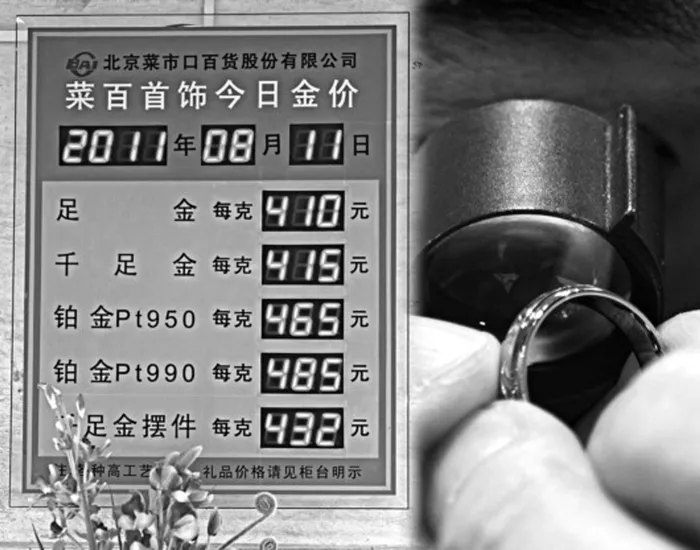
Platinum is luring jewellers away from gold after investors pushed up bullion prices to records as they sought to escape market turmoil. Gold surpassed platinum as the most expensive metal used in jewellery in August last year for the first time since December 2008.
Gold demand from jewellery makers dropped 3 percent last year, according to the World Gold Council. Platinum use climbed 1.8 percent, according to an estimate by Johnson Matthey, a global marketer and distributor of the precious metal.
“Each time gold rallies and hits new key psychological levels, jewellery demand is impacted,” said David Wilson, an analyst at Citigroup in London. “The switch last year, with gold overtaking, should be supportive for platinum jewellery demand.”
Platinum jewellery’s appeal is spreading, driven by China, which accounts for about 68 percent of consumption.
In India, the biggest market for gold ornaments, the greyish-white metal’s popularity was gaining among young women, with the switch partly explained by the surge in gold prices, Platinum Guild International country manager Vaishali Banerjee said in Mumbai.
“All retailers are reporting a strong uptake” in India, Banerjee said. “2012 will be a stronger year for platinum.”
The yellow metal has climbed for 11 successive years and peaked at $1 921.15 (R14 474) an ounce on September 6 before retreating to close at $1 784.23 an ounce in London on Tuesday, data show. Platinum closed at $1 718.50 an ounce the same day, up from a three-year average of almost $1 546 an ounce.
“Consumers have begun to see platinum as a bargain since gold reached parity with platinum,” Johnson Matthey said in its preliminary report for 2011. Even so, gold’s use in jewellery still dwarfs that of platinum by a multiple of about 25. The gulf between consumption levels in rings, necklaces and bracelets signals the potential for platinum’s growth.
Demand for gold from jewellers fell to 1 962.9 tons, or 63 million troy ounces, dragged lower by a 13 percent slump in the second half, the World Gold Council said. Jewellery accounted for 47 percent of gold purchases last year. Platinum’s use in jewellery rose to 76.7 tons, or 2.5 million ounces, according to Johnson Matthey.
In January Morgan Stanley forecast demand for platinum to rise, reversing its outlook for the metal compared with a report in April 2011. The bank expects jewellers’ consumption of platinum to climb 8.9 percent this year and by as much as 36.7 percent from last year through 2017, compared with its earlier estimate of a 21.7 percent slump through 2016.
Gold’s bull run might last for a further five to eight years, with the price of the precious metal more than doubling to as high as $5 000 an ounce, Christopher Wyke, Schroders Investment Management product manager for emerging market debt, commodity and currency funds, said on Friday.
In the near term, gold probably will remain more expensive than platinum through next year, according to analysts. Investment demand for gold in 2011 climbed 7 percent to a record 52.7 million ounces, or about $79.2 billion, the council said, boosted by concerns that economic growth would slow because of the euro zone crisis.
Edel Tully, the UBS analyst who had the closest average forecast for the metal in the London Bullion Market Association survey for 2011 prices, takes a more conservative view on gold, estimating it will fall from $2 050 this year to $1 300 in 2015.
She expects platinum to rise to $2 031 from $1 675.
Jewellery is the second-largest application for platinum, accounting for 31 percent last year, while use in automobile catalytic converters slowed in the past five years, according to Johnson Matthey.
Even a resurgence in price may fail to take the shine off platinum.
“The end consumer that is going to buy platinum is less price sensitive,” said Jeremy Baker, the manager of Harcourt’s Belvista Commodity Fund, part of the Vontobel Group. “The jewellery component is also growing a lot more in China and Asian markets. For that market, I wouldn’t say it is price sensitive.”
Gross domestic product per capita in China has more than doubled since 2000, according to the World Bank. The net worth of the 70 richest members of the National People’s Congress rose to 565.8bn yuan (R676bn) last year, a gain of $11.5bn from 2010, according to figures from the Hurun Report, a Shanghai-based publisher of magazines that tracks China’s wealthy. The legislature has about 3 000 members, some of the Asian nation’s most powerful politicians and executives.
Chinese demand for platinum probably grew 2 percent to 52.4 tons, or 1.68 million ounces, last year, while India’s consumption reached 2.9 tons, or 93 200 ounces, last year, according Johnson Matthey.
In the US, where platinum jewellery mainly means wedding rings, the Tiffany chain of jewellers agreed to buy platinum directly from US-based StillWater Mining, starting last year. Tiffany celebrates its 175th anniversary this year.
Gold and platinum may face competition from another member of the platinum group of metals as producers seek to promote use of palladium for jewellery.
Norilsk Nickel was looking for rising palladium demand from jewellers, Anton Berlin, the head of marketing, said in an interview last month. The Russian mining company accounts for 40 percent of global palladium sales and about 12 percent of platinum.
Palladium, at almost half the price of platinum, is used in jewellery to whiten gold in alloys. Jewellery accounts for 6 percent of consumption. It traded at $710 an ounce on Tuesday.
The metal was gaining attention in its own right for having the same rarity and strength as platinum, while being less dense and less expensive, said Stephen Webster, the creative director of Garrard, the world’s oldest jewellery house.
Webster is also the founder of Stephen Webster Limited, which counts Madonna, Christina Aguilera and Sir Elton John among clients. Both Garrard and Stephen Webster are owned by Californian billionaire Ron Burkle. – Bloomberg