

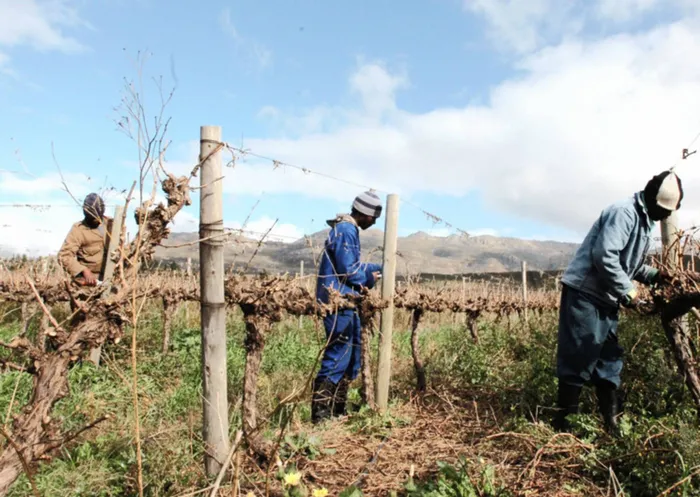
Stock picture by Tracey Adams-Reporter-Hellen. Stock picture by Tracey Adams-Reporter-Hellen.
As a culture and status symbol, wine is seeping in to the black community, as evident by such events as the Soweto Wine Festival, but black farmers are crying foul at being marginalised by the industry.
Ivan Cloete, the provincial chairman of the African Farmers Association of South Africa (Afasa), said: “In the Western Cape we are still victimised… transformation in the agricultural sector is just another word for us, because we do not see any progress in terms of land reform.”
“Black smallholder farmers are tired of being ignored, we need prime land. Real transformation in the wine industry is about being in BEE (black economic empowerment) partnerships with the big wine companies,” he said.
Afasa president Mike Mlengana said transformation was cosmetic and as long as black farmers were excluded in these sector’s, one could not talk about transformation. “As long as these sectors are still dominated by white people, the black smallholder farmers will never be part of the mainstream of the economy because close to 95 percent of black smallholder and emerging farmers continue to be excluded from all farmer support and programmes in the Western Cape.”
Afasa said attempts to meet with the Western Cape government to hold discussions about organising smallholder farmers into commodity groups and co-operatives had failed as there appeared to be no
comprehensive agricultural development plan.
However, Gerrit van Rensburg, the Western Cape Minister of Agriculture and Rural Development, disagreed with Afasa saying the department had spent 100 percent of its Comprehensive Agricultural Support Programme budget.
“We assisted 300 projects, which included smallholder farmers and land reform projects during the past financial year,” he said.
In addition, the department had also assisted smallholder farmer associations with establishment costs and member mobilisation.
“Many of the smallholder farmers are struggling to access land, and until they are settled legally on land there is very little we can do for them as we only assist and support them to farm,” he said.
Van Rensburg said the department had set a target of ensuring a 60 percent success rate with agricultural empowerment targets. “This target is incorporated in the performance agreements of our extension workers. We actively promote equity share schemes, as we believe it to be a successful model for land reform.”
He said that equity share schemes ensured that skills were retained within a project, market access was retained and expert advice was available from the previous owners.
“In the Western Cape, we also pioneered a commodity approach, where we link new projects to the relevant commodity organisation. This gives the new farmers access to all the expertise locked up within these private sector bodies,” he added.
According to data supplied by the department, 1 194 people from 42 farms (vineyards) had benefited from wine BEE land transactions in the Western Cape, including an additional 16 families, two BEE groups, 150 households and nine worker families.
This has resulted in 2 391.15 hectares of land being transferred between 2000 and 2010 with 10 transactions resulting in 100 percent black-owned wine farms. In addition, there have been 39 non-land transactions that have resulted in wholly black-owned wine labels and distribution companies established since 1997.
According to VinPro’s South African Wine Harvest Report, the 2011 wine grape crop was estimated at 1.2 million tons. It projected that the crop – which included juice and concentrate for non-alcoholic purposes, as well as wine for brandy and distilling wine – was expected to amount 992.5 million litres.
The SA Wine Industry and Information Systems (SAWIS), revealed that the industry contributed about R26 billion to the national economy and R14.2bn of that amount was generated in the Western Cape, with the industry supporting about 275 600 jobs.
At face value, these statistics reveal that transformation is taking place, however, some black wine farm owners are saying that this is not a true reflection of how BEE is being utilised in the industry.
Mlengana said that the agricultural sector was characterised by illiterate labourers who gave way to exploitation.
“BEE in agriculture is abused by white owners so that that they can meet their own transformation. It proposes equal partnership in decision making but that is not the case. In some instances, labourers are not even aware that they are in management and can make decisions about the direction of a company,” he said.
Vivian Kleynhans, the chief executive of African Roots, a wine producing company that owns the brand Seven Sisters, said local black wine producers were at the short end of lucrative markets and had to rely on foreign markets to keep their companies sustainable.
BEE policy does not hold any value in the wine industry, the Western Cape government had a programme for market access, but it did not look at the issue holistically, she said. - Ayanda Mdluli