

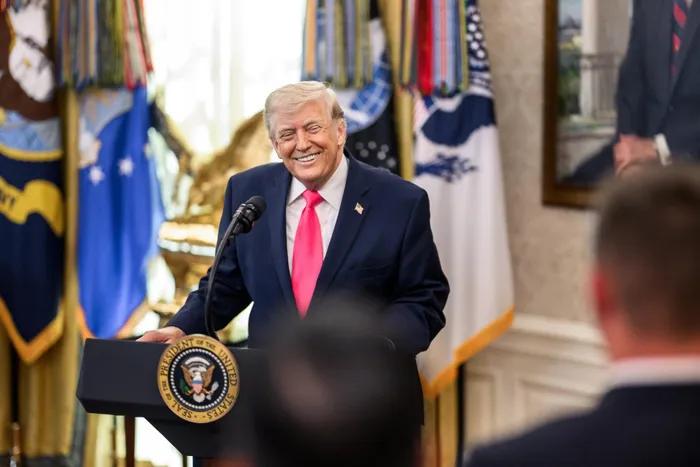
In the wake of President Trump’s ultimatum, markets face mounting uncertainty. Will oil prices soar further, or can calm be restored before the deadline? Dive into our analysis of the economic implications behind this critical geopolitical development.
Image: Facebook/The White House
South Africa’s currency came under renewed pressure this week as the rand weakened to around R16.90 against the US dollar, reflecting rising global risk aversion triggered by escalating tensions in the Middle East and a hardline ultimatum from US President Donald Trump.
The latest bout of volatility follows Trump’s 48-hour deadline for Iran to reopen the Strait of Hormuz — a critical global oil shipping route — or face potential military strikes. The move has injected a rare degree of urgency and uncertainty into global markets, prompting investors to reassess risk exposure across currencies, commodities and equities.
The rand, highly sensitive to global sentiment and oil price movements, has been particularly vulnerable. Since the conflict escalated in late February, the currency has experienced sharp swings, mirroring broader emerging market volatility and highlighting South Africa’s exposure to external shocks.
Oil prices have surged in response to the heightened tensions, with Brent crude climbing above $110 a barrel. This has intensified concerns about inflation, especially for import-dependent economies like South Africa, where fuel costs play a central role in determining broader price dynamics.
Nigel Green, CEO of deVere Group, warned that markets may be underestimating the scale of the risk tied to Trump’s ultimatum.
“The ultimatum introduces a rare, time-bound geopolitical trigger with immediate global market implications,” said Nigel Green.
“Markets are behaving as if this is background noise. A fixed, public deadline from the US president creates a binary outcome within hours — either de-escalation or direct strikes on Iranian infrastructure. This is rare and mispriced.”
Green stressed that while oil prices have already risen, current levels still reflect tension rather than full-scale disruption. Should shipping through the Strait of Hormuz be impaired, or insurers withdraw cover, energy prices could spike sharply, feeding directly into global inflation and growth risks.
Currency markets are already signalling a defensive shift. The US dollar has strengthened, with the dollar index rising above the 100 mark, indicating a move towards safe-haven assets even as equity markets remain relatively steady.
“The dollar is quietly telling a different story,” Green noted. “Capital is starting to move defensively, even if equity indices have not fully adjusted.”
For South Africa, the implications are significant. A stronger dollar and higher oil prices typically translate into a weaker rand and rising domestic inflation — a combination that complicates monetary policy.
Annabel Bishop said the rand has hovered around R16.90/$ in recent weeks as markets pause amid uncertainty, but warned that the situation could deteriorate quickly depending on developments around the Strait of Hormuz.
Bishop said the oil price is at around $110 per barrel and remains volatile, while global financial markets are still in a risk-off phase.
She cautioned that rising fuel costs are already feeding into South Africa’s inflation outlook, with under-recoveries pointing to further increases in petrol and diesel prices in the coming months. This, in turn, is expected to drive up food prices, given the heavy reliance of agriculture on diesel.
“Diesel costs make up nearly 20% of agricultural production costs and are significant, driving up the prices of grain, the staple food in South Africa,” Bishop explained.
“For food, the largest sub-component in the CPI, higher diesel costs will raise the cost of harvesting, planting and transport. Margins for the production of food in SA are already tight, with cost absorption not expected from producers for PPI inflation.”
The inflationary impact is likely to ripple across the economy, from transport and logistics to retail prices, placing additional pressure on consumers and businesses alike.
The tional Treasury has already indicated that it has limited ability to absorb cost increases from the impact of the Middle East war, and further fuel price rises will add upwards pressure to the inflation and interest rate outlook.
The South African Reserve Bank has so far adopted a cautious stance, holding interest rates steady at its March meeting while signalling readiness to act if inflation accelerates.
With risks tilted to the upside, analysts expect rates to remain elevated for longer, or even rise further if oil-driven inflation persists.
Much now hinges on the outcome of Trump’s deadline. A de-escalation could stabilise markets and ease pressure on the rand, while any military action could trigger a sharp repricing of risk assets globally.
BUSINESS REPORT