

Rare earth minerals are crucial for high-tech products, used in powerful permanent magnets for EV motors, wind turbines, and electronics.
Image: Graphic: Nicola Mawson | IOL
South Africa has a rare pitch that it can make at the World Economic Forum (WEF) this week in the form of some of the world’s highest-grade rare earth deposits.
The think tank’s research indicated that the demand for critical minerals required for clean energy technologies is projected to rise more than 3.4 times by 2040 under the International Energy Agency’s net-zero pathway.
Materials such as nickel, neodymium, silicon, silver, and zinc are essential for electric vehicles (EVs), solar panels, and wind turbines, highlighting South Africa’s potential global significance.
This increase in demand, the forum noted, will take place because the next decade will be defined by an energy transition and a digital transition, both of which are mineral-intensive.
The international think tank added that, “critical minerals are also now central to economic security and geopolitical stability”.
“Every AI data centre depends on copper-heavy power systems. Every electric vehicle begins with mined umetals. Every renewable grid, semiconductor and battery system is anchored in materials mined from the earth,” WEF said in a blog on its website.
Team South Africa, led by Finance Minister Enoch Godongwana, is using the Forum to signal that the country is more than a resource hub – it’s a potential partner in global innovation.
“The delegation’s strategic intent is to position South Africa as an attractive investment destination reflected in demonstrable progress in attaining macroeconomic stability, positive momentum in economic reform implementation, regional leadership, and global diplomacy,” said the government.
Brand South Africa said the delegation will highlight initiatives designed to translate dialogue into deals, while also planning to reinforce South Africa’s role in regional trade under the African Continental Free Trade Area.
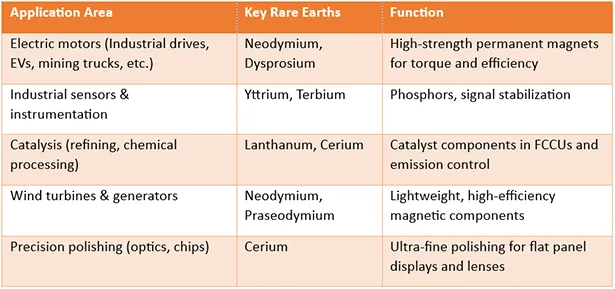
Rare earth mineral uses.
Image: Reliamag | Creative Commons
South Africa is home to some of the world’s highest-grade rare earth deposits.
The Steenkampskraal Mine in the Western Cape produces neodymium and praseodymium, crucial for permanent magnets in electric vehicles and wind turbines, along with thorium.
The Phalaborwa Project in Limpopo recovers rare earths from phosphogypsum, a mining byproduct, demonstrating a resilient and environmentally innovative approach.
Zandkopsdrift in the Northern Cape focuses on cerium, neodymium, and praseodymium, adding further scale to the country’s strategic portfolio.
“Achieving net zero by 2050 will involve securing an escalating supply of the primary inputs for green technologies, including nickel and neodymium for EVs, silicon and silver for photovoltaic solar panels and zinc for wind turbines.
"This creates a fundamental tension at the heart of the sustainable future we are trying to build,” said the WEF.
China is the dominant global leader in rare earth production, followed by the United States and Myanmar, with Australia, Brazil, and Russia also significant producers.
IOL BUSINESS