

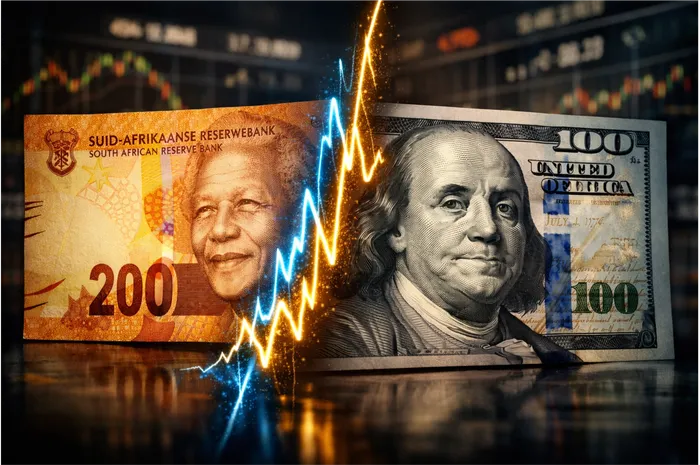
The local currency was near levels last seen in 2022, as markets responded positively to government’s commitment to stabilising debt and narrowing the budget deficit.
Image: Manus
The rand pushed to its strongest level in years on Wednesday, buoyed by optimism after the 2026 Budget signalled that South Africa’s long-rising public debt burden may finally be nearing its peak.
A credible path to debt stabilisation, easing debt-service pressures, and a calmer political backdrop have combined to give the rand, which turns 65 this year, fresh momentum.
The local currency traded below R16 against the US dollar on Thursday morning – at one stage hitting R15.85 – near levels last seen in 2022, as markets responded positively to government’s commitment to stabilising debt and narrowing the budget deficit.
Bianca Botes, director at Citadel Global, said the rand opened the day on firmer footing, although within its recent range.
The move followed a broadly constructive reaction to Finance Minister Enoch Godongwana’s budget presentation, where he indicated that public debt is expected to stabilise for the first time in 17 years.
According to the 2026 Budget, the debt-to-gross domestic product ratio is projected to peak at 78.9% in the 2025 to 2026 fiscal year.
While this is marginally higher than earlier projections due to weaker nominal growth and increased borrowing, debt-service costs as a share of revenue are forecast to ease to 20.2% by 2028 to 2029.
Nolan Wapenaar, head of fixed income and co-chief investment officer at Anchor, described the budget as “largely neutral”, but said confirmation of the debt peak carried important signalling value for investors.
“The budget is seen as confirming that the country is staying the course and will be bringing its debt under control,” Wapenaar said.
Wapenaar noted that debt peaking this year was “meaningful and comforting to the market”.
Although much of the fiscal trajectory had already been priced in, Wapenaar said markets reacted positively to the reaffirmation.
“Much of this was already in the price, though the market has taken positively to this confirmation.”
Wapenaar added that infrastructure allocations were another supportive element.
“We are also positive on the allocations toward infrastructure investment and rebuilding our nation.”
Wapenaar also highlighted adjustments in government’s borrowing approach, particularly the increased reliance on shorter-dated bonds.
“We are positive on this change as it will reduce funding costs and also takes pressure off the domestic bond market,” he said.
Despite the rand’s strength, he cautioned that dramatic market swings were unlikely. “We do not anticipate large market movements, though on this margin this is positive.”
First introduced in 1961, the rand has evolved into one of the most actively traded emerging market currencies, often acting as a proxy for global risk appetite.
Its name originates from the Witwatersrand ridge, the gold-bearing region that underpinned Johannesburg’s development and South Africa’s mining economy.
Gold prices have historically influenced the currency, given the country’s significant precious metals exports.
The rand also anchors the Common Monetary Area, with the currencies of Eswatini, Lesotho and Namibia linked to it.
Over time, the currency has depreciated significantly against the US dollar – from around R1.50/$ in the early 1970s to markedly weaker levels in subsequent decades – reflecting domestic economic cycles and global financial shifts.
IOL BUSINESS