

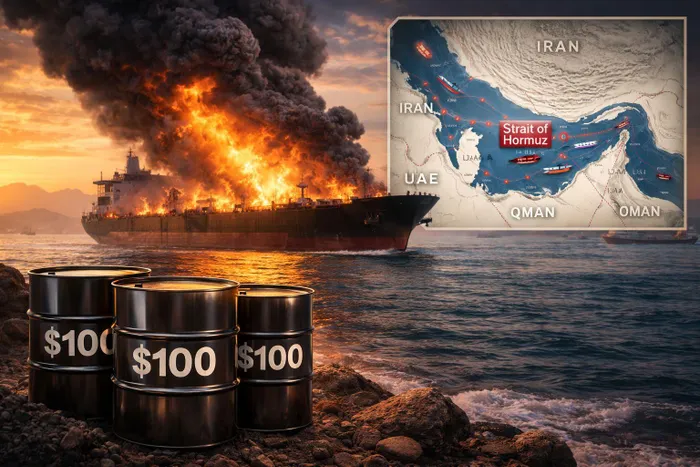
If oil stays above $100 per barrel, the resulting fuel price increases will be damaging.
Image: ChatGPT
The rand weakened towards R17 against the US dollar as surging oil prices and escalating tensions in the Middle East rattled global markets and raised concerns over a potential fuel price shock in South Africa.
Brent crude spiked to about $106 per barrel as supply fears intensified following attacks on key oil infrastructure near the Strait of Hormuz.
Annabel Bishop, chief economist at Investec, said heightened geopolitical tensions have driven a wave of risk aversion across global markets, placing pressure on emerging market currencies such as the rand.
“The oil price has spiked again, reaching $106 per barrel for Brent crude… as escalating market risk aversion drove the rand near R17.00 to the US dollar,” she said.
Concerns over further disruption to global oil supply have intensified after missile strikes in the Gulf region and attacks on key export infrastructure, Trading Economics noted. However, it said some vessels have started attempting the passage while global authorities move to stabilise supply.
Oil shipments from Fujairah, a major export hub in the United Arab Emirates just outside the Strait of Hormuz, were temporarily suspended following a second attack in three days while damage was assessed, the website said.
The US has also urged other countries to help safeguard the strategic shipping route, warning that failure to secure the strait could have serious consequences for global energy markets, Trading Economics said.
Bishop said markets still expect the conflict in the Middle East to be relatively short-lived.
The surge in oil prices and the weaker rand are already translating into a sharp expected increase in South Africa’s fuel prices. Bishop estimates the petrol price under-recovery has climbed to R4.27 per litre for April, while diesel could rise by about R7.04 per litre in April.
Such increases would significantly lift inflation.
“That would add around 1% year-on-year to South Africa’s inflation rate,” Bishop said speaking to April’s figures.
Higher fuel costs would also place pressure on businesses and households, reducing consumer spending and weakening economic growth. Diesel prices are particularly important because they are a key input for South Africa’s industrial and transport sectors.
Large increases in diesel costs can quickly filter through supply chains and drive up producer price inflation, which eventually feeds into consumer prices.
The rand has already been under pressure as investors move away from riskier assets amid the geopolitical tensions. According to TreasuryONE head of market risk Wichard Cilliers, the rand has lost nearly 3% over the past week and could weaken a further 2% this week if energy prices continue rising.
“The surge in energy prices fuelled by conflict in the Middle East has rattled global markets and heightened inflation concerns,” he said.
South Africa is particularly vulnerable to oil price spikes because it is a net importer of energy.
“About 50% of the fuel price in South Africa is taxes and levies, typically adjusted once a year, which means large swings in international petroleum product prices, in rands, only affect around half the fuel price, providing some buffer,” said Bishop.
This means sharp swings in oil prices can still significantly affect local fuel costs and inflation.
IOL BUSINESS