


Global markets are being buffeted by rising oil prices and geopolitical tensions, sending waves through currencies, inflation and interest rate expectations.
Image: ChatGPT
South Africa’s fragile economic recovery is facing new risks after a sharp surge in global oil prices triggered by conflict involving Iran sent shockwaves through financial markets.
The PayInc Economic Index, which tracks the monthly value of electronic transactions cleared through PayInc, improved slightly in February, suggesting economic activity had begun to stabilise before the geopolitical shock.
“The PayInc Economic Index increased by 0.4% to reach an index level of 103.9 in February,” says Shergeran Naidoo, head of Stakeholder Engagements at PayInc. “At 3.5% above year-ago levels, the index signalled resilience in economic activity at the beginning of the year.”
The number of transactions cleared through PayInc in February was slightly higher than those recorded in January and 12.5% higher than a year earlier.
However, the outbreak of war involving Iran on 28 February has abruptly darkened the outlook, introducing significant risks to inflation, fuel costs and economic growth.
“Our previous report, which outlined the economy’s prospects for 2026, highlighted risks such as geopolitical tensions, trade uncertainties and political reshuffling that could disrupt the outlook. However, a full-blown war was not anticipated,” says independent economist Elize Kruger.
“While the full impact is impossible to predict, given that no one knows how long the war will last, it is increasingly clear that even a relatively short duration could have ripple effects on global and local economic prospects in the months to come.”
The most immediate impact is expected to be felt at fuel pumps.
International oil prices have surged by more than 40% in March, reaching their highest levels since 2022 after the US-Israeli attacks on Iran prompted Tehran to halt shipping through the Strait of Hormuz, a key route for global oil supplies, said Elize Kruger.
The spike in oil prices, combined with a weakening rand, has sharply increased the local cost of fuel imports.
“But the daily under-recoveries compared to our current pump prices signal the extent of the fuel price shock on 1 April,” said Elize Kruger.
Elize Kruger said, “these increases will be the highest ever implemented in a single month in South Africa and will likely derail the fragile economic recovery envisaged for South Africa in 2026”.
There is also a chance that fuel prices will continue to rise over the next few months, said Elize Kruger.
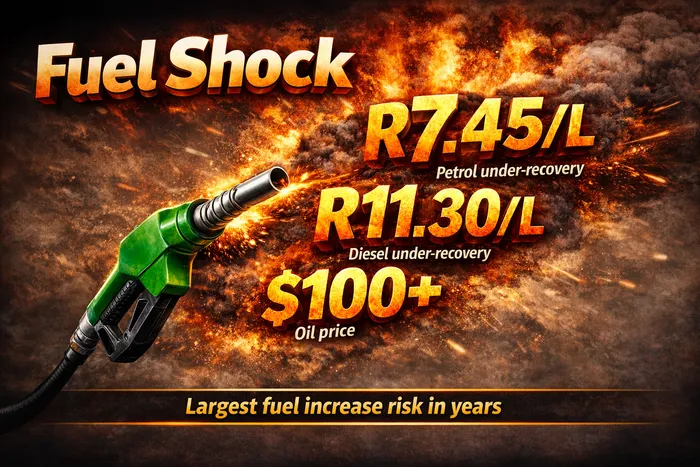
Record fuel price increases are on the cards.
Image: ChatGPT
Rising fuel prices are expected to push consumer inflation higher in coming months, potentially complicating the outlook for interest rates.
Maarten Ackerman, chief economist at Citadel, says the changing global environment has significantly altered expectations for monetary policy.
“However, the environment has shifted meaningfully. Rising geopolitical tensions in the Middle East have pushed oil prices above $100 per barrel, while renewed pressure on the rand is likely to add to inflation risks.”
Higher transport costs typically feed through to other categories such as food, further complicating the inflation outlook.
“Given these developments, expectations for interest rate cuts are now largely off the table for the foreseeable future,” Ackerman says. Just a few weeks ago, there was still a strong likelihood that the South African Reserve Bank would begin cutting interest rates during the course of 2026, he noted.
For emerging markets such as South Africa, the impact of rising oil prices is particularly severe because of their dependence on imported energy.
Kristof Kruger, head of fixed income trading at Prescient Securities, says the transmission from oil prices to inflation in oil-importing economies is immediate.
“For economies like South Africa – and many oil-importing emerging markets – the transmission is immediate and unforgiving: currency weakens, fuel rises, inflation expectations adjust.”
“This is not a uniform global inflation shock. It is a relative one,” said Kristof Kruger.
Global markets have already begun reacting to the disruption.
Trevor Garvin, head of multi-management at Nedgroup Investments, says the oil surge is now creating wider macroeconomic risks.
“At these levels, oil is no longer just an energy story, it becomes a macro and inflation shock, complicating central bank policy, pressuring growth, and amplifying volatility across markets.”
While the immediate outlook for growth has weakened, the turmoil could also create opportunities in some sectors.
Andrew Bahlmann, CE Corporate & Advisory at Deal Leaders International, says higher commodity prices could support investment in parts of the economy.
“Higher commodity and energy prices can benefit sectors like mining and oil. South Africa’s strong precious metals base – including gold, platinum and palladium – could see windfall revenues, attracting strategic acquisitions.”
Similarly, rising energy costs may accelerate interest in renewable energy projects, with Gulf investors increasingly funding African green energy ventures as a hedge against oil market volatility, said Bahlmann.
“This makes renewables and strategic infrastructure potential hotspots for deal activity even amid broader uncertainty,” Bahlmann added.
IOL BUSINESS