


Less South Africans are getting married, research shows.
Image: AI / ChatGPT
More women than men are asking for divorces in South Africa, and these women tend to be middle-aged, according to Statistics South Africa.
The latest marriages and divorces report shows that women initiated more than half of all divorces in 2024, accounting for 57.2% of cases, and maintaining a consistent trend over time.
“Taken together, the steady decline in marriages and unions since 2015 and the rise in divorces initiated by women tell a coherent story about social change,” said Statistics South Africa.
It added that “fewer people are marrying than a decade ago; those who do marry tend to do so later; and more women are exercising the freedom to choose relationship outcomes that best serve their well-being. In practical terms, that means having the authority and means to decide whether to stay or leave.”
Statistics South Africa’s data shows that women-led divorce cases were distributed unevenly across the provinces. Gauteng accounted for the largest share, followed by the Western Cape and KwaZulu-Natal.
A closer look at marital history shows that most of the women filing for divorce were experiencing the end of their first marriage and were generally employed, most often in professional, semi-professional and technical occupations.
“Age remains a telling factor in the profile of women initiating divorce. The data indicates that 70.7% of women who filed for divorce were younger than their husbands, reaffirming traditional age patterns in South African marriages,” the agency says in its latest report.
These women tend to be between 40 and 44 years old, it said. Those aged 35 to 39 accounted for 19.7% of marriages ending, while only 0.5% involved women younger than 25.
“Marriage duration offers another perspective on the stability of relationships,” said Statistics South Africa.
Divorces dropped during the COVID-19 period, with sharp declines in 2020 and 2021 as court activity slowed, but have since rebounded, rising again from 2022 onwards as administrative backlogs were cleared.
The longer-term trend shows that while divorce volumes remain below earlier peaks, they are climbing again as the system normalises.
The largest share of divorces, at 26.7%, occurred in marriages that had lasted between five and nine years. This was followed by marriages of 10 to 14 years at 21.3%.
A sixth of divorces were granted to couples married for less than five years. Overall, four in every ten divorces granted in 2024 involved marriages that had lasted less than a decade.
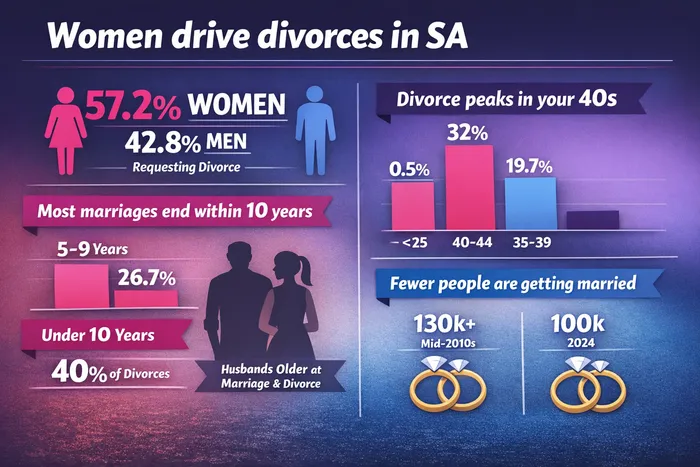
Statistics South Africa data shows that more women than men are getting divorced.
Image: ChatGPT
Marriage registrations have declined sharply since the mid-2010s, falling from well over 130,000 annually – and exceeding 150,000 in earlier years – to just over 100,000 in recent data.
The decline has been gradual rather than sudden, with fewer formal unions recorded in most years since 2015. The data points to a sustained move away from formal marriage.
“The data confirms a consistent downward trajectory in marriage registrations across the 10-year period from 2015 to 2024, suggesting a structural and sustained shift in how South Africans approach long-term unions,” said Statistics South Africa.
Age patterns across both marriage point to consistent gaps between men and women.
Men tend to be older than their partners at the time of marriage, with median ages rising in recent years to 39 for men and 35 for women. Among first-time marriages, men are typically several years older than women.
The data shows that this gap widens in remarriages.
Divorced men overwhelmingly remarry younger women, regardless of whether those women have previously been married. The same pattern is evident among never-married men, particularly older bridegrooms, who are more likely to marry younger partners, including divorced and widowed women.
By contrast, women are more likely to marry partners closer to their own age, or slightly older.
In terms of marriage types, civil marriages continue to dominate, while customary marriages and civil unions account for a smaller portion of registered relationships.
Statistics South Africa said the figures provide insight into changing household structures and social dynamics across the country.
IOL BUSINESS