

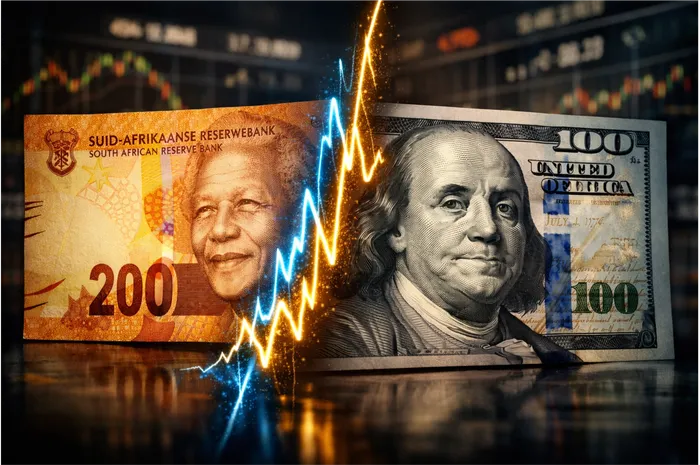
South Africa's rand could weaken by the end of the quarter.
Image: Manus
The local currency is expected to trade around R16.83 by the end of the current quarter and improve to R16.34 over 12 months’ time.
This is according to Trading Economics, which today notes that the rand fell overnight, down from recent one-month highs, as risk-off sentiment returned. This comes “amid uncertainty over US-Iran truce”.
Currently trading at R16.43, the currency has strengthened 0.21% and is up by 14.02% over the last 12 months, according to Trading Economics figures.
Nolan Wapenaar, head of fixed income and co-chief investment officer at Anchor Capital, said the currency had made a meaningful recovery from last week on the back of the ceasefire announcement and a weaker dollar.
Earlier this week, a two-week ceasefire between the US and Iran was announced, sparking a sharp market rebound, even as both sides claim victory, with US President Donald Trump saying the US achieved a “total and complete victory”.
Yesterday, however, it seemed that this fragile truce could break.
Trading Economics notes that “continuing strikes in the Middle East, with Israel intensifying military action in Lebanon, led Tehran to maintain the closure of the Strait of Hormuz and signal a potential withdrawal from negotiations with the US.
Wapenaar said markets have been digesting an “extremely fragile ceasefire”.
Despite this, oil is holding firmer and is below the key $100 a barrel mark. According to CNBC, the price for actual Brent oil cargos came in above $120 per barrel on Wednesday, nearly $30 more than the June futures contract.
“While actual oil supplies remain tight, US stockpiles recorded a higher-than-expected build, and markets are working on the assumption that shipments through the Strait will resume and the weekend’s talks in Islamabad will bear fruit. Overall, though, volatility remains very much at play, and the situation is extremely fluid,” said Wapenaar.
Oil prices saw a rebound as tensions remain high, said Bianca Botes, MD at Citadel Global, noted they gained 2.1% to trade at $96/barrel this morning after retreating to $90/barrel yesterday.
Gold, meanwhile, remains under some pressure but is still on track for a third straight week of gains said Andre Cilliers, currency strategist at TreasuryONE. “Ongoing geopolitical risks continue to support the metal, keeping demand steady,” he said.
Wapenaar added that, “domestically, South Africa still faces the prospect of a significant April fuel price increase and a potential return of the El Niño weather phenomenon, bringing with it drier conditions following recent high rainfall in the country.
“Overall, while the ceasefire is positive, it is proving to be extremely fragile, and risks remain. The talks in Pakistan, which begin today between the US and Iran, will be a critical test as the gap between the parties’ demands remains wide,” said Wapenaar.
IOL BUSINESS