

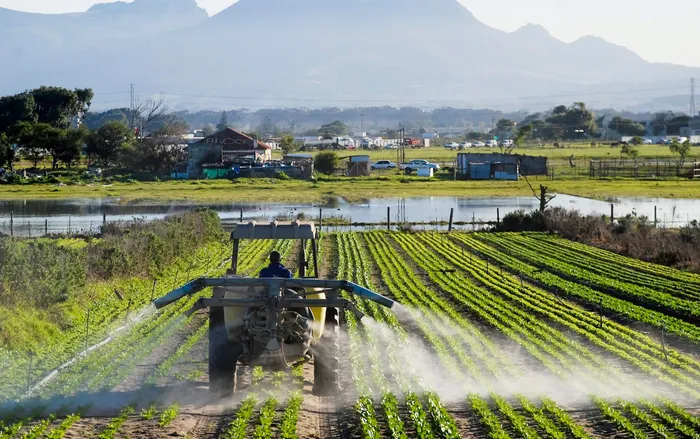
South African farmers planted 3% more land this winter compared to the prior winter season.
Image: David Ritchie
Some 841 685 hectares of land were planted by farmers this winter season, an increase of 3% from the previous season.
This is according to data from the Crop Estimate Committee (CEC). This comprises wheat, barley, canola, oats and sweet lupines.
“We observed an increase in plantings of most of these crops, except for barley, which declined slightly. But the optimism does not end with an increase in the area plantings. The yield potential is promising.
"The CEC forecasts South Africa's 2025-26 winter crops harvest at 2.79 million tonnes, up by 5% from the previous season.
"Production is expected to increase on most crops, except for barley, where the challenge is that farmers have shifted the area to other crops, partly due to profitability reasons,” says Wandile Sihlobo, the chief economist at the Agricultural Business Chamber of SA (Agbiz).
The agricultural organisation said that when delving into the details, starting with wheat, the 2025-26 production is estimated at 2.04 million tonnes, a 6% increase from the previous season, due to a slight increase in plantings and expected better yields.
It said this improvement is primarily driven by the majority of provinces, with the Western Cape being the major producer, followed by the Northern Cape, Free State and Limpopo, among others.
“If such a crop materialises, we could see a mild decline in import requirements in the 2025-26 marketing year. Already, the South African Supply and Demand Estimates Committee forecasts 2025-26 wheat imports at 1.74 million tonnes, a 3% decrease from the previous season.”
With regards to the canola crop, it is projected to reach a new high of 320 043 tonnes, up by 10% from the previous season. This is also boosted by both the increase in plantings and the expected better yields.
“This harvest prospect reinforces South Africa's position as a relatively new exporter of canola products. South Africa is now a net exporter of canola, having recently exported to countries such as Germany and Belgium.
"The 2025-26 oat production is forecast at 57 213 tonnes (up 32% year-on-year), with production of sweet lupines at 23 100 tonnes (up 20% year-on-year). On the downside, the 2025-26 barley harvest is estimated at 352 675 tonnes, down 55% from the previous season,” Agbiz says.
Sihlobo said with all things considered, 2025-26 appears to be a relatively better winter crop season compared to last season for the country, from a volume perspective.
However, he said that for farmers, profitability remains under pressure due to higher input costs at the start of the season, and the fact that in some regions of the Western Cape, farmers had to replant their canola fields because of snail infestations, which further increased costs.
From a consumer perspective, the agricultural economist said the better harvest and generally low global grain prices bode well for a moderating path of food price inflation.
“Indeed, we are still early in the season, and this is the first production estimate. We will need to closely monitor the weather conditions and the evolution of production conditions and prospects in the coming months,” Sihlobo said.
The South African Weather Service (Saws) said in its Seasonal Climate Watch for August to December this year said the El Niño-Southern Oscillation (ENSO) is firmly in a neutral state and is predicted to be in a neutral state for the foreseeable future.
The meteorological service said that ENSO, however, has limited influence on South Africa during the winter seasons and is not expected to have a significant impact.
Saws said that with the start of the spring and early summer seasons, the eastern parts of the country normally start receiving significant rainfall. It said that during early and mid-spring, the eastern and south-eastern areas of the country are expected to receive above-normal rainfall, with most other areas expected to be below normal.
During the late-spring season, however, it said most areas of the country are expected to receive below-normal rainfall. “Minimum and maximum temperatures are largely expected to be above-normal for the most part during the spring season.”
Saws added that it will continue to monitor the weather and climate conditions and provide updates on any future assessments that may provide more clarity on the current expectations for the coming season.
In February this year, agricultural organisation Agri-SA said that while land ownership did not guarantee success in agriculture, it is the foundation for accessing capital. At the time, the organisation said farmers rely on their land as collateral when applying for loans to finance expansion and production.
Between 2019 and 2023, agricultural debt at commercial banks averaged 52% of agricultural GDP, underscoring the critical role of private property in ensuring food security and industry stability. It is also a means to restore the dignity of people.
The organisation said it was for this reason that it and other agricultural organisations continued to advocate for extending property rights to emerging farmers.
“It is well documented that the Department of Agriculture, Land Reform, and Rural Development has yet to release 2.5 million hectares of state-owned land acquired through existing land reform programs.
"Unlocking this land and granting secure title deeds to emerging farmers would greatly enhance their ability to access financing and build sustainable enterprises,” Agri-SA noted.
Independent Media Property