

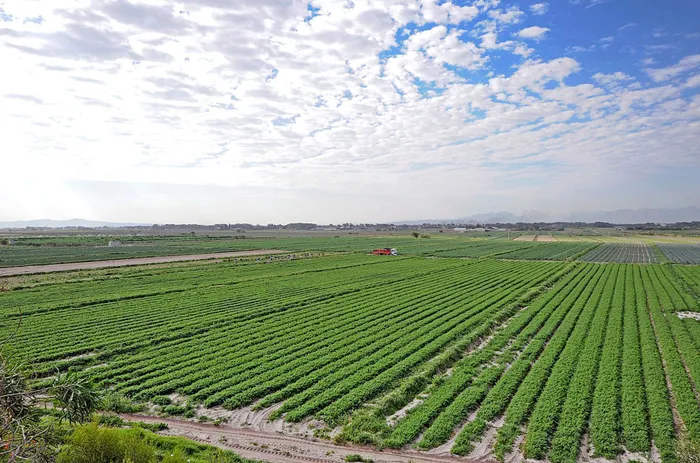
There are strong calls for the continuous affirmation of the property right.
Image: Leon Lestrade/African News Agency (ANA)
Local agricultural organisation Agri SA says it will employ all necessary resources to defend property rights and uphold the principles that support its farmers and the agricultural community at large.
“Private property rights are the primary basis on which South African agriculture is structured, says Johann Kotzé, the CEO at Agri SA.
“Over the past few years, agriculture’s debt-to-GDP ratio has averaged around 50%, highlighting the importance of land as collateral in the financing of production. Consequently, any risk to upholding these fundamental rights holds grave implications for agricultural sustainability and food security.
"Therefore, AgriSA is committed to defending property values and rights and will utilise all necessary resources in consultation with legal experts to uphold these principles,” Kotzé says.
The organisation said it has a long history of advocating for private property rights and their expansion to all new entrants.
It further called on the government to urgently transfer the 2.5 million hectares of land it bought for redistribution purposes to further agricultural development and demonstrate its commitment to meaningful economic development.
It added that it previously commissioned an independent investigation into the macroeconomic impact assessment of a policy of land expropriation without compensation in South Africa.
“The GOPA Group South Africa (Pty) Ltd’s assessment reiterated AgriSA’s long-held conviction that fostering capital formation is interlinked with private property rights and is subsequently a crucial prerequisite for economic development, job creation, and growth,” says Kotzé.
“While supporting the need for transformation and land reform in the agricultural sector, AgriSA emphasises that it must not come at the expense of the economy and investor confidence, added Kotzé.
The organisation remains dedicated to protecting private property rights and fostering the growth and stability of South Africa’s agricultural sector while ensuring food security for all.
In January, AgriSA raised its disappointment about President Cyril Ramaphosa’s signing of the Expropriation Bill into law. It said the bill facilitates the expropriation of land with nil compensation under specified conditions in the public interest.
At the time, Kotzé said the signing of the Expropriation Bill poses a risk to private property rights, which is the primary basis on which South African agriculture is structured. Consequently, he said the Bill poses a risk to agricultural sustainability and food security.
According to a land audit conducted by the South African government in 2017 to provide information on the private individual ownership of farms, agricultural holdings, erven and sectional title units by race, gender and nationality.
The land audit provides such private land ownership only on the basis of land parcels registered at the Deeds Office as of 2015.
Some 114 223 276 ha or 94% of 121 924 881 ha of land in the country is registered in the Deeds Office.
Of it, 7 701 605 ha or 6% is unregistered trust state land in the Eastern Cape and Limpopo at 5 545 156 ha.
The Land Audit also showed that individuals, companies, and trusts owned 89 523 044 ha or 90% of the 114 223 276 ha land. Individuals owned 37 800 986 ha or 39% of this total land. Trusts owned 29 291 857 ha of land.
Companies owned 23 199 904 ha of land or 25%. Community organisations own 3 549 489 ha or 4% of land.
Farms and agricultural holdings - with 469 258 or 6% of total land parcels and 111 025 515 ha or 97% of the total land - were owned by 588 045 or 7% of total landowners.
Meanwhile, on Wednesday, agricultural economist, researcher and author Wandile Sihlobo wrote that Zimbabwe’s land reform programme is no model for South Africa.
He said South Africa's land reform is based on market principles and supports growing investment in the country’s agricultural sector, enabling it to play a meaningful role in resolving the triple challenge of low growth, poverty, and unemployment.
He concurred with Agri SA that the starting point is the continuous affirmation of the strong property right, and thereafter, a release of the 2.5 million hectares of government land to appropriately selected beneficiaries with title deeds.
This could be followed by blended finance and upskilling, collaboratively implemented with the private sector, he said.
He quickly pointed out that the 2.5 million hectares will not be the end of land reform as the process must continue on its market principles under the three pillars of (1) restitution, (2) redistribution, and (3) tenure.
“To be clear, the South African government is still buying land from the open market for land reform processes, amongst other things. This is unlikely to change, and we all know that destructive policies won't help resolve our triple challenges.
"Instead, it is investment and continuous efforts in opening export markets, addressing biosecurity weaknesses, and improving the logistics and efficiencies of municipal service delivery that will bring shared prosperity in South Africa's agriculture,” Sihlobo wrote.
Independent Media Property