
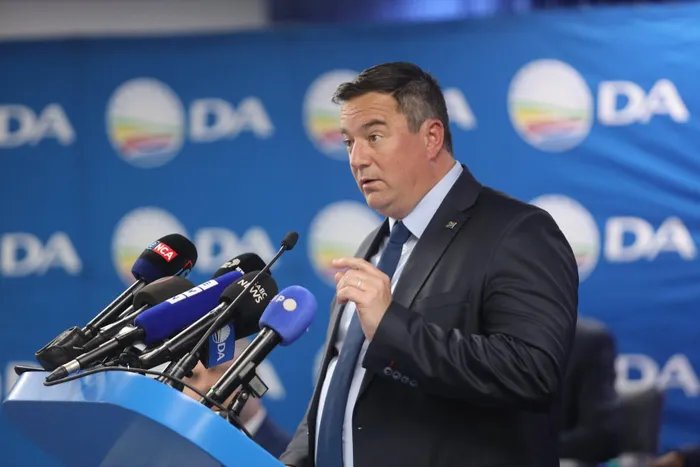
John Steenhuisen, the leader of South Africa's Democratic Alliance (DA), held a press briefing this morning in Durban. He announced that he will not seek re-election as the DA's Federal Leader at the party's upcoming elective conference in April.
Image: Timothy Bernard / Independent Newspapers
John Steenhuisen on Wednesday announced that he will not seek re-election for a third term as leader of the Democratic Alliance, formally ending weeks of speculation about his future and opening a wide-ranging succession contest ahead of the party’s federal congress.
Addressing supporters, colleagues and family in eThekwini, Steenhuisen framed his decision as the completion of a political mission rather than a retreat under pressure, saying he had fulfilled the mandate he received when elected DA federal leader in 2019.
“As I stood there looking out over South Africa’s capital city, I realised: it is mission accomplished for me,” he said, recalling a recent visit to the Union Buildings. “I have delivered everything that I promised my party when I was first elected as Federal Leader back in 2019.”
Steenhuisen confirmed that he would instead focus his full attention on his role as Minister of Agriculture in the Government of National Unity (GNU), particularly the fight against what he described as the most devastating foot-and-mouth disease outbreak in the country’s history.
“That is not a part-time job,” he said. “It would not be fair to the incredible farmers of South Africa for me to split my time between battling the worst FMD outbreak ever and running an internal campaign for the next three months.”
In a sweeping address, Steenhuisen traced the DA’s journey from long-term opposition to national power, arguing that its entry into government after the 2024 general election marked a historic breakthrough. He described the DA’s role in negotiating the GNU with President Cyril Ramaphosa as “the single greatest achievement in the history of our party”, saying it had decisively altered South Africa’s political trajectory.
“For the first time in many years, life is getting better for the people of South Africa,” he said, pointing to improved economic growth, a credit rating upgrade and South Africa’s removal from the Financial Action Task Force grey list as evidence of the GNU’s early impact.
Steenhuisen also used his speech to caution against internal factional battles as leadership contests loom across GNU partners. “It would be a tragedy too great to contemplate for internal party manoeuvring to plunge the GNU and our country into chaos,” he said, warning that instability could reopen the door to what he repeatedly characterised as a populist “doomsday coalition”.
With Steenhuisen’s departure now confirmed, attention has shifted sharply to who could succeed him as DA leader at a critical moment for the party, with local government elections approaching and the DA seeking to broaden its national appeal.
Among the most prominent names is Geordin Hill-Lewis, the executive mayor of Cape Town. Hill-Lewis combines national and local government experience, having previously served as the DA’s shadow minister of finance before resigning from Parliament to lead the country’s second-largest metro. His governance record in Cape Town and rising profile within party leadership structures have positioned him as a leading contender.
Solly Malatsi, the Minister of Communications and Digital Technologies, is also being closely watched. A former DA national spokesperson and deputy federal chairperson, Malatsi brings deep parliamentary experience and has played a visible role in the party’s work within the GNU, strengthening his standing among senior party figures.
Veteran leader Alan Winde, the Premier of the Western Cape, is another name frequently mentioned in internal discussions. With executive experience running the DA’s only provincial government and a strong focus on economic management, Winde represents the party’s experienced governance wing, although it remains unclear whether he would pursue national party leadership.
Several younger leaders are also part of the conversation. Siviwe Gwarube, now Minister of Basic Education, has built a strong profile through her roles as DA chief whip and national spokesperson, while Gauteng opposition leader Solly Msimanga brings provincial leadership credentials and experience as former executive mayor of Tshwane.
Chris Pappas, a South African politician and the mayor of the uMngeni Local Municipality in KwaZulu-Natal, who gained national and international attention after the DA captured the municipality in 2021, has also been mentioned in internal debates, though he has not publicly declared an intention to contest the party’s top post.
In closing, Steenhuisen struck a personal and reflective note, insisting his decision was driven by timing and a belief in leadership renewal. “For the true test of whether you love a thing, is the ability to let it go when the time is right,” he said. “I have loved leading the DA, which is why today I let it go with a smile on my face, and triumphant peace in my heart.”
He said he was handing over a “fundamentally healthier party” than the one he inherited, noting that the DA had grown from polling at 16% to consistently polling around 30%, and pledged his full support to whoever is elected next.
As the DA enters one of its most open leadership contests in years, the outcome is expected to shape not only the party’s future direction, but also the stability and trajectory of South Africa’s first democratically elected multiparty national government.
Cape Argus