

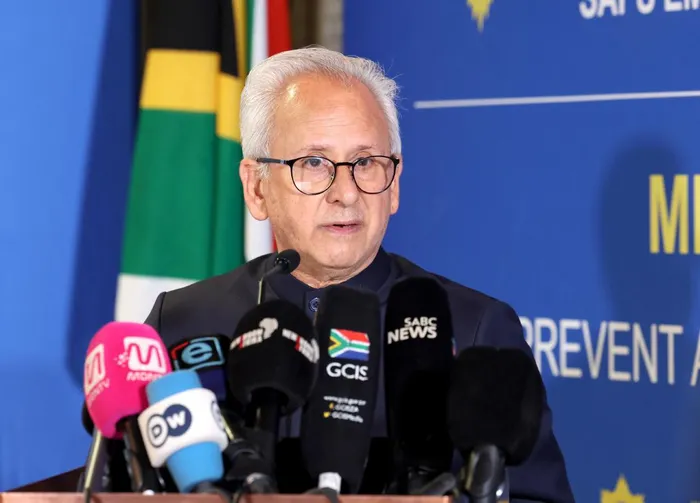
Acting Police Minister Firoz Cachalia says the procurement of body-worn cameras has not yet been finalised because the process is at a contracting phase.
Image: File
SAPS is set to begin the first phase of its long-awaited body-worn cameras rollout, nearly a decade after the initiative was proposed in 2019.
Acting Police Minister Firoz Cachalia announced that the procurement process is currently at the contracting stage, with an estimated cost of R14 million, expected to commence in the new financial year starting in April.
Cachalia was asked by DA MP Ian Cameron about the number of body-worn and in-vehicle dash cameras that have been procured by the SAPS for use in the Western Cape.
Cameron also wanted to know whether the body-worn cameras have been deployed and were currently operational.
In response, Cachalia confirmed that there has been no procurement of body‑worn cameras or in‑vehicle dash cameras for use in the Western Cape.
“The procurement of body-worn cameras has not yet been finalised, as the process remains in the contracting phase,” he said.
However, Cachalia revealed that the SAPS application for deviation to publish the bid was not approved.
He said the process will now be handled by the State Information Technology Agency (SITA).
“The bid is still to be advertised by SITA. Once a service provider is appointed, the SAPS will develop a comprehensive national rollout plan, which will determine the full implementation timeline,” said Cachalia.
The promise of body-worn cameras dates to 2019 when the SAPS announced its intention to roll them out while former minister Bheki Cele was still at the helm of the department.
In 2021, the SAPS issued a request for information “to determine the impact of infrastructure, operations technology, and the aspects of society and business, which will have a direct influence on how technology supports and delivers services to the business over the next five years and to conduct market research on the matter”.
Although a draft bid specification document was compiled to match the needs of the SAPS, Cele had stated that a bid specification was planned for final sign-off at the end of July 2021.
In November 2024, suspended Police Minister Senzo Mchunu announced that the commencement of the deployment of body-worn cameras in 2025/26 would follow testing various solutions to update the specifications, ensuring the technology was fit for SAPS operations and addresses the specific needs of officers in the field.
Mchunu had stated that SAPS planned to initiate the procurement process with a target of acquiring 100 body-worn cameras annually, with an intention to gradually integrate this technology across different units.
“The estimated cost for each body-worn camera is approximately R28,818. It is important to note that while we are committed to this initiative, the overall budget for the procurement of body-worn cameras will be contingent upon the availability of funding,” he said at the time.
In October 2025, Cachalia said SAPS has a plan in place to modernise infrastructure with the introduction of new technologies in the fight against crime.
“Several new technologies are planned for the 2025/26 to 2027/28 Medium-Term Expenditure Framework period, including the procurement and implementation of body-worn cameras and vehicle dashboard cameras.”
Cachalia revealed that R14 million was made available for the first phase of implementation for the 2025/26 financial year.
Meanwhile, Cachalia has revealed that SAPS has not procured any closed‑circuit television (CCTV) infrastructure for identified crime hotspots in the Western Cape over the past three financial years.