

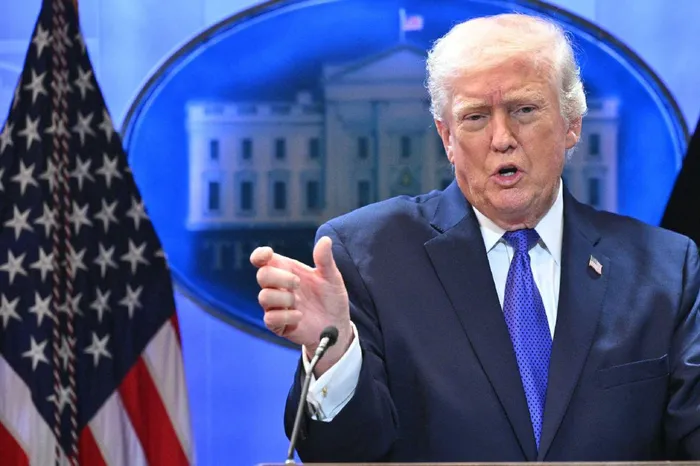
US President Donald Trump.
Image: Mandel Ngan / AFP
US President Donald Trump warned Monday that all of Iran could be "taken out" on Tuesday at the expiry of a deadline he issued for the Islamic republic to reopen the key Strait of Hormuz waterway.
"The entire country could be taken out in one night and that night might be tomorrow night," Trump told reporters at a White House briefing on Monday.
Earlier Trump had said that a proposed 45-day ceasefire with Iran was a "very significant step" but "not good enough" for him to sign, as Iranian officials vowed to keep fighting.
Talk of a ceasefire came as the US and Israel struck targets across Iran, including major petrochemical facilities, while time ticked down to Trump's deadline for Iran to reopen the Strait of Hormuz or face attacks on its civilian infrastructure.
Meanwhile Iran continued missile and drone attacks around the region.
Trump said intermediaries between the US and Iran "are negotiating now" on improving the ceasefire proposal, which US media reported was being mediated by Pakistan, Egypt and Turkey.
"It's not good enough, but it's a very significant step," he told reporters.
Trump added that he would still go through with his threat against civilian targets if a deal is not reached.
Iran's IRNA state news agency said Tehran "has rejected a ceasefire and insists on the need for a definitive end to the conflict" in a message relayed to America via Pakistan.
Neither Trump nor IRNA named any specifics of the proposed ceasefire.
Iran's military would "continue the war as long as the political authorities see fit", army spokesman Mohammad Akraminia told the ISNA news agency.
The Republican leader had given Iran until 0000 GMT Wednesday to open the Strait of Hormuz, a waterway that is crucial to global oil and gas flows.
In a stark, expletive-laden social media post on Sunday, Trump demanded: "Open the F****n' Strait, you crazy bastards, or you'll be living in Hell."
The Revolutionary Guards, however, said Hormuz "will never return to its former status, especially for the US and Israel".
Iran's virtual blockade of Hormuz has sent oil and gas prices soaring and pushed countries around the world to enact measures to contain the fallout.
Without singling out either side in the conflict, International Committee of the Red Cross chief Mirjana Spoljaric said in a statement that there had already been widespread destruction of "essential" infrastructure and that "any war fought without limits is incompatible with the law" and "indefensible".
International Atomic Energy Agency (IAEA) chief Rafael Grossi warned against further strikes near Iran's Bushehr nuclear plant, saying one recent impact hit just 75 metres (245 feet) from the perimeter.
Earlier Monday, Israeli strikes had hit major Iranian petrochemical facilities including Assaluyeh on the Gulf coast, the country's biggest, and another outside Shiraz in central Iran.
Israel's military said it had also struck Iranian air force targets including planes and helicopters at airports in Tehran and elsewhere.
Iran's Guards posted on Telegram on Monday that their intelligence chief Majid Khademi had been killed at dawn in US-Israeli strikes.
Israel's military also said it had killed Asghar Bagheri, commander of the Guards' Quds Force special operations unit, on Sunday.
"We will reach anyone who seeks to harm us," Israeli Prime Minister Benjamin Netanyahu said.
The Guards' Intelligence Organisation vowed a "major retaliatory strike" against those responsible for killing their commanders, their official Sepah news website reported.
Yemen's Houthi rebels said they launched an attack targeting Israel, supporting their backer Iran and Lebanon's Hezbollah.
Cape Times