

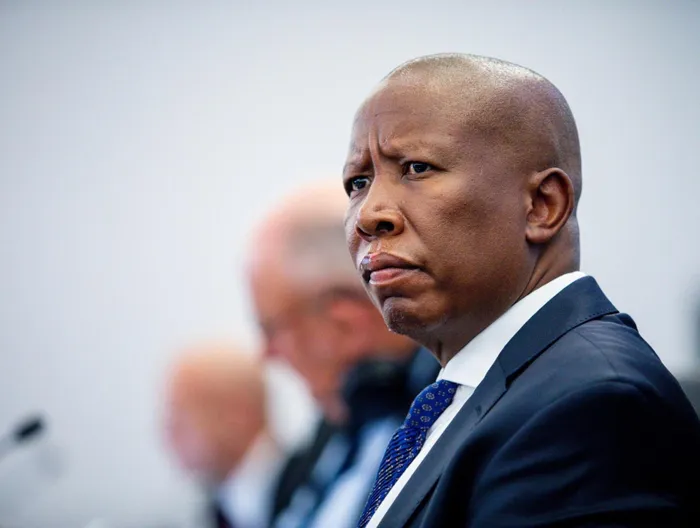
EFF leader Julius Malema.
Image: Abongile Ginya / Isolezwe lesiXhosa
EFF leader Julius Malema will learn his fate in the Magistrate’s Court in KuGompo City on Thursday as the State pushed for a prison term of up to 15 years.
Magistrate Twanet Olivier heard final arguments from the defence and the State before postponing the matter to Thursday for judgment.
Prosecutor Adv Joel Cesar told the court the State is seeking a prison term of up to 15 years for Malema, who was convicted in October 2025 on five counts under the Firearms Control Act. Alternatively, he asked for a sentence of 10 years’ imprisonment, with three years suspended, along with fines on the remaining counts.
The charges stem from a 2018 incident at an EFF rally in Mdantsane, where Malema fired a semi-automatic firearm into the air. Co-accused Adriaan Snyman was acquitted. The court previously heard that Snyman handed the firearm to Malema during the event.
If Malema is sentenced to more than 12 months in prison without the option of a fine, he will lose his seat in Parliament.
Thousands of EFF supporters gathered outside the court from early Wednesday morning, many having camped overnight after a vigil. Police set up a heavy security presence around the building.
Advocate Laurance Hodes told the court that all five charges arose from a single incident lasting less than two minutes.
"To impose a custodial sentence for a single, brief incident of this nature would be disproportionate and inappropriate," he said.
He outlined Malema’s personal circumstances, saying he is now 45, was 37 at the time of the incident, has no previous convictions and has "led a blameless life". There have been no similar incidents since 2018, he said.
Hodes told the court that Malema received the rifle from someone likely linked to security services, describing it as a licensed weapon. He said Snyman handed the firearm to Malema, who borrowed it for the event, held it for less than a minute while firing, and returned it immediately.
Malema did not obtain the weapon illegally and had no intention of using it for any other purpose, he said.
Hodes also cited other cases where people discharged firearms in public but did not receive prison sentences. In one case, a man fired a Glock pistol under a table in a restaurant with about 220 people present, causing damage but no injuries, and received a three-year suspended sentence. In another, he said, two intoxicated police officers fired shots in a public area and received partially suspended sentences with fines.
Hodes argued that the state was inconsistent, describing Malema as an ordinary person who should be treated equally before the law, while also relying on his status as a political leader to argue for a harsher sentence.
Cesar however told the court the firearm used was an assault rifle, not a handgun, with more powerful ammunition that could have caused fatal consequences.
He referred to video footage of the incident as a "silent witness".
Cesar argued that Malema placed more than 20 000 people at risk during the rally in Mdantsane, one of the most densely populated areas in the country. He said the video showed people running, with several individuals in the line of fire, and stressed that Malema fired more than one shot.
He argued that Malema, as a public representative, had set a dangerous example.
Meanwhile, Snyman is suing the state for R20 million in damages after being acquitted of charges brought against him.
Speaking to the SABC, Snyman’s spokesperson, Kirsten McLeod, said it was clear the State had dropped the charges because there was no evidence against him.
She added that they were still awaiting a response from the NPA and SAPS regarding a written demand for payment of more than R20 million.
“This is a result of a malicious prosecution claim. The 30-day period we gave the NPA and SAPS to respond has now expired. We will be instituting legal action shortly, and if they fail to respond, we will apply for default judgment,” she said.
Cape Times