Peaceful surrender deadline expires
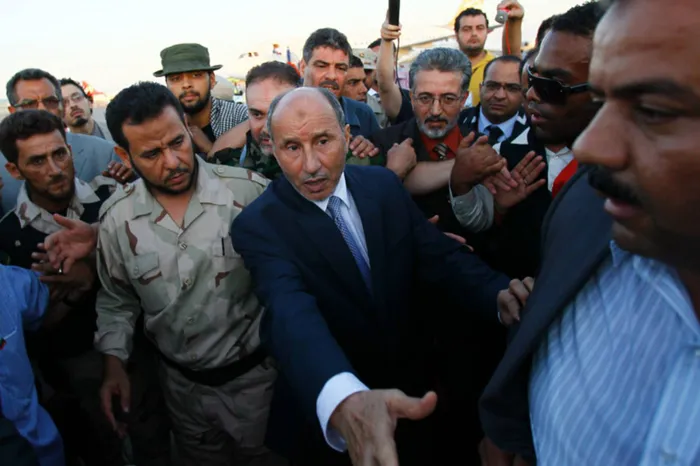
Libyan Transitional National Council chairman Mustafa Abdel Jalil (centre right) is flanked by former rebels' and military commander Abdel Hakim Belhaj (left) at Metiga airport in Tripoli on Saturday. Libyan Transitional National Council chairman Mustafa Abdel Jalil (centre right) is flanked by former rebels' and military commander Abdel Hakim Belhaj (left) at Metiga airport in Tripoli on Saturday.
Libya's new rulers were poised on Sunday to launch a final assault on towns still loyal to Muammar Gaddafi a day after a deadline expired for their peaceful surrender.
As interim leader Mustafa Abdel Jalil visited Tripoli for the first time since his forces seized the city last month, armoured vehicles mounted with anti-aircraft guns massed outside Bani Walid, AFP correspondents said.
One group of National Transitional Council fighters gathered at a military base seven kilometres (five miles) outside Bani Walid, which is the advance base for NTC forces in readiness for an assault on the town, one of the remaining bastions of Gaddafi forces.
NATO warplanes were heard flying overhead.
Another correspondent said fighters gathered from dawn in the desert in Hisha, some 90 kilometres (56 miles) from Misrata, awaiting orders to march on Bani Walid or on Gaddafi's hometown in Sirte
The fighters were from the Misrata brigade and backed by around 200 cars including pick-up trucks mounted with light artillery and armed with Kalashnikov rifles, Grad rockets and anti-aircraft guns, the reporter said.
Volunteer fighters spent much of Saturday evening testing equipment, cleaning weapons and packing bags as they awaited orders to march, AFP correspondents said.
Abdel Jalil arrived Saturday to a red-carpet welcome at Tripoli's Metiga military base where he was mobbed by hundreds of supporters and had to be protected by a thick human chain.
The visit was eagerly awaited in the hope that it would help tackle rivalries emerging among rebel groups that overthrew the fugitive Gaddafi.
Abdel Jalil said the NTC “has mapped out a path and we hope that Libyans understand that we have to move along this path fast and that it is no time for revenge.”
“We should put all our forces together to liberate the remaining Libyan cities of Bani Walid, Sabha and Sirte,” he said after declaring that the deadline for pro-Gaddafi enclaves to surrender had passed.
“Now the situation is in the hands of our revolutionary fighters,” Abdel Jalil said, effectively giving commanders authority to attack Bani Walid, Sirte, Sabha and other pro-Gaddafi enclaves.
The battle for Bani Walid already got off to a fitful and unscheduled start on Friday night, but NTC fighters withdrew on Saturday, apparently in anticipation of NATO air strikes.
Abdullah Kenshil, who tried but failed to negotiate the town's surrender, said NTC fighters withdrew “for tactical reasons that could be linked to military operations that NATO might be planning.”
Four NTC fighters were killed and 26 injured in clashes around Bani Walid on Saturday, said Dr Abdul Rawuf, an emergency services doctor operating a field clinic in the hamlet of Wishtata, 40
kilometres (25 miles) from the town.
Omar al-Hariri, who oversees NTC military affairs, told AFP that the war against pro-Gaddafi pockets in Bani Walid and Sirte could take up to a week to win.
A number of former regime officials, including Gaddafi spokesman Mussa Ibrahim, are believed to be holed up in Bani Walid. The whereabouts of Gaddafi himself is unknown.
On the frontline east of Sirte, fighters of the new regime advanced five kilometres (three miles) on Saturday, an AFP reporter said.
Abdel Jalil urged Gaddafi loyalists to allow his fighters a peaceful entry into their strongholds.
“We try to extend our hands to show peace to our brothers there to let our troops enter these cities peacefully without fighting,” he said.
Many NTC members, including half of the executive committee, moved to Tripoli after it fell late last month but Abdel Jalil and his deputy Mahmud Jibril were slow to arrive in the capital.
He is expected to tackle political tensions already surfacing between the capital Tripoli and other NTC strongholds, particularly the second-largest city Benghazi, which was the rebels' wartime base, and the third-largest city Misrata, which endured a prolonged siege by Gaddafi forces.
Anti-Gaddafi fighters in Misrata have started to challenge NTC authority, refusing to turn over abandoned tanks as requested by interim leaders.
Many in Tripoli stress the importance of the NTC setting up base in the traditional capital quickly so that the transition can get underway, regardless of whether Libya has been fully liberated.
But Abdel Jalil has said that his current visit to Tripoli is “temporary” and warned that the struggle against Gaddafi, who still has enough money and gold to buy men, is not over.
The whereabouts of the toppled strongman remained a mystery.
The NTC fears that he may try to slip across one of Libya's porous borders.
In a defiant message on Thursday, Gaddafi dismissed as lies reports he had fled to Niger, insisting he was still in Libya. Niger has also denied that Gaddafi is on its soil.
Guinea Bissau Prime Minister Carlos Gomes Junior said on Saturday that Gaddafi would be welcomed “with open arms” if he sought asylum in the west African country. - Sapa-AFP