

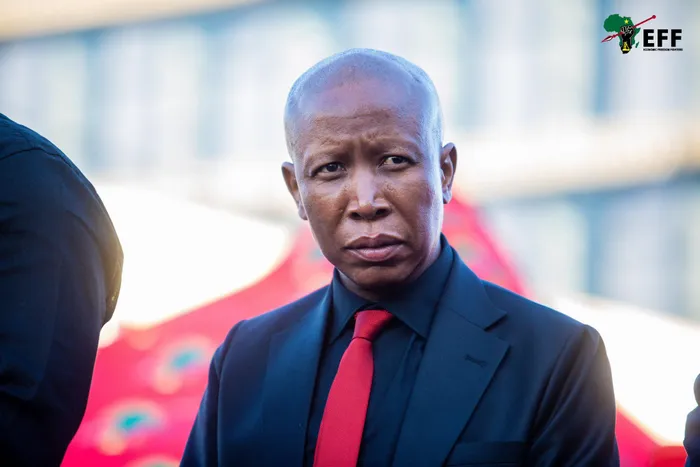
Julius Malema faces political upheaval following court conviction In a historic verdict, Julius Malema's conviction raises critical questions for the EFF and South Africa's political landscape. Read more about the implications of this ruling and what lies ahead for the controversial leader.
Image: Supplied
Is this the beginning of the end for Julius Malema?
The leader of the Economic Freedom Fighters (EFF), is standing at a critical crossroads following his conviction on multiple charges, including unlawful possession of a firearm and discharging a firearm in a public area.
Once hailed as the paragon of South African politics and one of the future leaders of South Africa, Malema's future hangs in the balance. The firebrand leader of one of the most influential political entities in Africa finds himself facing political obscurity.
The East London Magistrate's Court pronounced a verdict on Wednesday that found Malema guilty on all five counts filed against him, which also included reckless endangerment and failing to take reasonable precautions to avoid danger.
These convictions carry hefty sentences of a minimum of two years and a maximum of 15 years in prison.
The court ruled that the firearm brandished by Malema was a real weapon, contradicting the defence's assertion that it had fired only blanks.
This pivotal ruling raises the stakes, as Malema now faces the possibility of incarceration for more than 12 months a sentence that would lead to the forfeiture of his parliamentary seat, as highlighted by political analyst Sipho Seepe.
“The law is clear: if Malema receives a custodial sentence exceeding 12 months, he would lose his position in parliament,” Seepe explained.
“While the judgment impacts his role and could potentially weaken his standing, the final determination is yet to unfold.”
Constitutional law expert George Devenish echoed Seepe’s statement saying that the court ruling would jeopardise Malema’s political career.
“This judgement may endanger his political career and he may lose his job in Parliament. No one should serve in Parliament while having a criminal record against them,” Devenish added.
As the repercussions of the verdict sank in, the EFF leader remained defiant.
Outside the courthouse, he reiterated his intention to appeal the judgment, alleging that the legal proceedings were politically motivated.
“A revolutionary going to prison or death is a badge of honour,” Malema remarked, suggesting that the trial was aimed at undermining him and the EFF's mission.
He named various political figures and organisations including AfriForum and former U.S. President Donald Trump, whom he claimed were benefiting from the judicial process against him.
However, Devenish said the judgement was correct, saying Malema would want to appeal it to stir controversy as he was a controversial figure.
The magistrate’s ruling has drawn mixed reactions, with opposition factions likely to leverage the verdict against Malema in political discourse.
This ongoing legal battle places Malema's leadership and vision in parliament under scrutiny, especially amid a backdrop of increasing political tensions.
As he prepared to contest the conviction, the road ahead appears long and arduous.
Malema is currently out on bail, with a pre-sentencing appearance scheduled for January 23, where the consequences of his conviction will be further deliberated.
Throughout this process, parliament's stance remains neutral.
Spokesperson Moloto Mothapo refrained from commenting on the implications for Malema's parliamentary role, citing the ongoing nature of the case. “Parliament cannot comment on an ongoing case,” he stated.
With appeals set to extend into the foreseeable future, the political landscape may very well shift as testy electoral debates loom in the air.
The outcome of Malema’s legal tribulations could have far reaching implications not only for him but also for the EFF and South African politics as a whole.
DAILY NEWS