

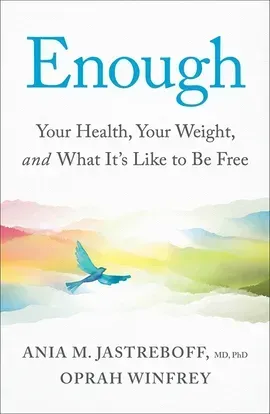
A deeply personal and science‑driven exploration of weight, biology and shame, this work challenges the idea that body size is a matter of willpower. It explains how the brain defends a natural set point, why intrusive “food noise” is biological rather than weakness and how years of diet culture have misled women into blaming themselves.
Image: Supplied.
I had just finished watching three episodes of a Netflix documentary revisiting America's Next Top Model. What it took to be chosen. What was said to young women about their bodies on camera, in front of the world? The measuring. The dismissal. And then I picked up this book.
The timing felt like something.
The same culture that produced that show also told Oprah Winfrey, co‑author of Enough: Your Health, Your Weight and What It’s Like to Be Free, that she needed to lose weight before she could appear on it. What if that was never true? That is the question this book asks. And it does not ask it gently.
I have spent enough time in women’s wellness spaces to know that the body conversation is never really just about the body. It is about what we were told we deserved, what we decided we had failed at and what we quietly accepted as our fault.
Your Body Was Never the Problem
Dr Ania Jastreboff, a Yale obesity specialist with over 12,000 scholarly citations, makes the central argument bluntly: “Having obesity is not a choice. It’s not a question of willpower. Obesity is a disease.”
The body is not broken. It is doing exactly what it was built to do: survive. The brain actively defends a biological set point for body fat, which she calls the “Enough Point.” When someone with obesity tries to eat less, the body fights back by burning less. She compares it to holding your breath underwater — you will always rise. “We’re asking our patients to control their biology,” she writes. That sentence is worth sitting with.
The concept that stayed with me most was “food noise,” the constant, intrusive thoughts about food that many people experience not as weakness but as a biological symptom. Women in my wellness circles have described this for years. They believed it was a lack of discipline. The science says it never was.
Know Because I Have Watched It
I follow a protocol that is simply a way of life for me. Early mornings. Movement. Intentional eating. Mindfulness practices. It works for me. We each find what works for us and that is exactly the point. There is no single path.
I have a sister whose thyroid condition later in life meant her body began storing weight regardless of how she lived. I have sat with women navigating perimenopause facing the same bewildering shift. Women doing everything right by every standard they knew and still watching their bodies change. Still blaming themselves.
This book gave me better words for what I had long been witnessing.
She Said It Out Loud
What lifts this beyond a science book is the willingness to be publicly undone.
There is a memory shared of Joan Rivers looking across a stage in 1985 and saying, “How’d you gain all the weight?” The response was not anger. It was an agreement. The famous 1988 “wagon of fat” moment is called one of the biggest regrets, a standard the book acknowledges that “I nor anybody could uphold.”
Then this line, which I had to sit with quietly: “I could weep right now for all of the many days and nights I journaled about this being my fault and why can’t I conquer this thing?”
How many women do you know who have written something like that?
The turning point came with the understanding that overeating does not cause obesity. Obesity causes overeating. “The most mind‑blowing, freeing thing I’ve experienced as an adult.” And with it, an acknowledgement of years spent as “a steadfast participant in the diet culture that contributed to some of this shame.”
Not Vanity, Dignity
Dr Jastreboff describes what freedom actually looks like for her patients: crossing your legs, walking into any store and finding clothes that fit, eating a meal with a friend without calculating every bite.
And this final line, which is everything: “I am free to behold whatever is new and possible for myself.”
That is why the title drew me in. And that is the sentence I will carry into every wellness conversation I have from here.
Enough leans heavily on pharmaceutical solutions and leaves the emotional dimensions of weight underexplored. But for every woman who has spent years blaming herself for a biology she never controlled, this book offers something no prescription can replace.
It was never your fault.
Available at Exclusive Books.