

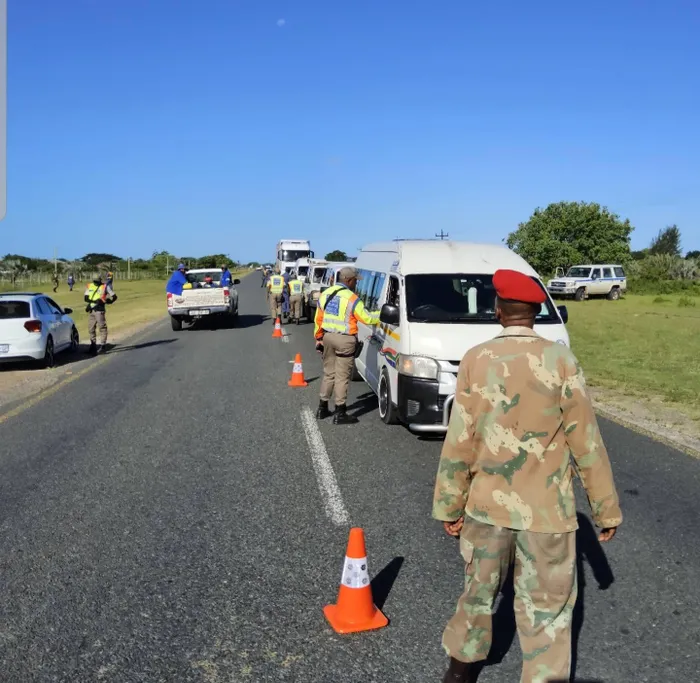
The Road Traffic Inspectorate has stopped and inspected more than 27,100 cars in northern KZN since December 1.
Image: KZN Department of Transport / Facebook
The KwaZulu-Natal Department of Transport and Human Settlements has intensified its crackdown on illegal immigration and cross-border crime, yielding significant results in the Empangeni region, particularly along northern border routes.
MEC for Transport and Human Settlements, Siboniso Duma, welcomed the impact of the Road Traffic Inspectorate (RTI) deployments, citing measurable enforcement outcomes across Umkhanyakude, Zululand, and King Cetshwayo Districts.
“We are seeing results following the deployment of our energetic RTI team from Empangeni region to the border and other routes used for cross-border crime,” Duma said.
According to the MEC, operations have focused on high-risk corridors along the borders between KwaZulu-Natal, Mozambique, and Swaziland, with extensive vehicle searches conducted as part of the strategy.

A total of 4,118 motorists were charged with various offences, 273 were found driving without licences, and 364 unlicensed vehicles were taken off the road.
Image: KZN Department of Transport / Facebook
“More than 27,100 cars have been stopped and searched. In particular, we targeted the border between KZN, Mozambique, and Swaziland,” he said.
The operations led to multiple arrests in key northern towns, including Manguzi, Mbazwana, and Jozini, with a special operation executed in Thengani.
“Many motorists have been arrested in Manguzi, Mbazwana, and Jozini, with a special operation executed in Thengani,” Duma stated.
Providing a breakdown of enforcement figures from December 1 for the Empangeni region, Duma highlighted the scope of the intervention. Twelve illegal immigrants were arrested, while 281 motorists were apprehended for drunk driving.
A total of 4,118 motorists were charged with various offences, 273 were found driving without licences, and 364 unlicensed vehicles were taken off the road.
Duma reaffirmed the department’s commitment to inter-agency collaboration to sustain and expand these efforts.
“RTI will continue to work with local traffic officers in various municipalities, SAPS, SANDF, and Home Affairs Immigration Units,” he concluded.
The department has indicated that similar targeted operations will continue as part of a broader strategy to improve road safety and disrupt criminal activities linked to cross-border movement.