

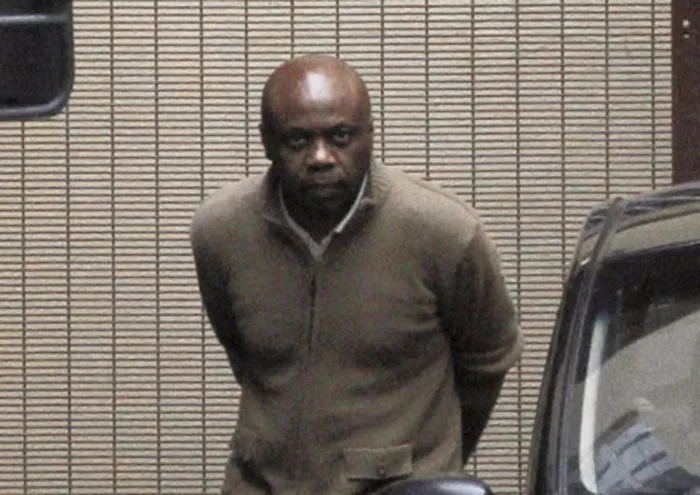
Henry Okah, a senior Mend (Movement for the Emancipation of the Niger Delta) figure, now living in South Africa, leaves a court in Johannesburg. Henry Okah, a senior Mend (Movement for the Emancipation of the Niger Delta) figure, now living in South Africa, leaves a court in Johannesburg.
The appearance of Nigerian militant Henry Okah in a Johannesburg court on terrorism charges on Friday has been followed by another bomb warning from Jomo Gbomo, mysterious spokesman for the Movement for the Emancipation of the Niger Delta (Mend).
The last time Gbomo issued an Internet bomb warning, 12 people died on Nigeria’s Independence Day, October 1. Nigerian authorities failed to evacuate an area in the Nigerian capital, Abuja, where Mend warned car bombs had been primed to go off.
Mend, via Gbomo, later took responsibility for the bombing, distancing itself from the “avoidable loss of life”, which it blamed on the Nigerian government for failing to respond to warnings given five days in advance.
Calling the South African legal process against Okah a “kangaroo” court and “scandalously biased”, Friday’s Gbomo communique – sent by group email at 5.15pm – did not say where or when the bomb would be planted, but indicated that “as usual we will give 30 minutes’ advance warning to avoid civilian casualties, then sit back and watch how the blame game will be played out on all those already falsely accused”.
Gbomo was described by the prosecution at Friday’s hearing as nothing more or less than a convenient alter ego for Okah.
Following his arrest at his home in Johannesburg’s southern suburbs the day after the Independence Day bombing, Okah has been accused of gun running, illegal entry into South Africa and terrorism.
Both “Gbomo” and Okah have denied that they are one and the same person.
Described by prosecutors, in opposing bail, as a dangerous person, capable of interfering with witnesses and slipping unseen out of the country, Okah is credited by military analysts of guerrilla warfare as having been in the forefront of sinister and cybersmart methods adopted in recent years by liberation armies around the world.
Former US Marine turned military analyst John Robb calls the approach pioneered by Okah “open-source warfare”, in which communications and information are consciously and manipulatively used as tools of the struggle.
Backed up in Okah’s case by the allegedly deliberate promotion of a criminal infrastructure to weaken the hold of the Nigerian state on Okah’s home territory, the oil-rich Niger Delta, the strategy has proved staggeringly effective.
Okah’s trial has been postponed to tomorrow for further investigation.
A series of questions were sent by email to Gbomo’s address on Saturday, but no response was forthcoming by the time of going to print.
Attempts to reach the Department of International Relations and Co-operation for comment proved fruitless. - Sunday Independent
Additional reporting by Craig McKune, Cape Times.