

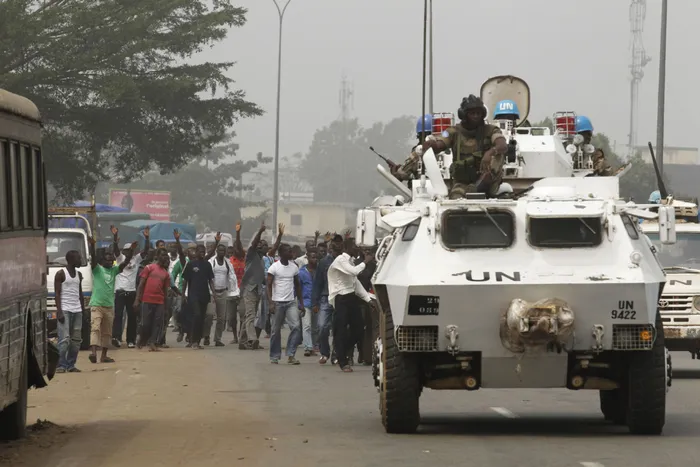
A United Nations convoy is forced to turn back by a group of Young Patriots, youth supporters of Laurent Gbagbo, blocking the road in the Abobo neighborhood of Abidjan, Ivory Coast, Tuesday, Jan. 11, 2011. U.N. peacekeepers retreated from a neighborhood where security forces loyal to incumbent leader Laurent Gbagbo had opened fire Tuesday, turning around at least nine U.N. vehicles after dozens of angry young men built a blockade out of a table and sticks.(AP Photo/Rebecca Blackwell) A United Nations convoy is forced to turn back by a group of Young Patriots, youth supporters of Laurent Gbagbo, blocking the road in the Abobo neighborhood of Abidjan, Ivory Coast, Tuesday, Jan. 11, 2011. U.N. peacekeepers retreated from a neighborhood where security forces loyal to incumbent leader Laurent Gbagbo had opened fire Tuesday, turning around at least nine U.N. vehicles after dozens of angry young men built a blockade out of a table and sticks.(AP Photo/Rebecca Blackwell)
Security forces loyal to Ivory Coast’s incumbent leader, who refuses to cede power, fired volleys of gunshots yesterday as they cordoned off a large section of a neighbourhood known to be his rival’s stronghold.
UN peacekeepers arriving in a convoy of 13 vehicles were forced back as they tried to enter the area. Young men allied with incumbent Laurent Gbagbo massed on a road leading to the area and threw large objects in their path.
PK 18, where the incident occurred, is part of Abobo, an Abidjan district that supported Alassane Ouattara, internationally recognised as winner of the presidential election.
Results verified by the United Nations say Ouattara won the November 28 poll with a margin of more than half a million votes. Gbagbo accused the UN of bias after it endorsed the results and is refusing to leave office.
Marco Boubacar, head of the New Forces rebels allied to Ouattara, said police awoke them between 4am and 5am and wounded several people.
Boubacar, a resident of PK 18, spoke while brandishing a long kitchen knife as he stood on the bridge leading into the neighbourhood. He said a group of neighbours belonging to the rebel group retaliated, killing two policemen.
“We were able to take down two men in uniform,” he said.
The deaths could not be independently verified, but other witnesses said they saw the bodies. Ambulances were also seen speeding into and out of the neighbourhood.
Shots could be heard at regular intervals and large police trucks were seen zooming into the area, loaded with armed police and helmeted soldiers.
Adama Toungara, mayor of the PK 18 area, said the early morning raid was an intimidation tactic to keep Ouattara supporters from disrupting a rally planned for later in the day, but eventually cancelled.
Human rights groups have criticised the UN for bowing to Gbagbo’s forces and allowing abuses under their watch. The head of the UN human rights section received reports of two mass graves containing as many as 80 bodies of people shot or killed after the election, but his convoy was turned back at gunpoint when he tried to enter one of the sites in a suburb of Abidjan.
UN patrols have also been intimidated and forced to retreat on other occasions, including an incident last month in which ruling party loyalists torched a UN vehicle. State TV controlled by Gbagbo has shown footage of UN convoys stopped in front of crowds, or made to turn around, reasserting an image of UN powerlessness.
The UN was invited to observe the election and to certify the results following a 2005 peace deal signed by all political parties after a civil war. The certification was intended to create an independent mechanism to ascertain the winner and prevent fraud.
Both Gbagbo and Ouattara signed the accord, but Gbagbo has since discounted the international body’s findings and has called on the 9 000-strong peacekeeping mission to leave the country.
After three high-level delegations of African leaders failed to persuade Gbagbo to cede power, the 15-member Economic Community of West African States last month warned that it was considering an armed intervention.
The move is controversial, though, because Ivory Coast has been a magnet for immigrants from other African nations, including Nigeria, where troops would probably come from. And the Gbagbo regime has insinuated any military action would lead to reprisal attacks against immigrants from the countries sending soldiers.
Experts say the risk of a return to civil war is real because Gbagbo is backed by the hardline Young Patriots, a group led by Charles Ble Goude, who was placed on a 2006 UN sanctions list for his role in inciting violence.
Goude has warned there would be no peace if Gbagbo is forced out.
“They shouldn’t kid themselves and imagine that they can come and remove him … Because in every Ivorian there is a Gbagbo,” Goude said in an interview on Monday. “Do they want to govern an Ivory Coast cemetery?”
Already, at least 25 000 civilians have already crossed the border into neighbouring Liberia in anticipation of possible clashes.
Adrian Edwards, a spokesman for the UN High Commissioner for Refugees, told reporters in Geneva that 600 more were arriving in Liberia daily and being housed in a teeming refugee camp. - Sapa-AP