

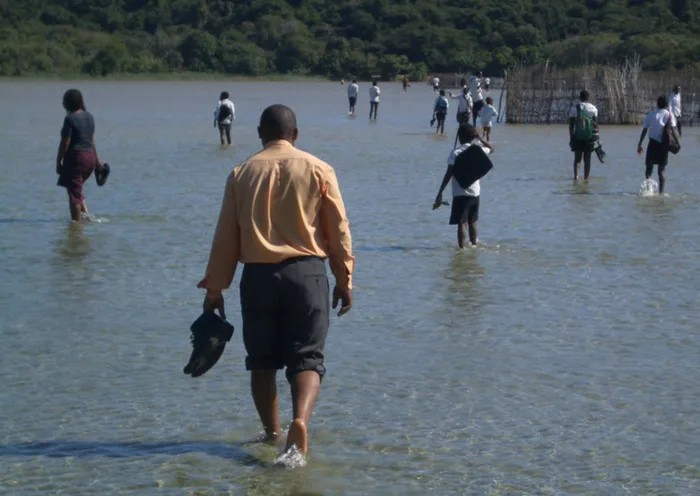
School prinicipal, Thokozani Tsilo begins his hour walk to his car after a day teaching at eNtovukeni Primary School. Picture: Fred Kockott School prinicipal, Thokozani Tsilo begins his hour walk to his car after a day teaching at eNtovukeni Primary School. Picture: Fred Kockott
Three horrific accidents on the first day of school this week - a seven-year-old crushed beneath a bus en route to school in New Germany; an 11-year-old killed by a car while returning from school in Inanda Road; and 12 pupils injured when a bakkie overturned near Vryheid – suggest that getting to and from school is becoming increasingly risky.
Transport Minister Sibusiso Ndebele said road deaths were the biggest killer of schoolchildren aged 10 to 14 and the second biggest in the five to nine-year age group. He said a UN Make Roads Safe report released last year indicated that by 2015, road crashes would be the number one killer of children aged five to 14 in Africa, outstripping malaria and Aids.
But road deaths are not all pupils have to fear - increasing numbers of children are being physically and sexually abused on the way to and from school.
Childline head Linda Naidoo said that over the past year more children had reported terrifying experiences. She said there had been a marked increase in children aged nine to 12 being raped by strangers on the way home from school, particularly in Inanda, Ndwedwe, KwaMashu and Umlazi.
Many children, especially in rural areas, walk to school along dangerous roads or through dense bush.
The Department of Transport says 76 percent of pupils get to school on foot and at least 560 000 have to walk more than an hour to get there. KwaZulu-Natal has the highest percentage of children who walk to school, followed by the Eastern Cape, Mpumalanga and the North West.
Where there is public transport, it is usually unreliable.
Naidoo related an incident on the upper South Coast. “While waiting at a bus stop with her cousin, a 15-year-old girl was sexually abused by a 53-year-old man.
“The abuser, who was only partially dressed, chased the children until he caught one. He dragged her into nearby bush, raped and bit her. She was found by her mother, who reported it the police. She was hospitalised and the perpetrator arrested.
“The traumatised child attended therapy and, as a result, is working through her fear of men and the external environment.”
She said that while implementing orphan and vulnerable children programmes in Ngoyameni, near Umlazi, Childline counsellors gained insight into the horrors of walking to school. “Children walk long distances through forest. Some said they were sexually abused and robbed. Children have drawn pictures which have given us insight into their community and the trauma to which they are exposed. One child drew her walk to school. It showed a man hanging from a tree with a rope around his neck.”
Charmaine Okbandrias, a single mother of three who lives on the Durban beachfront, said she had different concerns with each of her children. When it comes to 11-year-old daughter Cynthia, who walks to school, she said she was worried about the people she could meet along the way. “People offer children sweets and Cynthia, like 90 percent of children her age, would probably take them. She could be tempted to try drugs, get pulled into buildings or into cars and raped.”
Schoolteachers believe children are more likely to confide in them than in parents, who often don’t believe them and feel their “stories” are excuses to bunk school. They said although it was a growing problem, not all incidents were sexually motivated - bullying remained a big problem.
Punishment
A teacher at a Midlands school said one of very few boys with school shoes was forced to give these to peers while walking home. He was punished by his parents for losing the shoes and the terrified youngster has never identified the culprits.
A Hluhluwe teacher said many urban and all rural roads lacked safe places for children to walk or wait for transport. Taxis pick up children randomly along roads. A lack of bridges over rivers and busy highways is another danger.
Educators and authorities believe the worst offenders are drivers - both those operating public transport and careless road users. Most road accident deaths involve pedestrians, many of whom are children.
In March last year, four Soweto schoolboys were killed when musician Molemo “Jub Jub” Maarohanye and Themba Tshabalala allegedly swerved off the road during a high-speed race.
Netcare 911’s Chris Botha, who described the New Germany bus accident as “pretty horrific”, said child pedestrian deaths were becoming more common. “Drivers need to consider the child factor. Kids don’t have good road sense. Kids don’t think, they run. It happens so fast. In rural areas, kids walk in groups and play and laugh. The last thing on their minds is an oncoming car.”
Botha said taxi accidents where children were not strapped in were “just a nightmare”. In August, nine pupils died when a taxi collided with a train at a level crossing in the Western Cape.
Logan Maistry, Ndebele’s spokesman, said authorities were cracking down on risky road users in line with the National Rolling Enforcement Plan, announced by the minister in October. On January 13, Gauteng traffic police impounded 58 vehicles ferrying schoolchildren. On Monday, 23 vehicles including 12 buses, 10 minibus-taxis and one truck were taken off the road in Mount Frere, in the Eastern Cape, in a pupil transport operation. “On Wednesday, a driver was arrested after he was found behind the wheel of an overloaded school bus near Beaufort West. The vehicle is only licensed to transport 62 people, but 116 children were crammed inside. On the same day, in the Eastern Cape, 173 fines were issued to pupil transport operators,” said Maistry.
He said the government was investing R70 billion in infrastructure over three years to improve matters.
“More than R8bn has been targeted for rural road development. The Department of Transport is also auditing access to all schools and clinics to ensure every one can be reached by road.”
After three years of delays, the department is also finalising a pupil transport policy. - Tribune