

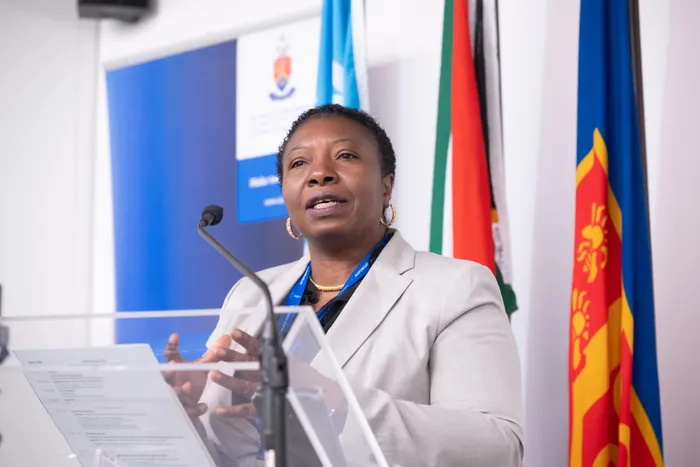
Dr Mary Mangai, the convenor of a multi-stakeholder conference held at the University of Pretoria over the weekend in line with World Peace Day, is calling for a shift "from reactive policing to proactive policing”.
Image: SUPPLIED
“The world faces rising challenges, conflicts old and new, divisions deepened by inequality, hate speech, climate shocks and the disruptive power of technology.”
This warning was sounded by Nelson Muffuh, Resident Coordinator of the United Nations in South Africa, speaking at a World Peace conference at the University of Pretoria on Sunday.
Muffuh spoke about the need for a new approach to peacebuilding from the UN’s perspective against the backdrop of major geopolitical fragmentation and its deleterious effects on multilaterla organisations such as the UN.
“The tools that once kept peace are being tested as never before. That’s why the UN leadership is calling for a new approach towards peacebuilding, peacemaking and peacekeeping, one that goes beyond the absence of war and actively builds societies that are resilient to violence, exclusion and injustice.”
Muffuh added that peace is “not a moral imperative but an economic necessity”. He pointed out that in Gauteng – South Africa’s economic hub – multiple forms of crime affect the long-term socio-economic trajectory of the province.
“When we invest in safety, we unlock development; when we strengthen justice, we build peace; and when we empower communities, we create the conditions for lasting and sustainable peace,” he said.
The university hosted a cross-sector workshop at its Javett Art Centre in Pretoria on violence and crime prevention in Gauteng to commemorate World Peace Day, observed annually on September 21. The event brought together a diverse range of stakeholders, including MMCs for Community Safety.
The theme was "Sharing Good Practices and Shaping Policy for Sustainable Attainment of Sustainable Development Goal (SDG) 16: Peace and Security in Gauteng".
Gauteng faces unique security challenges, including high levels of violent crime, gender-based violence, gang-related activities and recurring community conflicts. Workshop attendees were clear in their understanding that safety is the bedrock for community prosperity, and that fear and instability hamper efforts to make lasting improvements to education, healthcare or economic opportunities.
The convener of the event, Dr Mary Mangai, a senior lecturer at the School of Public Management and Administration, said: “From what we see in the field, there’s a need to move from reactive policing to proactive policing.”
Dr Mangai, who, along with Dr Jan Wilhelm of the University of Potsdam in Germany, set the agenda for the day and offered actionable policy recommendations for various stakeholders in the sector.
“Building trust with communities is very important, as is focusing on prevention alongside response – there is more that the police can do to work together with people,” she said.
Emphasising that peacebuilding “goes beyond SAPs”, they briefly demonstrated the role that the government, community leaders and traditional authorities, civil sector and faith-based organisations, the police, academic institutions, and private sector enterprises can play in crime prevention.
The keynote was followed by a brief Q&A session, before dignitaries from the province gathered for a panel in which they spoke about the complexities they face at the local level, and the practical prevention and response strategies being employed to tackle specific issues, such as land invasions.
The panel featured SAPS Deputy Provincial Commissioner Major General PF Kekana, who outlined the six pillars of the Integrated Crime and Violence Prevention Strategy; Alderman Hannes Coetzee, MMC for Community Safety, City of Tshwane, who focused on the work of the Integrated By-law Enforcement Committee; and Dr Nazira Cachalia, who represented the MMC for Community Safety, City of Johannesburg, who shared insights about the City Safety Strategy.
“The challenge with policies is their implementation, and even if you implement those policies, if you don’t communicate with your people on the ground – residents and communities – then those policies mean nothing,” Coetzee said.
For Dr Cachalia, in cities that are growing in complexity, “the notion of collaboration and coordination isn’t a nice-to-have any longer; we need to think collectively about problems and find the right solutions to them”.
An international expert panel was then convened on cross-regional security policy as it relates to best practices in other parts of the world. Prof Dr Bernhard Frevel of the University of Applied Sciences for Police and Administration in North Rhine-Westphalia in Germany and Dr Antony Otieno of Leiden University in the Netherlands offered their insights via Zoom.
Thereafter, a national panel discussed the benefits of integrated multistakeholder security governance for crime prevention, drawing on local community experiences. It featured Pastor Immanuel Landman, whose premise was that safety needs to be taken up by communities as a whole; Arnold Adams of Eersterust, who focused on “bottom-up governance” within communities rather than depending on outdated policy frameworks; and Rtd Col Jan Malan of Streetsafe in Tshwane, which safeguards neighbours, who focused on the need to find innovative ways to create lasting peace.
“This workshop was an invitation to partnerships,” said Dr Mangai in her concluding remarks.
According to her, the institutional collaboration forged through the workshop is expected to strengthen frameworks for sustained coordination among stakeholders. This means Gauteng will likely establish ongoing working groups that continue to meet, plan and monitor progress in crime and violence prevention.