

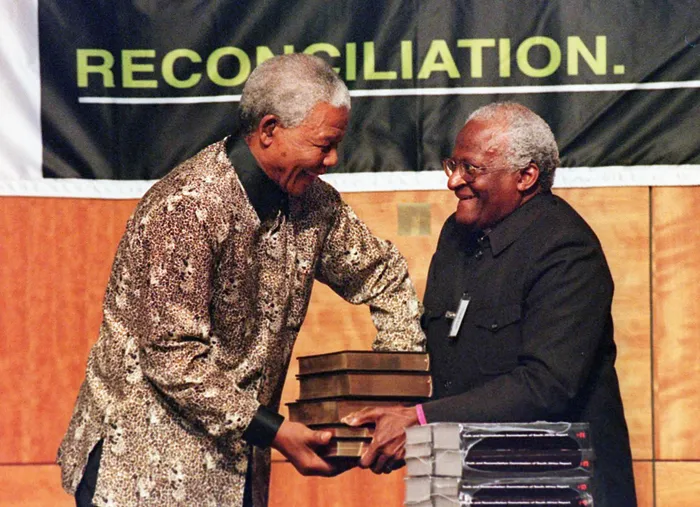
President Nelson Mandela receives five volumes of the Truth and Reconciliation Commission (TRC) final report from Archbishop Desmond Tutu, in Pretoria on October 29, 1998. Decades later, on Monday, a commission set up to investigate why criminal cases recommended for prosecutions by the TRC were not followed up starts its public hearings.
Image: AFP
From Monday South Africans will be treated to another commission of inquiry hearing complete with live streaming and national television coverage. However, the Khampepe Commission of Inquiry will differ from the usual and is “not a repetition” of the TRC (Truth and Reconciliation Commission).
The Foundation for Human Rights (FHR) explained what can be expected as the public hearings commence on Monday at the Sci-Bono Discovery Centre in Johannesburg. It said the hearings were expected to kick off with opening statements by interested parties. However, there were some “preliminary procedural matters” that the commission needed to first address, including the contentious issue of whether witnesses may be led by their own counsel other than the commission evidence leader.
“The Commission, established under the Commissions Act, is not a repetition of the TRC. It is not mandated to look into individual cases of gross human rights violations but is a quasi-judicial body tasked with inquiring into allegations of interference in the criminal justice system in respect of the TRC cases. This interference resulted in the blocking of hundreds of murder cases and other serious crimes from South Africa’s past from being taken forward,” the foundation said in a statement released on Wednesday.
The interested parties list includes the foundation, the families and survivors who are otherwise known as the “Calata applicants”, and possibly the Presidency, the National Prosecutions Authority, the South African Police Service as well as other individuals and organisations that have submitted statements, including former NPA head Shaun Abrahams and Imtiaaz Cajee, the nephew of activist Ahmed Timol.
FHR Executive Director Zaid Kimmie confirmed that the families and the foundation have been recognised as interested parties.
The commission, launched in May, has not had a smooth pre-hearing period. Recently it issued a statement decrying the lack of cooperation from organs of state – including the SAPS, the Department of Justice, and the Presidency – that was frustrating its work. Other interested or affected parties, including Ramaphosa and his predecessors, had asked for more time for providing the inquiry with information about deliberations about the TRC cases during their tenures. However, the commission headed by retired Constitutional Court Judge Sisi Khampepe stated that it remained “resolute” not to delay the start of the public hearings scheduled for Monday.
Asked about their preparations for what could possibly turn out to be a complex start-stop inquiry, Kimmie said: “We have warned them (the families) not to expect immediate outcomes and kept them informed about the various obstacles that may be put in our path.”
The FHR said the interested parties opening statements will be followed by oral evidence given by the Calata group that includes Lukhanyo Calata, son of the late anti-apartheid activist Fort Calata, as well as Human Settlements Minister Thembi Simelane, former TRC Commissioners Yasmin Sooka and Dumisa Ntsebeza, and former National Directors of Public Prosecutions Bulelani Ngcuka and Vusi Pikoli.
Explaining the commission’s relationship with the FHR and the Calata group’s ongoing R167 million damages claim, Kimmie said: “At this stage the dispute about constitutional damages will proceed in the High Court (after the States attempt to pause proceedings was denied), but the question of constitutional damages is still part of the COI’s (commission of inquiry) reference.”
The foundation prefers the two issues – allegations of political interference and the damages claim – dealt with separately, fearing that the commission may run for a couple of years, further delaying justice and reparations for the families and survivors.
“This is not a great state of affairs, and we are not sure exactly how the COI will handle this conflict. There is no question, however, that the court findings will take precedence over the recommendations of the COI.”