

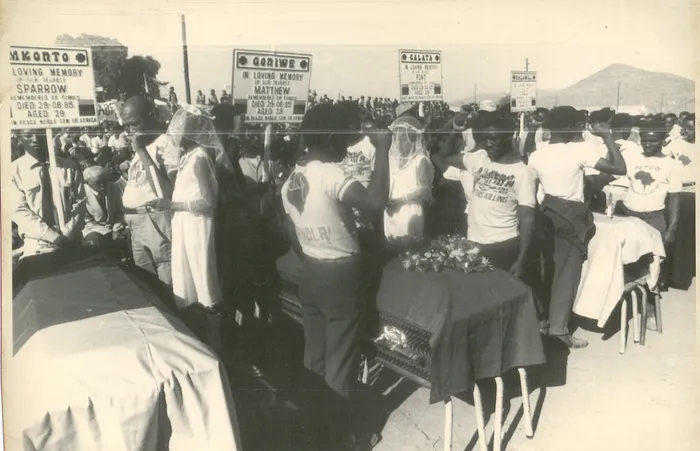
The funerals of the Cradock Four, Mathew Goniwe, Fort Calata, Sparrow Mkonto and Sicelo Mhlauli. More than 16,000 people in 160 buses, and thousands more in private cars and bakkies, descended on Cradock for the funerals of the community leaders on July 20, 1985. Public hearings of the Khampepe Commission were on Monday postponed due to conflict of interest concerns regarding its chief evidence leader.
Image: Independent Media Archives
The Khampepe Commission of Inquiry’s public hearings were derailed before they could begin on Monday after issues of conflict of interests were raised about its chief evidence leader, Advocate Ishmael Semenya.
The National Prosecuting Authority (NPA) and the Department of Justice raised these issues and after some deliberations retired Constitutional Court Judge Sisi Khampepe adjourned proceedings to allow them to make a formal application for Semenya’s recusal. At issue is the fact that Semenya previously represented the NPA and participated in the formulation of policy around the subject of the commission – the cases recommended for further investigation and prosecution by the Truth and Reconciliation Commission (TRC).
The group of families of victims and survivors of apartheid-era atrocities that has been campaigning for justice and closure, together with the Foundation for Human Rights (FHR), were “very disappointed” as they were hoping the commission would start in earnest. Some not only expressed disappointment but alleged it was part of "delaying tactics" by those wanting to deny them the truth and justice.
“We are very disappointed that, once more, the substantive work of the Commission has been delayed,” said FHR Executive Director Zaid Kimmie.
“The issue that derailed proceedings today was the question of whether Ish Semenya should be recused from his role as evidence leader because of his prior work for the NPA. The NPA and the DOJ were aware of Semenya’s appointment for many months and waited until the last minute before raising their objections.”
Kimmie said, however, that they remain committed to seeing the process through and “getting some answers for the families of victims”.
Human Settlements Minister Thembi Simelane, whose sister Nokuthula Simelane was abducted and disappeared by the apartheid government’s operatives in 1983, described the delay as unfortunate. She and the other families, survivors or their representatives had been invited to attend what was supposed to be the start of public hearings at the Sci-Bono Discovery Centre in Johannesburg.
"What angers me more is that the State did not discover the registration of Advocate Semenya this morning. They knew, and they could have approached the chairperson and the Commission and filed their papers if they were not in agreement," she said.
The foundation stated last week in a statement that it was aware there were some “preliminary procedural matters” that needed to be dealt with before the hearings start. There were also some interested or affected parties that were expected to first deliver their opening statements. These include the foundation, the group of families and survivors otherwise known as the “Calata applicants”, and possibly the Presidency, the NPA, the South African Police Service as well as other individuals and organisations that have submitted statements, including former NPA head Shaun Abrahams and Imtiaaz Cajee, the nephew of activist Ahmed Timol.
The opening statements were expected to be followed by oral evidence by the Calata group that includes Lukhanyo Calata, son of the late anti-apartheid activist Fort Calata, as well as Simelane, former TRC Commissioners Yasmin Sooka and Dumisa Ntsebeza, and former National Directors of Public Prosecutions Bulelani Ngcuka and Vusi Pikoli.
The Calata group, alongside the FHR, is waging another separate but related court campaign for R167 million damages, but the question of damages is also part of the Khampepe Commission’s scope of work.
The commission's proceedings were delayed for two weeks, until November 26.