

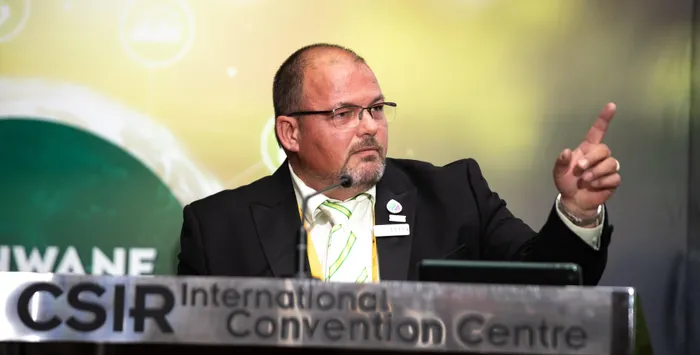
Dr Lardo Stander has urged municipalities to rethink their funding priorities, suggesting that investing in innovation could be the key to addressing pressing service delivery issue.
Image: Supplied
Dr Lardo Stander, CEO of the Tshwane Economic Development Agency (Teda), has called for a shift in how municipalities approach funding for innovation aimed at addressing service delivery challenges such as water and electricity losses.
He highlighted the irony that municipalities are willing to accept significant losses in water and electricity revenue, yet they are hesitant to invest in new technologies that could help address service delivery challenges and potentially turn things around.
Stander made remarks during the recent Unisa Innovation Festival, where Teda - a municipal parastatal - was a key participant calling for bolder public sector innovation.
The event aimed to explore ways to support emerging entrepreneurs in commercialising their innovations and navigating complex legislative frameworks, such as the Municipal Finance Management Act and Public Finance Management Act, which can be major hurdles for startups and innovative businesses.
Stander called for the local government environment to find ways to accommodate the iterative, risk-taking nature of innovation.
“While local government may not be the natural appropriate space for innovation, that should not stop entrepreneurs and officials from innovating,” he said.
Calling for a shift in how cities approach innovation funding, Stander argued that municipalities often accept annual losses in water and electricity revenue “yet hesitate to invest comparatively small sums in new technologies that could address core service challenges”.
He highlighted that the workshop revealed challenges stemming from municipal administration's rigid systems that often clash with innovation's fluid nature.
He said local government is built on structured discipline, rules and regulatory frameworks, but innovation is iterative.
“You try, fail, learn, and adjust. Local government is not allowed to fail — yet failure is the very bedrock of innovation," he said.
Stander said a startup cannot compete on the same footing as an established player, saying there is a need for consensus on how we interpret rules so that we don’t accidentally shut innovators out.
He said participants also raised concerns about intellectual property, with innovators often required to disclose specifications to the city, only to see their ideas potentially exposed to competitors during procurement processes.
“We have to find a balance. How do we protect the human ingenuity behind these innovations while ensuring fairness? Innovators cannot invest years of effort only to have someone else copy and paste their work,” he said.
Stander acknowledged individual entrepreneurs often bear the brunt of bureaucratic red tape, citing cases where innovators have spent years trying to navigate municipal systems.
“As a collective government, we have to do better. Time is of the essence, both for innovators and for the problems we must solve,” he said.
According to him, government leadership is crucial in paving the way for private-sector investment.
“The private sector will play its role if the government leads. A real signal of seriousness would be for cities to say: ‘Let’s buy from our innovators'. There are private companies out there looking for innovators, looking for people with passion, looking to take risks that the government may not be able to take,” he said.
rapula.moatshe@inl.co.za