

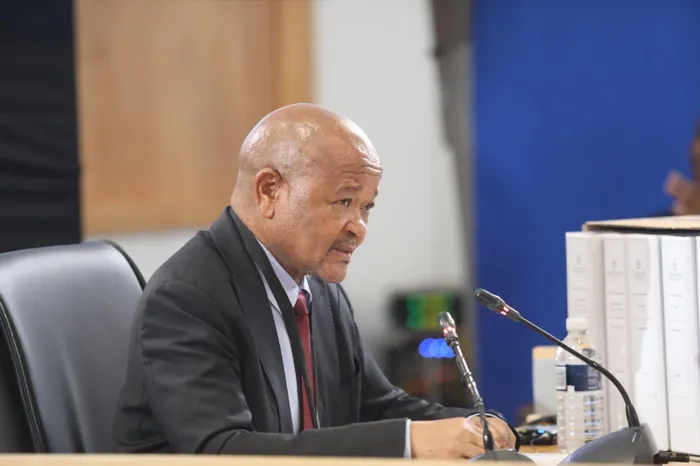
Minister of Police Senzo Mchunu has defended his decision to disband the Political Killings Task Team.
Image: Oupa Mokoena / Independent Newspapers
Minister of Police, Senzo Mchunu, has testified that if National SAPS Commissioner General Fannie Masemola had approved the new organisational structure based on the 2019 work study, the Political Killings Task Team (PKTT) would have been dissolved back in March 2024.
Mchunu, who is on a special leave, was testifying before the Madlanga Commission of Inquiry on Tuesday.
His decision to write a letter dated December 31, 2024, ordering the disbandment of the PKTT, has come under criticism from KwaZulu-Natal SAPS Commissioner Lieutenant-General Nhlanhla Mkhwanazi, who testified at the commission on September 17.
The letter in question stated that the task team was not adding value to the policing work.
According to Mkhwanazi, Mchunu’s conclusion that the team does not add any value to policing in South Africa “was misplaced”.
Masemola had also testified that he deemed as “unlawful” a directive by Mchunu to disband the PKTT, saying he reached out to President Cyril Ramaphosa for intervention.
“The president did come back to me to say he talked to Mchunu, but did not tell me about the outcome,” he said during his testimony three months ago.
Mchunu denied interfering in operational policing matters, including the December 6, 2024, raid on Katiso “KT” Molefe's home. Molefe is accused of murder and is allegedly a member of the Big Five criminal cartel.
Mchunu stated that the PKTT was a temporary project established in 2018 by Ramaphosa to address politically motivated killings in KwaZulu-Natal, emphasising that it was not a permanent SAPS structure, but a time-bound initiative.
Mchunu mentioned that during his orientation as police minister, he raised concerns about Lieutenant-General Dumisani Khumalo's dual roles as PKTT head and Crime Intelligence boss.
“I raised the concern, and not necessarily because of the load (of work), but the role Crime Intelligence played in the country. It is critical in assisting police in fighting crime,” he said.
Mchunu stated that his focus in the ministry is on governance and systemic issues, specifically budgetary concerns and budget allocation considerations.
“By late 2024, the national operational centre was required to absorb the national PKTT cost amounting to R94 million for the 2024/25 financial year,” he said.
He stated that, like all government projects, the PKTT required periodic assessment, a budget, and a defined end date.
“There is no project in government that runs indefinitely,” he said, noting that the PKTT was initially set for six months with annual assessments.
Mchunu stated that the PKTT had not received any extensions beyond 2022, despite operating for over two years without the required assessment. He argued that this rendered the expenditure irregular under the Public Finance Management Act.
He said the 2019 work study, which was translated into organisational structure, “effectively de-established the PKTT and established a single murder and robbery unit”.
He explained that according to the study, the functions of PKTT were supposed to be transferred to the murder and robbery unit.
Mchunu said Masemola, on June 5, 2024, signed off on the work study with an instruction that implementation must be expedited.
He said the PKTT would have been dissolved in March 2024 “for the simple reason that the PKTT would not have coexisted with the specialised unit” dealing with serious and violent crimes under the murder and robbery unit.
Mchunu’s testimony is expected to resume on Thursday.
On Wednesday, the commission will hear testimony from the suspended deputy chief of the Ekurhuleni Metro Police Department, Brigadier Julius Mkhwanazi, whose appointment has come under scrutiny due to allegations of irregularities.
rapula.moatshe@inl.co.za