

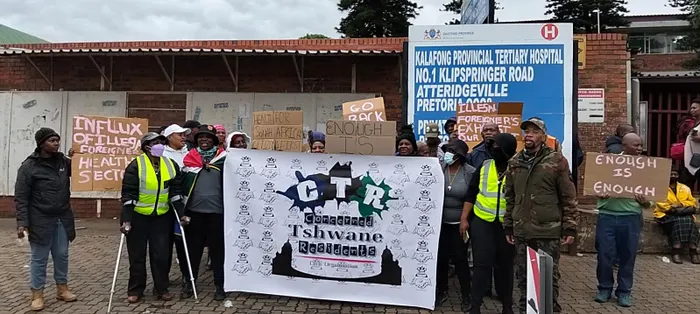
Residents of Atteridgeville, grouped under Concerned Tshwane Residents, protesting outside Kalafong Provincial Tertiary Hospital calling for undocumented foreigners to be barred from the hospital. A landmark ruling has been delivered by the Gauteng High Court ordering state organs to act against self-appointed groups enforcing the exclusion of immigrants from accessing help at public healthcare facilities.
Image: Supplied.
Civil society groups including the Treatment Action Campaign (TAC) have welcomed a landmark judgment by the Gauteng High Court, Johannesburg, ordering the state to take immediate action to end the anti-foreign nationals blockades by vigilantes at two city clinics.
Doctors Without Borders (MSF), which was part of the urgent court application led by the TAC and also involving Kopanang Africa Against Xenophobia (KAAX) and Section 27, issued a statement welcoming the ruling by Judge James Wilson on Thursday.
The judge ordered 15 organs of state, including the City of Johannesburg, the National Department of Health, the Gauteng Department of Health and the South African Police Service (SAPS), to take steps to deal with the self-appointed members of society who have been targeting foreign nationals and preventing them from accessing the Yeoville and Rosettenville clinics. He ordered the state organs to confront and take all reasonable steps to secure the removal of any unauthorised people from the clinics’ premises and their surroundings who have been controlling access to the health facilities with a view of excluding foreign nationals or those without South African IDs.
Despite earlier arguments to the contrary during the court proceedings, the judge confirmed that all tiers of government have a duty to ensure safe access to public health facilities for all. It ruled that none of them could “outsource” their responsibilities or leave them to the affected city or local government.
The judge also said the police had to do more than wait for complaints.
“I turn now to the responsibilities of the police respondents. The case for the police appears to be that their role is limited to responding to complaints from members of the public. On the facts established before me, that cannot be accepted. The police respondents are constitutionally obliged “to prevent, combat and investigate crime, to maintain public order, to protect and secure the inhabitants of the Republic and their property, and to uphold and enforce the law” (section 205 (3) of the Constitution). This necessarily implies a role well beyond the passive receipt of complaints,” said Judge Wilson passing judgment.
Thursday’s judgment comes on the heels of the Gauteng High Court ruling against Operation Dudula, confirming that acts of intimidation and harassment of migrants are unlawful.
While both cases deal with the unlawful conduct of vigilante groups against "foreign nationals", the recent case seeks relief against the state authorities charged with the constitutional mandate to protect the right to access healthcare services of all, including foreign nationals.
The court was told that the vigilante groups seemed to be encouraged by the "passivity" of the clinics' management and the other state authorities. On this the judge said all 15 organs of state "are directed, forthwith, to take all reasonable measures to ensure safe and unhindered physical access to the Yeoville and Rosettenville clinics for all persons seeking health services".
The non-governmental organisations launched their application after months of inaction by authorities, despite repeated reports that individuals at many facilities were blocking patients, including migrants and South Africans who were unable to produce their IDs, from entering public clinics and receiving essential medical care.
In support of the application, the organisations documented a clear and escalating pattern of vigilante activity at public healthcare facilities across Gauteng. Patients reported being denied entry if they could not produce their South African IDs.