
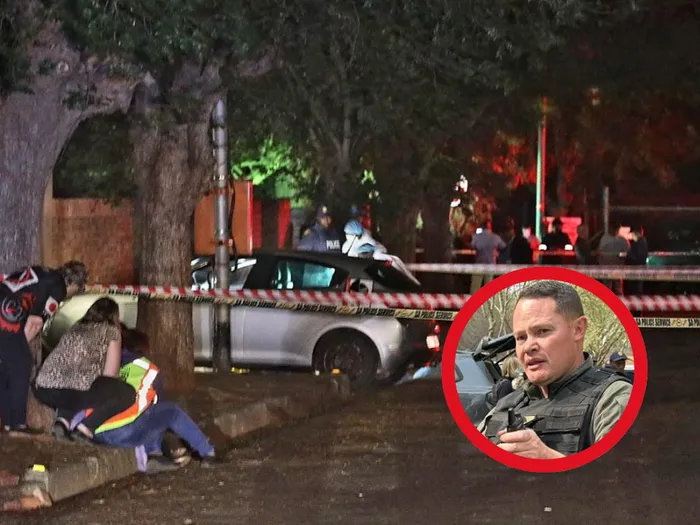
The scene of the shooting in Brakpan where Marius 'Vlam' van der Merwe (inset) was shot dead a couple of weeks after testifying in the Madlanga Commission of Inquiry.
Image: Timothy Bernard / Independent Newspapers/IOL Graphics
Marius ‘Vlam’ van der Merwe was assassinated to silence him because he was about to make more explosive revelations related to illegal mining, crime and corruption involving senior state and police role players.
This has been revealed in a statement issued by the South African Community of Faith-Based Fraternals & Federations (SACOFF) following the murder of the former Ekurhuleni Metro Police Department (EMPD) officer who recently delivered damning testimony about criminality involving members of the EMPD.
Van der Merwe told the Madlanga Commission of Inquiry he was instructed to dispose of the body of a Mozambican who had died after being tortured and interrogated in April 2022.
SACOFF, a Pretoria-based umbrella body of churches and faith-based organisations from across the country, expressed shock, outrage and sorrow following Van der Merwe’s killing. It criticised the commission and said it “suffered a grave failure” by failing to protect the man who testified before it under the alias of Witness D.
It said Van der Merwe, who worked in the security industry after leaving EMPD, was killed to silence him because he “stood for truth” and was about to expose more criminality allegations.
“Marius van der Merwe stood for truth in a climate of fear and intimidation. He sought to expose the alleged involvement of senior state and police role players in the torture and murder of a Zama Zama miner who was allegedly buried alive — an act of unspeakable cruelty. Before he could present these allegations publicly, his life was taken.
“His silence was forced through violence. His courage must not be forgotten,” the organisation said in a statement issued on Sunday.
SACOFF’s leadership was part of a number of civic and other organisations, as well as ordinary community members, who took part in a candlelight vigil and laid flowers at Van der Merwe’s Brakpan home.
“We stood beside candles and flowers laid against the boundary wall of his house — quiet symbols of remembrance but also loud warnings to the nation. These flames must not die out. They must ignite within every South African a renewed commitment to protect the brave who speak up,” SACOFF said in the statement.
The organisation called for:
Urgent state protection for whistle-blowers and witnesses: Not symbolic protection — functional, armed, rapid, and guaranteed;
A national inquiry into the killings of all whistle-blowers: No case must be allowed to fade into the archives of forgotten injustice;
The arrest and prosecution of every individual behind these assassinations: From triggermen to masterminds—no rank, title, or uniform must shield the guilty; and
Legislative reform to secure whistle-blower integrity and anonymity: South Africa needs laws strong enough to protect the brave and expose the corrupt.
SACOFF condemned the assassination of Van der Merwe as well as other whistle-blowers and others “who stand for truth”.
“The blood of those who stand for truth must not be in vain. SACOFF stands with all the families, their communities, and all who carry the weight of their bravery. We will continue to push for justice, accountability, and systemic reform. We commit ourselves to ensure that the voices of justice — though silenced by bullets — will echo across South Africa until justice is done and the truth prevails.”
The organisation said Van der Merwe’s killing brought the number of murdered whistle-blowers in recent years to more than 24.
“These are not statistics — these are fathers, mothers, professionals, patriots. These were people who believed that truth is worth defending:
Mpho Mafole,
Bouwer van Niekerk,
Simnikiwe Mapini,
Sarel May,
Luzuko Ntlabezo,
Tracy Brown,
Andries Mgoqi,
David Khanda,
Babita Deokaran,
Cloete Murray,
Thomas Murray,
Charl Kinnear,
Ayob Mungalee,
Zanele Nkosi,
Loyiso Nkohla,
Frans Mathipa,
Valtyn Kekana,
Ralph Kanyane,
Moss Phakoe,
Thokwe Elias Mfikoe,
Armand Swart,
Marius van der Merwe.”