
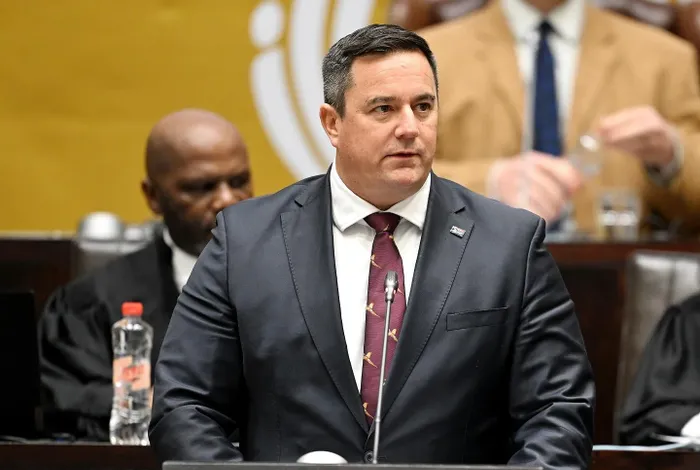
With the red meat industry in crisis due to a persistent foot-and-mouth disease outbreak, a call has been made for Minister of Agriculture John Steenhuisen to be held accountable.
Image: File Phando Jikelo / Parliament of RSA
Pressure is mounting on the national Department of Agriculture as the red meat industry continues to suffer the effects of the stubborn foot-and-mouth (FMD) disease gripping the country following an outbreak early last year.
The Chairperson of Gauteng Legislature’s Portfolio Committee on Agriculture, Rural Development and Environment Affairs, Jaco Mulder, issues a statement on Friday decrying the department’s failure and its reliance on vaccine imported from Botswana, which is only expected to be available by the end of the month.
“The sharp increase in cases of foot-and-mouth disease in Gauteng, and surrounding provinces, has reached a critical point and the executive authority has to take immediate and decisive action to curb it,” said Mulder.
He said there has been a “particularly marked rise” in West Gauteng, around Tarlton, and it was clear that the government has failed to effectively contain the disease.
Calling for an urgent intervention to deal with the crisis, Mulder said it was “extremely concerning” that the department was not communicating its planned interventions to farmers and the industry, which left role players feeling “disheartened, vulnerable and powerless”.
“Meanwhile, stud breeders with established bloodlines and valuable genetic material are incurring severe damage, which has serious medium- and long-term consequences for the red meat industry and food security.
“The legislative authority, and particularly the portfolio committees that oversee the executive, has a constitutional duty to intervene and hold the executive fully accountable,” said Mulder.
Meanwhile, Limpopo’s Department of Agriculture and Rural Development recently introduced new requirements for pre-approved permits and risk-based assessments for the movement of cloven-hoofed animals into, within and out of the province.
The stricter measures applied to cattle, sheep, goats, pigs and game were welcomed by agriculture associations. Under the new protocol, any inter-provincial movement of these cloven-hoofed animals into Limpopo must be supported by a pre-approved movement application.
Mulder said as part of action by his party, the Freedom Front Plus, to deal with the crisis, he planned to engage with all other provincial chairpersons of agriculture portfolio committees, as well as the parliamentary Oversight Committee on Agriculture, to collectively hold the provincial executive, its departments, as well as the national minister, DA leader John Steenhuisen, and his department accountable.
“Where the executive fails, the legislative authority has to step in and act within its mandate to manage the crisis,” he said.
He and other critics have decried the government’s failure to control the movement of livestock and enforce biosecurity measures, and the collapse of the country’s capacity to produce FMD vaccine.
However, DA Gauteng MPL Bronwynn Engelbrecht defended the minister, praising his “science-based leadership”, his “FMD-Free with Vaccination” policy and his procurement of vaccine from Botswana as a temporary measure while working in parallel to fix South Africa’s production capacity.
She said: “The Minister’s early and proactive decision to secure large volumes of FMD vaccine from the Botswana Vaccine Institute is commendable in ensuring that South Africa is protected during a period of heightened risk while longer-term local manufacturing capacity is being rebuilt.”
She said the DA supported the planned phased vaccination rollout in Gauteng scheduled for March and targeting feedlots and commercial and communal farmers.
She said the confirmation that up to one million vaccine doses per month will be available from the end of February represented a “critical intervention” that significantly strengthens South Africa’s ability to contain the disease and protect farmers.