

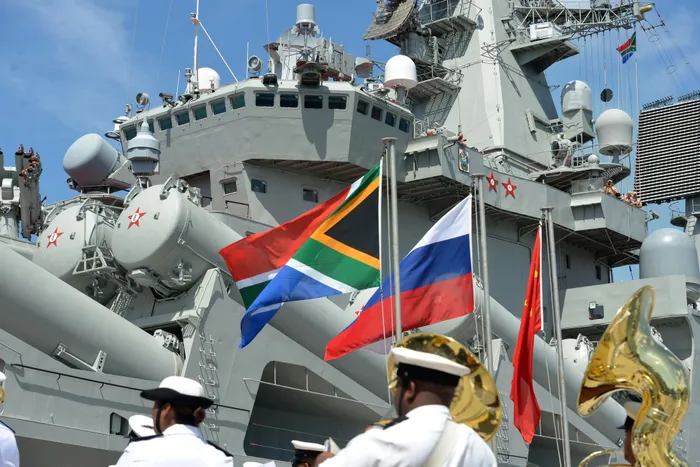
Senior SANDF leadership, including Joint Operations Headquarters commander Major General Godfrey Thulare, conducted briefings and walkabouts at Simon’s Town Naval Base on January 8, ahead of the China-led Exercise Will for Peace 2026, which runs from Friday until January 16 in South African waters.Iran has exited the drills reportedly due to pressure from the United States of America in connection with the protests and violent suppression by the Islamic Republic.
Image: File
Over the last couple of decades Iran's Islamic Republic has managed to deal with uprisings and challenges to its authority. It has been "pretty resilient"; it has benefited from the support of a "strong working class" that supported its ideology as well as that of the Basij Resistance Force or Sazman-e Basij-e Mostazafin, a volunteer paramilitary force operating under the command of the Islamic Revolutionary Guard Corps (IRGC).
However, a former Middle East Times editor and BBC Arabic Service journalist who has been observing the previous as well as the current uprisings across the country believes that this time "there doesn't seem to be a way out" for the regime.
Nicolas Pelham, who was once held hostage for a couple of months and later released in a barter deal involving the United Kingdom, the United States and an Iranian oil tanker, says that for the first time in many decades the regime "is in trouble". It has resisted similar internal and external pressures before, but this time the protestors are openly calling for Ayatollah Ali Khamenei to go.
The situation is different from previous uprisings, such as the Mahsa Amini women's rights-focused protests of 2022, he says. The citizens are “tired of the politics, the economics and the isolation". And apart from the "air of anticipation" and strong desire for change among the population, the regime "doesn't have very much to give" and whatever subsidies and such measures it has tried simply will not be enough to help citizens battling high inflation and runaway costs of living.
"It's not a government that can deliver for its people any more," says Pelham in a recent webinar interview with Political Tours director Nicholas Wood.
And the external pressures have been ratcheted by US President Donald Trump direct and harsh warnings to Iran and its allies and those who continued to trade and work with the beleaguered regime, including South Africa, with telling effects.
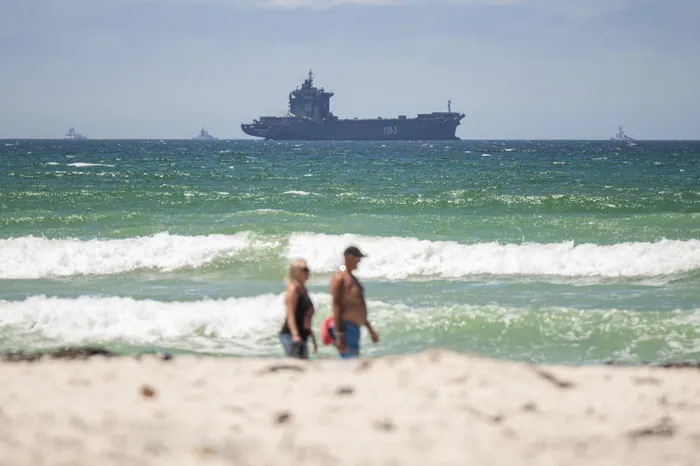
The Islamic Republic of Iran Navy’s expeditionary base ship Shahid Mahdavi (110-3) was still in False Bay on Tuesday as other warships prepared to depart for the much-debated maritime military exercises.
Image: Armand Hough / Independent Newspapers
Pretoria is reported to have urged the country to withdraw from Exercise Will for Peace in South Africa this week to “avoid antagonising the US in particular, at a sensitive time when the Iranian government is violently suppressing protests at home”.
Iran navy’s expeditionary base ship Shahid Mahdavi was still in False Bay on Tuesday as other warships prepared to depart for the much-debated maritime military exercises. Warships from several countries have anchored off Cape Town as part of Will for Peace, a week-long multinational naval drill hosted by South Africa and led by China.
Vessels from China, Russia, South Africa and the United Arab Emirates are currently in False Bay, including China’s destroyer Tangshan, Russia’s corvette Stoikiy and South Africa’s frigate SAS Amatola. Iranian vessels that arrived in Simon’s Town last week are no longer expected to take part in the exercises after South Africa asked Iran to withdraw, as part of diplomatic efforts to avoid escalating tensions with the US.
The decision comes at a delicate time for trade relations, with South Africa seeking to maintain its preferential status under the African Growth and Opportunities Act (AGOA). Earlier on Tuesday, the US House of Representatives approved a three-year extension of the programme, which grants many sub-Saharan African countries duty-free access to American markets. AGOA expired last October after lapsing for several months, prompting economists and trade experts to warn that the delay could disrupt African exports, harm businesses and weaken the continent’s trade ties with the US.
The South African National Defence Force has said the exercises were routine operations aimed at strengthening naval cooperation and maritime security, though critics argue the drills are politically charged against the backdrop of rising global tensions.
Meanwhile, Trump’s actions against Venezuelan President Nicolas Maduro last week, while they could have given Iran some temporary respite because of the US shift in focus, were thought to have had a chilling effect on Iran.
During his last visit to the troubled country Pelham says "it felt North Korean" the way he and his entourage had their movements and conversations monitored. They had minders and the minders had their own minders. But the regime was also desperate to have “their story” told, hence they welcomed him in to visit.
"I think we got a sense of just how brittle it (the regime) was by the fact that we were very, very heavily minded ... every conversation we had would be monitored ... and it wasn’t just that we had minders the whole time; the minders seemed to have minders as well," he said.
However, set against this “brittle regime” and the citizens’ strong push for change, is the "fear of what would happen if the system went, if we did have a collapse". And that was one of the reasons Iran escaped the Arab Spring revolution as the citizens realised "you can get out of the frying pan and into the fire quite easily".
But now things are different, the protests are “quite persistent” with “direct and deliberate” attacks against the regime’s facilities such as the IRGC prisons and police stations which have been stormed and set alight. And, as Pelham describes it, all this did not happen with the memorable uprisings 2022, the Mahsa Amini movement.
Using a local’s description of the current uprisings, Pelham says “if the Mahsa Ahmini protests were feminine, these ones are masculine”. Most of those killed, harassed and arrested were men – traders and other businessmen.
Pelham drew parallels with what is happening now in Iran to the last years of the country’s monarchy leading to the ousting in the late 1970s of Mohammad Reza Pahlavi, the last Shah of Iran.
He says there seems to be a “crisis of confidence” inside the regime, which is a “kind of strange symmetry” to the last years of the Shah.