

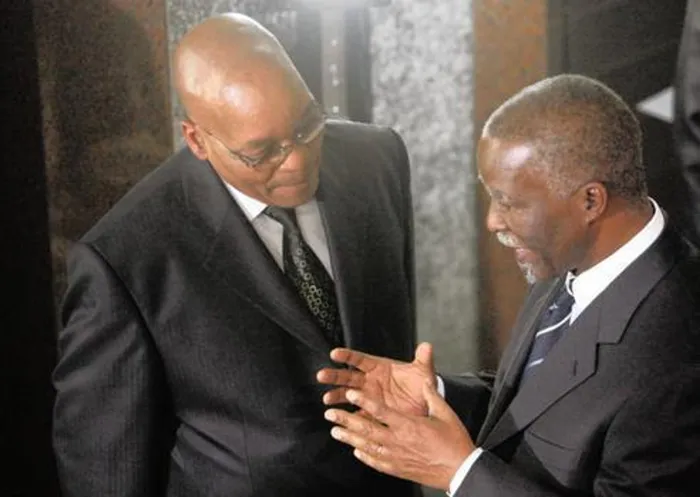
Former presidents Thabo Mbeki and Jacob Zuma are heading to the Gauteng High Court, Johannesburg to force retired Constitutional Court Justice Sisi Khampepe to recuse herself from the judicial inquiry into allegations regarding efforts or attempts to stop the investigation or prosecution of Truth and Reconciliation Commission cases.
Image: Independent Media
Ex-presidents Jacob Zuma and Thabo Mbeki have launched another legal challenge to force retired Constitutional Court Justice Sisi Khampepe to recuse herself from chairing the commission investigating the failure to prosecute apartheid-era crimes.
Justice Khampepe was appointed by President Cyril Ramaphosa in May last year to head the Judicial Commission of Inquiry to investigate political interference in the investigation and prosecution of Truth and Reconciliation Commission (TRC) cases following demands and legal action by families of victims and survivors of apartheid-era human rights violations.
She is assisted by retired Northern Cape Judge President Frans Kgomo and Advocate Andrea Gabriel SC.
Zuma and Mbeki are heading to the Gauteng High Court, Johannesburg in a bid to overturn Justice Khampepe’s January 30 ruling, in which she refused to recuse herself as sought by the two former heads of state.
In his papers, Zuma wants the high court to declare Justice Khampepe’s conduct in dismissing the recusal application unconstitutional and invalid as well as review and set aside the decision. Alternatively, Zuma has asked the court to review and set aside Justice Khampepe’s decision on the basis of the principle of legality.
Mbeki has asked the high court to order that Ramaphosa terminate his appointment of Justice Khampepe and declare all the decisions the commission has taken so far under her null and void.
Among the grounds sought for Justice Khampepe’s recusal are that she worked for the TRC’s amnesty committee and as Deputy National Director of Public Prosecutions (NDPP) before being appointed to the bench.
At the time, according to Zuma, Justice Khampepe was then NDPP Bulelani Ngcuka’s deputy and he is one of the main participants in the commission and a possible witness.
Zuma accuses Justice Khampepe of bias, gross misconduct and/or corruption for coaching and/or colluding with the commission’s chief evidence leader Advocate Ishmael Semenya SC, advising him (Semenya) of the weaknesses of his response to an application to recuse himself.
The former president explained that this was reported to him in November last year by a whistleblower, who claimed Justice Khampepe shared her research and told Semenya to convey certain tips to his legal representative during the recusal application, which was ultimately unsuccessful.
In addition, Zuma added that this fuels his own personal reluctance predilection and/or strong discomfort at the prospect of expecting fairness from Justice Khampepe given her leading role in writing and handing down the two judgments that led to what he described as unfair and irregular detention without trial in July 2021.
Zuma was jailed for 15 months for contempt of court after refusing to continue giving evidence at the commission of inquiry into state capture chaired by then Deputy Chief Justice Raymond Zondo, with whom he claimed he had a personal relationship.
“For obvious reasons, mainly to do with the general need to protect whistleblowers who expose such corrupt activities from victimisation and other retaliatory recriminations I was reluctant to present corroborating evidence in any manner which could be detrimental to any person or persons,” the founder of the uMkhonto weSizwe Party explained in his affidavit.
Zuma also insisted that he did not obtain the information by any unlawful means.
During his testimony this week, Lukhanyo Calata, the son of Fort Calata – a member of the Cradock Four killed by apartheid security police in the 1980s – called on the Commission to subpoena Zuma and Mbeki to give evidence on why the prosecutions were delayed, obstructed or not pursued at all.
The Foundation for Human Rights (FHR), which represents survivors and families of victims of apartheid-era crimes, said Zuma and Mbeki’s actions were delaying accountability and that their efforts to get justice were once again being obstructed by some of the very individuals and entities who publicly claim to support victims.
According to the FHR, the process to review Justice Khampepe’s recusal decision could take a significant period of time to conclude, especially if the high court judgment is taken on appeal.
“We are advised that if the judicial review proceeds while the Khampepe Commission continues with its hearings, there is a risk that the proceedings could be nullified if the review succeeds. Annulment is not automatic, but the risk remains,” the foundation complained.
It continued: “As a result, a Judicial Commission of Inquiry established to investigate decades-long delays and obstruction in achieving justice for apartheid-era crimes is itself being obstructed by actors who want to avoid accountability for actions taken, or condoned, that may have contributed to the suppression of TRC cases.”
loyiso.sidimba@inl.co.za