

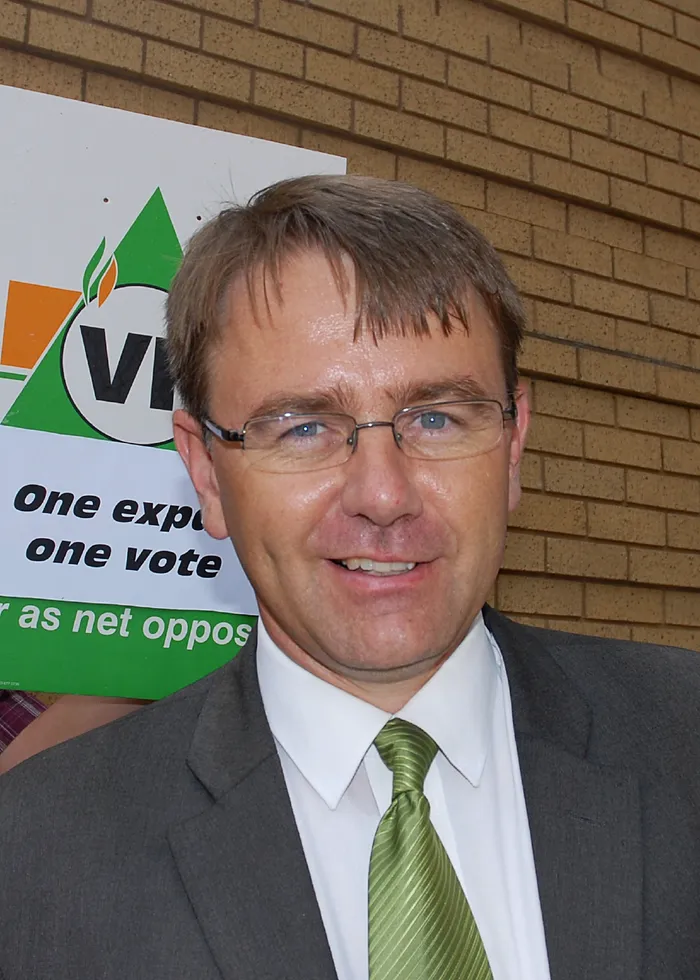
A seasoned attorney Willie Spies, is Freedom Front Plus' (FF Plus) newly-announced Tshwane mayoral candidate ahead of the 2026 local government elections.
Image: Damaris Helwig
A seasoned attorney Willie Spies, who is Freedom Front Plus' (FF Plus) newly-announced Tshwane mayoral candidate, has expressed hope that his return to politics after 16 years will bridge the gap between communities and the government.
Spies, who was FF Plus Member of Parliament from 2004 until 2009, had represented civil society organisations, notably AfriForum, in high-profile cases as an attorney.
In 2017, he took on the then Zimbabwe's First Lady Grace Mugabe, representing Gabriella Engels and AfriForum. He challenged Mugabe's diplomatic immunity, seeking to hold her accountable for allegedly assaulting Engels in the Sandton hotel room and having her face trial in South Africa.
Five years ago he represented four learners against former Basic Education Minister Angie Motshekga's decision to have matric learners rewrite maths paper 2 and physical science paper 2 due to leaked exam papers. He argued the decision unfairly punished innocent students, seeking to have their papers marked and results released.
On Saturday FF Plus leader Dr Corné Mulder announced Spies as party mayoral candidate for Tshwane ahead of the 2026 local government elections, adding that Grandi Theunissen, an experienced Tshwane councillor will lead the party's campaign alongside him..
“Together, they make an experienced and knowledgeable team determined to restore the capital to its former glory. With his introduction, Willie stated that he has realistic hopes, and that he believes collaboration between politicians, the business sector, civil organisations and the public can achieve what seems almost impossible – resurrecting the metro from the ashes,” Mulder said.
Spies, a lifelong Tshwane resident, on Sunday cited a growing concern about the disconnect in South African society as his motivation for re-entering politics.
“What has driven back into politics is the fact that I see a huge gap in South African society today. There is a massive gap between our communities, our civil society, on the one hand and the government, on the other hand. Our government has become the elite state that is not connected to the communities where we come from and that gap needs to be bridged,” he said.
He mentioned that it is important to establish a new social contract between the state and civil society.
“I have been active in civil society for the past 16 years. Through litigations and activism I tried to accomplish certain victories for communities. And those victories for civil society need to be given substance by government policies and government policies can only change if there are changes in government,” he said.
According to him, Tshwane needs to be taken back by a responsible government and not by a government that is not driven by greed and corruption.
“I think the main concern is the problem with priorities. We have politicians in water tanks, for instance the water cuts leaving communities without water. The budget for water cuts has grown so substantially that there is nothing left to establish the infrastructure that can ensure running water for each and every household,” Spies said.
He accused the present government of blocking development because “they benefit from the lack of infrastructure”.
“They won’t improve infrastructure because they benefit from the lack of it. That needs to stop,” he said.
He added that the government needs to stop activities of the construction mafia that makes it impossible for any contractor to conduct business.
“When contractors are starting to do infrastructural work they get these construction mafia asking for bribes. The city does have the capacity and the metro police needs to get involved in stopping the construction mafias from stopping projects of the city,” Spies said.
According to him, the city needs a turnaround strategy to grow its income by debt-collection and killing the culture of non-payment.
“We need to create a culture of payment for services. We can do that by doing two things right. One thing is to ensure that the money they are paying for services are utilised to improve their part of the suburb or their part of the township. Secondly, that they do get the services that they are paying for,” he said, adding that the city must act against people who do not pay for services.
rapula.moatshe@inl.co.za