

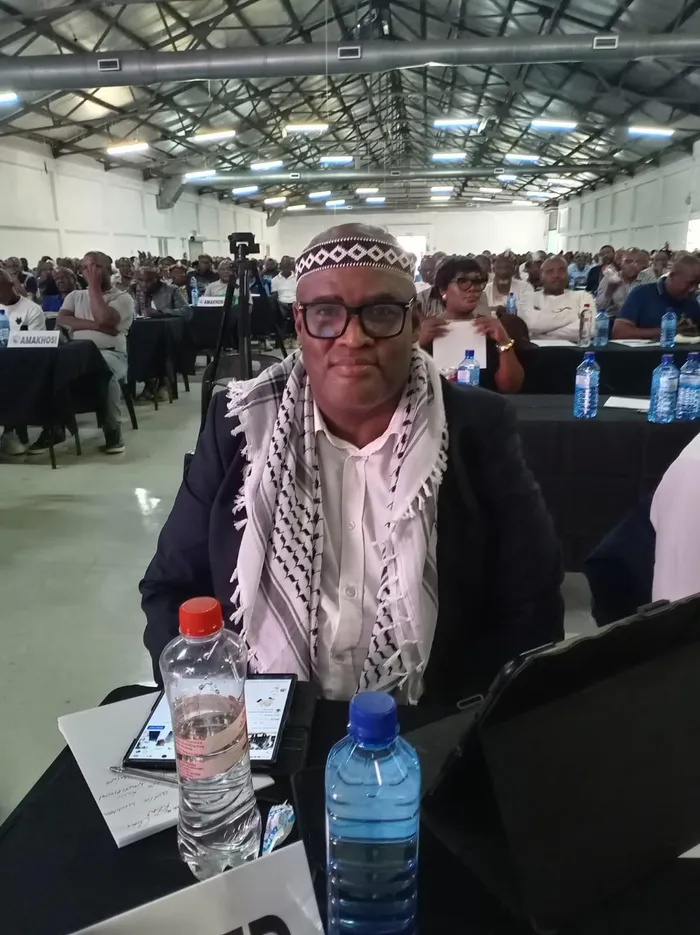
Rural Development and Land Reform (DALRRD) Minister Mzwanele Nyhontso told traditional leaders in Pietermaritzburg about policies that would benefit their rural communities.
Image: Bongani Hans
Department of Rural Development and Land Reform (DALRRD) Minister Mzwanele Nyhontso has vowed to introduce a new land transformation policy, which he said will make those who are against transformation even more worried.
Addressing the gathering of Congress of Traditional Leaders of South Africa (Contralesa) in Pietermaritzburg on Thursday, Nyhontso, who is the leader of the Pan African Congress, said the Equitable Access to Land Bill was currently undergoing final refinements before it is presented to the Cabinet.
The 2026 Imbizo, which was attended by amakhosi and izinduna, was to celebrate Contralesa's 40th anniversary.
Nyhontso described the Bill as more draconian than the Land Expropriation Act in terms of transforming the land for the benefit of traditional leaders and their rural communities.
“the Bill speaks directly about Section 25 of the Constitution, which states that land should be allocated equally.
“I can assure you that there are people who left the country to complain to Trump because of the Public Works Expropriation Act, but this Equitable Access to Land Bill would not make them run to complain to Trump; they would run to complain to God himself,” said Nyhontso.
He said the Bill was designed to be more decisive in breaking the land ownership and access patterns of the past, “and to ensure that land is redistributed in a way that fuels economic growth”.
He told traditional leaders their voices were crucial in ensuring that the Bill benefits rural communities.
“Even more directly, the policy vision that the Communal Land Tenure and Administration Bill, whose drafting is under way, seeks, among various other objectives, to break the current state of impasse around tenure rights issues, land-holding systems, and the administration of communal land.
“We are looking forward to your robust participation in the consultations on this Bill (Equitable Access to Land) that we envisage to commence in the near future,” he said.
Nyhontso also appealed to traditional leaders to participate in the process of amending the Spatial Planning and Land Use Management Act (SPLUMA), which is currently under consideration.
He said SPLUMA should end the currently unchecked proliferation of residential developments, and the inadequate provision of land for essential infrastructure, commercial, and industrial enterprises in rural areas.
“We reiterate our call for us to work together to make the land work for our people. If we do so with dedication, resoluteness, and courage, there is no problem that we cannot overcome.”
He said rural land should be transformed so that it could create job opportunities for rural communities.
“The focus must be on promoting transformation from mere survival to sustainable economic independence.
“Also located centrally and strategically in this transformation of rural people and economy is the provision of land for the establishment and development of rural industries.
“This means facilitating access to land parcels for value addition initiatives, such as plant, logistical, and cultural tourism ventures.
“In other words, land must be the source of creation, not conflict,” he said.
The minister said under his watch, the department would broaden the National Rural Youth Service Corps (NARYSEC), which is DALRRD’s programme targeting to train rural unemployed youth aged 18-25 in technical, vocational, and soft skills to improve employability, foster entrepreneurship, and facilitate community service.
“It provides a vital model whose scope of implementation has to be broadened.”
He said that although this programme was meant for rural youth, it has gained traction among urban young people.
“We are witnessing an increasing phenomenon whereby our youth, especially young women, are adopting the use of technological platforms with much passion, as you all know that technology is the future.”
He also called on traditional leaders to rise above Communal Property Associations (CPAs), whose members were dominantly controlling rural land that had been achieved through land restitution.
He stated that in many cases, the leaders of the CPAs were behaving as if they were above traditional leaders and sometimes appointed themselves as amakhosi in a traditional land.
Nyhontso explained that this had led to members of the CPAs killing each other as they fought over who should be in charge of the claimed land.
bongani.hans@inl.co.za