

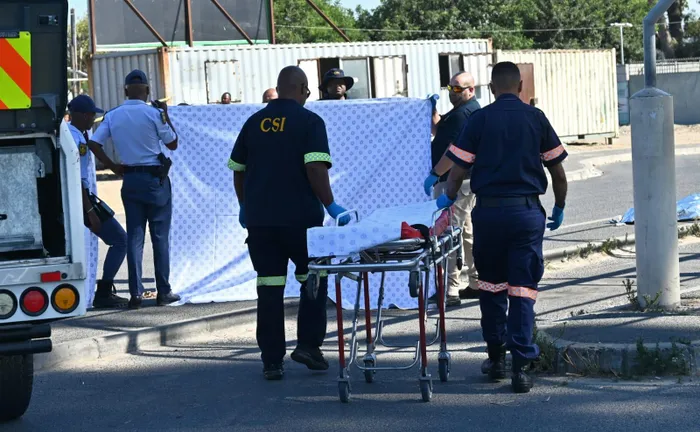
On the morning that MEC Deidré Baartman presented the Western Cape budget Speech for 2026, police were at a crime scene at Delft Taxi Rank, investigating the fatal shooting of three individuals.
Image: Ayanda Ndamane / Independent Newspapers
The Western Cape government has allocated R8.595 billion towards safety initiatives over the next three years as violent crime, gang shootings and gender-based violence continue to affect communities across Cape Town and the broader province.
Presenting the 2026 provincial budget in Parliament on Thursday, Western Cape Finance MEC Deidré Baartman said the funding forms part of the province’s strategy to address violent crime through both policing support and social interventions aimed at tackling the root causes of violence.
"Supporting our safety policy priority, we will allocate R8.595 billion for safety in the 2026 Medium-Term Expenditure Framework," Baartman told Parliament.
The allocation comes amid continued concern over violent crime in the Western Cape, where several police stations regularly feature among the country’s most dangerous according to the South African Police Service crime statistics.
Communities across the Cape Flats continue to face high levels of murder, attempted murder and sexual offences, while residents in many neighbourhoods live with the daily threat of gang violence and drug-related crime.
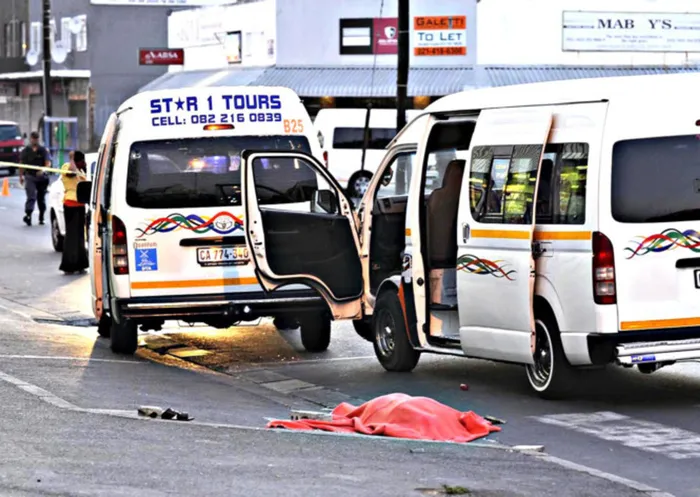
The body of an unidentified body lies next to two taxis in Halt Road, Elsies River in taxi related shooting in Cape Town.
Image: Leon Lestrade
Crime
Baartman said part of the province’s crime-fighting approach is focused on prevention programmes aimed at strengthening families and addressing social factors linked to crime.
"We will invest R373.747 million over the MTEF in care and services to families through the Department of Social Development," she said.
"This strengthens parenting support, family therapy, reunification services and violence-prevention programmes."
In the Western Cape crime statistics, substance abuse regarded as a major contributor to violent crime and domestic violence. Addressing this, is also a part of the priorities.
"We allocate R396.093 million for substance abuse disorder prevention and treatment, focusing on prevention, early intervention for about 4,000 service users a year, and residential treatment," Baartman said.
The Department of Social Development will receive R1.223 billion over the MTEF to support adults and children in conflict with the law, including diversion programmes aimed at preventing repeat offending.
Baartman also highlighted the ongoing crisis of gender-based violence and femicide.
"Gender-based violence and femicide has been declared a national disaster. It demands a whole-of-society response," she said.
"To support the Western Cape GBV Implementation Plan, we allocate R47.139 million over the MTEF to advance this work, reducing violence, restoring dignity to survivors and building safer, more resilient communities."
Gang violence
Gang-related crime remains one of the biggest drivers of violence in parts of Cape Town, particularly in areas on the Cape Flats where turf wars, drug markets and extortion rackets continue to fuel shootings.
The province said it will strengthen anti-gang interventions and investigative support to help combat organised criminal networks operating in these communities.
Baartman announced that R6 million will be allocated to the provincial Anti-Gang Hub, alongside the rollout of a detective-capacity pilot with the South African Police Service.
The initiative aims to strengthen case detection, analysis and investigations into gang-related crimes, which often contribute to the province’s high murder rate.
Law enforcement
The province will also continue supporting additional policing capacity through the Law Enforcement Advancement Programme (LEAP), which deploys officers to high-crime areas.
"Speaker, we remain committed to reducing murders in our province," Baartman said.
"In the precincts where Law Enforcement Advancement Programme officers are deployed, we have seen a sustained decline."
She said that during the 2024/25 financial year more than 1,000 LEAP officers were deployed in six high-violence precincts, where murders declined by 1.5% compared with a provincial reduction of 0.8%.
The programme will continue to receive major funding.
"We will maintain LEAP with R1.14 billion over the 2026 MTEF, which will include extending support to 25 municipalities," Baartman said.
Community safety structures will also receive support as part of the province’s “whole-of-society” approach to fighting crime.
Baartman said R169.376 million has been allocated to neighbourhood watches and community policing forums, while R20.961 million will go towards street coaches and the Safety Observatory.
A further R18.588 million has been allocated to the Community Resilience Programme, which supports local initiatives aimed at strengthening safety in vulnerable communities.
Oversight and accountability within policing structures will also be strengthened.
During the 2024/25 financial year, the Western Cape Police Ombudsman processed 366 complaints, while the Court Watching Brief programme continued monitoring murder and gender-based violence cases.
To improve oversight, R54.231 million has been allocated over the MTEF to implement the Capability Maturity Matrix, which will assess performance at police station level.
Baartman said addressing crime requires coordinated action across government, communities and civil society.
"Building safe and secure communities requires a whole-of-society approach," she said.
lilita.gcwabe@inl.co.za