

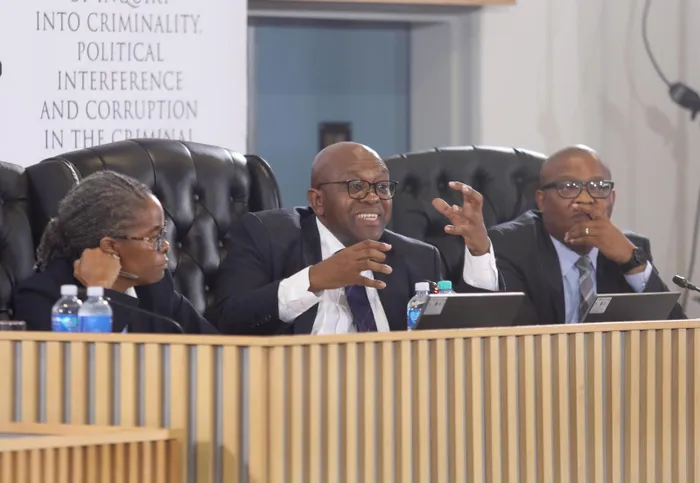
A mystery witness dealing with informers in Gauteng has applied to testify behind closed doors, with public access, and with voice-altering technology at the Madlanga Judicial Commission of Inquiry.
Image: Oupa Mokoena / Independent Newspapers
The Madlanga Judicial Commission of Inquiry is expected to hear the evidence of a witness running covert operations involving informers in Gauteng next month.
Witness G’s lawyer, Tshepo Matlala, told the commission headed by retired Constitutional Court Justice Mbuyiseli Madlanga that his client wanted evidence to be heard partially in-camera, which could be heard remotely and off camera.
He said they were asking for evidence to be heard remotely, but it can be broadcast.
“Our client is willing to assist the commission, but there are some sensitivities, as the commission may well know that our client runs some covert operations and there is a high-risk unit that he is running based in Gauteng,” Matlala stated.
He said his client’s request offered the commission the opportunity to reaffirm perception that it takes the safety of witnesses seriously.
Matlala said Witness G deals with informers and the likes, as well as operational contacts.
“Their safety may be at risk as well, for instance, somebody who has witnessed our client with a particular informer. There could be conclusions drawn, correctly or incorrectly, that the particular individuals who may have been seen with the witness were acting in the capacity of being informers,” he explained.
Matlala added: “What makes it even more risky is that individuals who are socially incidental to the witness could be seen as informers.”
Witness G, according to Matlala, would also prefer voice-altering technology if the commission has such a facility.
“We are trying to be as prudent as possible to conceal the identity of the witness,” he said.
Chief evidence leader Matthew Chaskalson SC said the commission investigated whether they had voice-altering technology and did not come up with any satisfactory results.
“It’s not clear to me that he will be identifiable by voice,” insisted Chaskalson.
He said the request for off-screen testimony that will nonetheless be screened without any visuals is one that the evidence leaders would support, but would not go beyond that.
“Some of the questions that I may ask this witness may render him identifiable with reference to information that is publicly available, and those are not questions I can avoid asking because they will be directly relevant to the inquiries of the commission,” Chaskalson explained.
He undertook to structure his questioning so that any questions that might expose the identity of the witness would be dealt with in one particular session, which might have to be entirely in camera.
“If the commission is inclined to make such a ruling, it may make it in the form of a rule nisi because we have given an undertaking to the media that we will not ask for a fully in-camera testimony without giving a 72-hour notice to the media to object,” Chaskalson said.
A rule nisi is an interim court order granted in the absence of the respondent (media in this case), which will be allowed to return on a later date to give evidence and to argue why that temporary order should not be made final.
Witness G will not testify for another three weeks in terms of the commission’s schedule, according to Chaskalson.
Justice Madlanga asked Matlala and Chaskalson to put together a draft order, which will then be publicised not less than 72 hours before Witness G’s testimony.
The commission will resume on Monday.
loyiso.sidimba@inl.co.za