

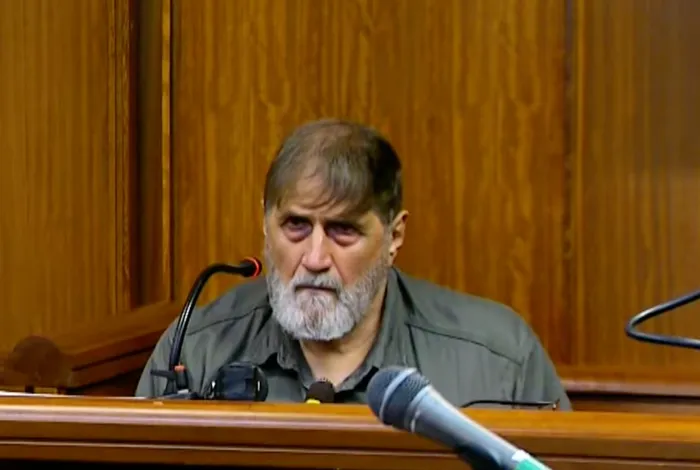
Eugene de Kock said orders to kill came straight from the top.
Image: Screengrab via SABC
Convicted apartheid assassin Eugene de Kock told the Gqeberha High Court on Monday that suspected “terrorists” who could not be arrested were expected to be killed — sometimes by any means, including what he called “taking the head off the snake".
And those orders, the 77-year-old said, came straight from the top of the apartheid state — then president PW Botha — and were passed down through the highest levels of the security police.
De Kock, also known as "Prime Evil", was testifying at the Cradock Four inquest into the 1985 abduction and murders of anti-apartheid activists Matthew Goniwe, Fort Calata, Sicelo Mhlauli, and Sparrow Mkonto.
The four men were kidnapped, brutally beaten, shot, and their bodies set alight.
Taking the witness stand with a grey beard and a khaki short-sleeved shirt, De Kock said that though he had no role in the actual killings, he had been part of the apartheid security system that hunted and killed people “deemed enemies of the state".
De Kock, who was supposed to testify in October last year but could not due to suspected heart failure, said suspected “terrorists” included anyone the apartheid government considered a threat, including members of the ANC and PAC.
“A terrorist is any person who attacks structures that are central to the government of the state, such as electricity, water, senior personnel, or acts against the police, the government, [and similar] structures," said De Kock, who had been sentenced and spent about 20 years behind bars before being released on parole in 2015 for his role in apartheid-era crimes.
“Terrorism is not race‑based, gender‑based, or based on religion or ideology.
"Terrorism is when nobody feels safe, even to go to a Wimpy bar or to a church, and then being bombed or shot.
'If we couldn't arrest him, we would shoot him, and then you also must take the head off the snake."
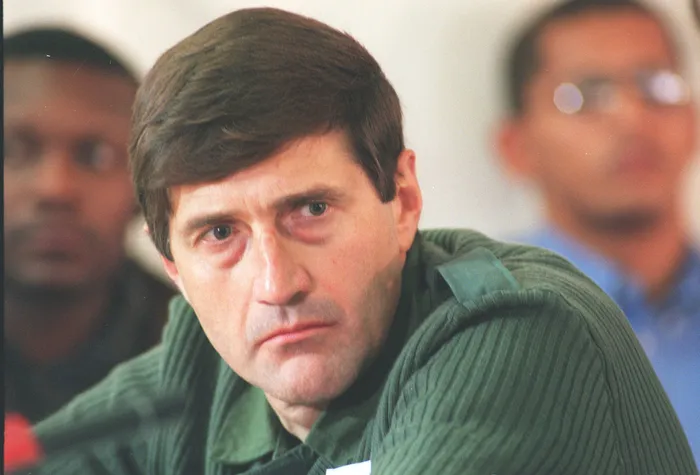
The man they called ‘Prime Evil’, Vlakplaas commander and apartheid assassin Eugene de Kock
Image: FILE
De Kock said he started his career with compulsory military service in 1967 and then joined the SA Police in 1968, where he trained at the Police College.
He said he served in Rhodesia, now Zimbabwe, and in South West Africa, now Namibia, where he trained members of the Ovambo Home Guard and former Angolan fighters in counter‑terrorism.
The Ovambo Home Guard was a local armed force in northern Namibia, trained to fight against anti-apartheid fighters.
In 1979, he said he helped start the notorious Koevoet counter‑insurgency unit under Colonel Hans Dreyer.
By 1983, De Kock said he was worn out from years on the frontlines and asked to return to SA, where he was assigned to Vlakplaas, a secretive unit of the security branch.
He eventually became commanding officer under Brigadier Jack Cronje before taking full command in 1985.
He described how operations were planned and carried out.
'I would assemble a team to carry out specified tasks,” De Kock said.
“In certain situations, I would participate with the team in a designated task and assume the role of commanding officer for that operation.
'In my absence, command responsibility would be delegated to the captain of Vlakplaas.”
De Kock said all orders came from Brigadier Willem Schoon at Vlakplaas and were authorised by senior Security Police figures and the State Security Council.
“We were not an autonomous unit; we were essentially a support unit,” he said.
He said teams had to get ready carefully for operations by checking travel documents, changing weapons if going across borders, and collecting information on their targets.
Internal missions required coordination with divisional heads in regions such as Durban, Gqeberha, and Cape Town, who would assign command under their own structures.
He detailed the CAAT system, a card index with 6,600 to 6,800 photographs and information on individuals considered “terrorists".
Officers would show the cards to informants to confirm identities and record where training had taken place and who provided it.
He said the system dated back to the Second Anglo-Boer War and was later refined and computerised.
When asked if the Cradock Four had been seen as terrorists, De Kock said: “Not one single one. They were civilians. That is it.
“They could have been detained under Article 29. They had done so with many people.”
De Kock also said: 'I'm also not aware of any testimony, statement or document that suggests I had any involvement whatsoever with the murder or planning of the murders of the Cradock Four.'
He said he also told Captain Sakkie van Zyl that a weapon used in an operation involving the Cradock Four could not be trusted to be altered and should be thrown into the sea because it had been used in a serious crime.
De Kock said he carried out cross-border missions and attacks in Swaziland and KwaZulu-Natal, bombings abroad, and that all operations had formal approval, called Staff of Excellence awards, signed off by senior officials, including the minister and president.
He said he carried out the bombing of Khotso House on orders from Schoon, who told him the directive came “from the top — President Botha".
Khotso House was a building in Johannesburg that housed offices of anti‑apartheid and liberation movement organisations, including the ANC and other groups.
It was targeted and bombed by apartheid security forces in the 1980s.
He said 15 to 19 people inside were tortured so severely that some were nearly dead before being taken outside, necklaced, and killed on a highway.
He said operations required careful planning to avoid harming surrounding infrastructure.
“You couldn’t just go to a place, investigate, pick up somebody, or shoot them.
"It could be an operation for 10, 12, 15 years already,” he said, describing how intelligence from sources guided every step.
De Kock said all operations were conducted only with formal authorisation and within a strict chain of command.
The inquest continues.