

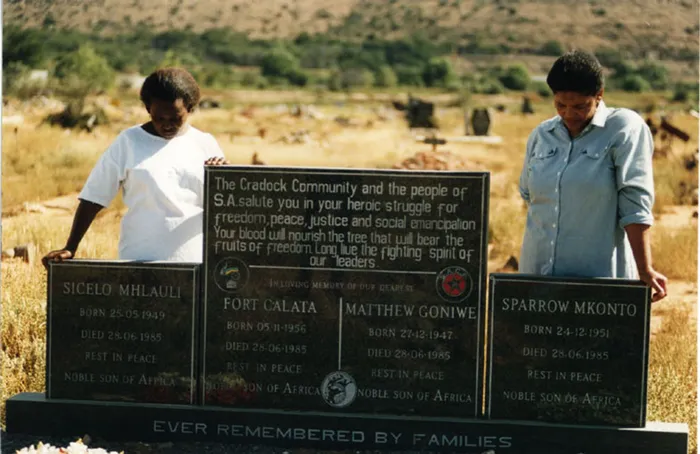
The grave site of Matthew Goniwe, Sparrow Mkonto, Fort Calata and Sicelo Mhlauli, who were known as the ’Cradock Four’. The four men were killed by apartheid state security forces in 1985.
Image: Benny Gool / Independent Media
Forty-one years ago, Nomonde Calata was told her husband had been abducted and brutally killed by apartheid police.
Her suffering is still continuing because, after all these years, she is still waiting for answers and for someone to take responsibility for the death of Fort Calata, one of the Cradock Four.
The Cradock Four — Calata, Matthew Goniwe, Sicelo Mhlauli, and Sparrow Mkonto — were all anti-apartheid activists in the Eastern Cape.
They were abducted, tortured, and killed by security police in 1985 because of their work opposing apartheid.
The third inquest into their murders is currently underway at the Gqeberha High Court.
On Monday, former apartheid mass murderer Eugene de Kock gave testimony, but Nomonde said his evidence left her with more questions than answers.
De Kock had been sentenced and spent about 20 years behind bars before being released on parole in 2015 for his role in apartheid-era crimes.
The 77-year-old said though he had no role in the actual killings of the Cradock Four, he had been part of the apartheid security system that hunted and killed "terrorists".
De Kock, former commander of the notorious Vlakplaas, said he understood a terrorist to be “any person who attacks structures that are central to the government of the state, such as electricity, water, senior personnel, or acts against the police, the government, or similar structures".
When asked if the Cradock Four had been seen as terrorists, De Kock said: “Not one single one. They were civilians. That is it."
De Kock also said: 'I'm also not aware of any testimony, statement or document that suggests I had any involvement whatsoever with the murder or planning of the murders of the Cradock Four."
He said he also told Captain Sakkie van Zyl, of the Security Branch, that a weapon used in an operation involving the Cradock Four could not be trusted to be altered.
He said it should be thrown into the sea because it had been used in a serious crime.
De Kock was then heckled and interrupted by the defence, who repeatedly questioned his relevance.
He said he wanted to tell the full story and that everything must come out, while flatly denying any involvement in the killing of the Cradock Four.
He added that the directives to kill during apartheid came straight from the top, naming former President PW Botha.
Nomonde said De Kock was not given enough time to talk.
“Even if the things he was saying were not related to our story, we wanted to hear more so that we could put the dots together and hear what really happened," she told IOL.
"But he was sort of limited on the things he was supposed to say.”
Nomonde described the decades since her husband’s death as unbearably difficult.
“It is very difficult," the grieving widow said.
"We were waiting for so long to hear at least something tangible that we can rely on.
"Now to hear all these different versions and different stories — it hurts.
"It has been almost 41 years now that we, as wives, have lost our husbands, and we are still running around searching for the truth.
"When we hear things like this, it takes you back.”
Nomonde said the families feel neglected, watching both the inquest in Gqeberha and a separate commission of inquiry in Johannesburg.
That commission is the Khampepe Commission, which is investigating delays in the investigation and prosecution of cases referred by the Truth and Reconciliation Commission.
“We feel sad, we feel neglected and we don’t even have support — people who are standing up for our rights and justice,” she said.
Time, she said, has stolen accountability as well as answers.
She said many of the people involved in the killings are now dead.
“That is the part that is very painful," Nomonde said.
"They took too long, and that makes us feel very, very sad. We had high hopes that in this democracy, at least the only thing we would get is justice for the death of our husbands.
"Unfortunately, it did not happen.”
The families are hoping this inquest will finally bring truth and closure, though hope has grown fragile after decades of waiting.
“We do have hope, and also not, because we have waited for too long,” she said.
Referring to testimony that De Kock helped dispose of a firearm after the murders, she questioned his claim of limited involvement.
“That is surprising. If he was so innocent, he would have spoken out even then. He didn’t. So he’s just as guilty as the others.”
The inquest continues.
IOL