

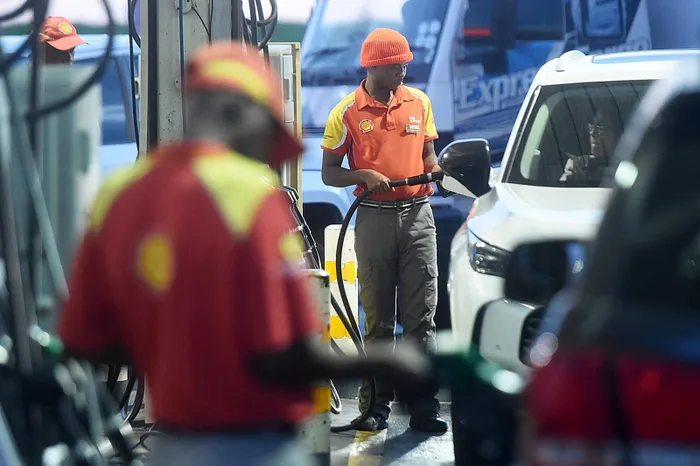
South Africans are facing a sharp rise in everyday costs as global fuel shocks ripple through the economy, pushing up the price of food, travel and borrowing. What began as a surge in oil prices is now being felt directly in household budgets, with increases filtering through multiple layers of spending.
Image: Tumi Pakkies / Independent Newspapers
Dozens of filling stations across SA ran dry on Tuesday as motorists scrambled to fill up with petrol and diesel ahead of the drastic fuel price hike at midnight.
And though the government cushioned the blow at the very last minute, announcing a R3 cut in the fuel levy, it did very little to stem the onslaught at the pumps.
Long queues formed from early morning and stretched throughout the day, with some stations so overwhelmed that waiting times reached an hour, while others ran out of stock entirely.
Some motorists have taken drastic measures, filling containers in a desperate bid to beat the soaring fuel prices.
Petrol increased by R3.06 a litre, while diesel rose by between R7.37 and R7.51 a litre, depending on the grade.
The wallet-crushing leap was driven mainly by a global oil shock, as conflict in the Middle East — particularly around Iran and the Strait of Hormuz — disrupted supply and pushed crude prices above $100 a barrel.
At the same time, a weaker rand and SA’s reliance on imported fuel made the hikes even steeper locally, as the country pays more for oil priced in dollars.
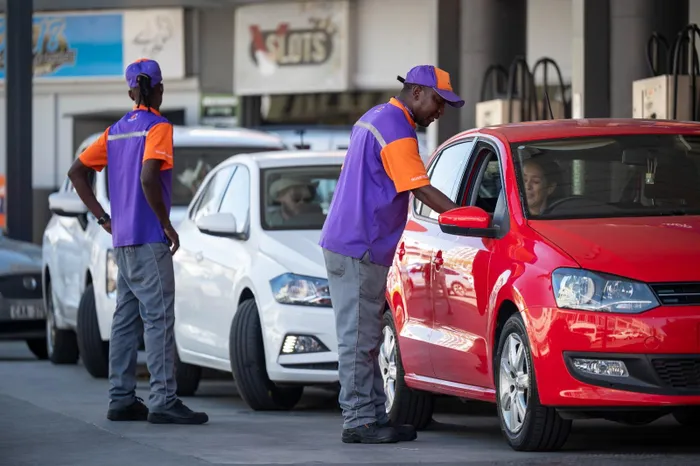
In Cape Town’s CBD, garages were a hive of activity as motorists rushed at the last minute to fill up their cars
Image: ARMAND HOUGH
It comes as South Africans face a sharp rise in everyday costs as global fuel shocks ripple through the economy, pushing up the price of food, travel and borrowing.
What began as a surge in oil prices is now being felt directly in household budgets, with increases filtering through multiple layers of spending.
The increases are not isolated.
Fuel sits at the centre of the economy, meaning a rise at the pump feeds through into transport, production and logistics, and ultimately into the price of goods, services and borrowing.
Dawie Roodt, of Efficient Group, said if global oil prices and the rand continue on this trajectory, further increases could be on the table in May.
"This is an average over under-recovery," he said.
"The real increase in the oil price happened over the past two weeks or so.
"If prices stay at the current level, there could be another increase in May, because the average for the coming month will be higher than it is at the moment."
Zero Carbon Analytics' Nick Hedley said SA was highly exposed to the conflict unfolding in the Middle East.
"SA is a net importer of crude oil and oil products," he told IOL.
"Fuel prices are pushed higher by two factors: the much higher oil price, and the weakened rand as investors flee to safe-haven assets, mainly the US dollar.
"This will push up inflation throughout the economy, given that people, food, and goods are mostly transported by road."
SA saw a similar shock after Russia invaded Ukraine in February 2022, triggering a global energy crisis that pushed oil, food and fuel prices sharply higher.
Inflation in SA rose by 2.1 percentage points in the months that followed, climbing from 5.7% to 7.8% in just five months, with food inflation reaching 10.1% by July 2022 as prices for grains, cooking oils, fish and meat surged.
This also led to higher borrowing costs as the SA Reserve Bank raised interest rates to contain inflation.
The central bank lifted interest rates by 4.25 percentage points in the 15 months after the Russia-Ukraine war began.
"Unless the war ends soon and the Strait of Hormuz is reopened, we are likely to see something similar to the shock that hit when Russia invaded Ukraine," Hedley said.
Motorists were anything but impressed with fuel prices racing skywards.
Wilfred Fortuin, of Strand, Cape Town, said he was going to feel the pinch.
Speaking amid the long queues, Fortuin said he had to leave work just to fill up.
"I'm part of the rush to fill up the tank today," he said.
"I had to leave my work to come and fill up.
"It is a struggle to juggle work and then break away to come and fill up — that is the problem at the moment."
Asked how the increase would affect his finances, he said: "It is definitely going to affect it in the long run.
"I will have to think about it twice before I can say 'OK, I'm good for now'."
Ryan Vosloo, who runs a school transport company in Cape Town, said rising fuel costs were starting to bite.
"It does not help financially, because normally I do smaller transport, so I pay travel expenses a lot," Vosloo said.
"When the petrol is finished, my customers have to pay for it.
"But because it is so expensive now, my customers demand that petrol be included in the total price, so yeah, it is affecting me."
He added that costs have already jumped sharply.
"At the moment it cost me about R1,500, now it’s going to be about R1,800.
"My three-seater bus used to cost me R1,800, but now it is going to be about 2,200."
Many filling stations had already run out of stock well before midday.
Astron Energy at Sir Lowry’s in Woodstock, Cape Town, also reported running completely out of fuel.
The Engen station on the corner of the N2 and Gerber Boulevard in Helderberg, just outside Cape Town, said it had run out of both diesel and petrol.
General manager Charles Loots said they were still waiting for new stock, with one tank costing about R600,000 — a figure set to rise to nearly R900,000 from Wednesday.
"The customers are angry at me," Loots said.
"They shout at me, accusing me of keeping fuel for friends or hiding it away.
"Tempers flare, which one can understand. It is a mess.
"We really don’t have supply.
"There was a logistical nightmare at head office."
MBT Fuel on Main Road, Van Ryneveld, Cape Town, said it only had petrol left around 1 pm.
Michael du Plessis, the station’s general manager, said they were waiting to see when the next batch would arrive from Johannesburg.
"This morning we were dispersing about 20 litres of diesel per vehicle to help customers, but we have run out.
"We can still help with petrol," he said.
The station was also packed, with long queues.
Some fuel stations in Johannesburg reported running low on supply as motorists rushed to fill up.
One of those stations was the Engen in Auckland Park.
Manager Oscar Domain said the situation was tense.
He said he was panicking and that the station could run dry at any moment.
New Hanover Garage in KwaZulu-Natal said it imposed temporary limits because of supply shortages.
Containers were not being filled, trucks were limited to 40 litres per fill, and diesel vehicles to 25 litres.
While the vehicle limits have been lifted, the garage was still not allowing containers to be filled.
Wartburg Fuels also said it had temporary limits per customer to manage demand.
Durban motorist Siv Moodley, meanwhile, said he hoped prices would stabilise soon so life could get back to normal.
Another local driver Hafiz Usmani said the fuel hike would hit his budget hard, making daily expenses more expensive and affecting many people.
Fuel stations in Gqeberha in the Eastern Cape also faced severe supply shortages and long queues on Tuesday, particularly at the Engen at Baywest, where lines of vehicles had been snaking through the forecourt.
Resident Zihle Mabaso said the fuel hike would affect the unemployed and those relying on piece jobs.
Taxi driver Siyabonga Mkhwanazi said everyone was going to be affected.
Meanwhile, finance minister Enoch Godongwana temporarily slashed the general fuel levy by R3 per litre for petrol and diesel in April, in a bid to soften the blow of sharply higher pump prices.
The levy is a tax built into the price motorists pay at the pump and is normally a key contributor to the national budget.
It funds everything from health and education to policing and road maintenance.
Cutting it reduces the amount drivers are taxed per litre.
The move is set to cost the government roughly R6bn in lost revenue.
Godongwana furthered said relief could be considered for May and June if global conditions do not ease, though such measures may not be sustainable beyond mid‑year.
Trade unions, political parties and business groups — including Cosatu, the DA, Business Leadership SA and the Fuel Industry Association — had publicly urged National Treasury to cut fuel levies ahead of the hike to cushion households and the economy from the steepest monthly increases on record.
Their pressure helped set the stage for the government’s decision to act.
The Freedom Front Plus welcomed the concession as much‑needed relief for motorists but cautioned that it was only temporary.
The party said the cut applied for just one month and warned that the lost tax revenue will eventually have to be recovered.