


Professor Armanda Bastos, Director of the Hans Hoheisen Research Centre at the University of Pretoria’s Department of Veterinary Tropical Diseases, delivering the 37th UP Expert Lecture at the university’s Future Africa Campus. Bastos called for changes to the FMD slaughter regulations that will bring relief to the cattle and related industries devastated by the disease.
Image: SUPPLIED
While South Africa is still on a “very, very long road to recovery”, research conducted at the University of Pretoria (UP) is providing some hope for relief for the cattle and related industries devastated by foot-and-mouth disease (FMD).
The latest research offers conclusive scientific evidence that a change in the current FMD regulations for cattle slaughter could help alleviate the economic devastation caused by the disease – without in any way compromising efforts to curb its spread.
Recommendations for the proposed slaughter regulation change have been submitted to the authorities, said Professor Armanda Bastos, Director of the Hans Hoheisen Research Centre at the university’s Department of Veterinary Tropical Diseases.
Bastos recently delivered the 37th UP Expert Lecture at the university’s Future Africa Campus, which was attended by Agriculture Minister John Steenhuisen and a number of officials from his department, along with members of organised agriculture, the livestock industry and other stakeholders.
Bastos, a molecular biologist and epidemiologist, stated that a swift response to the findings from the authorities responsible for the slaughter regulations could help stem the losses of an industry bleeding jobs and revenue.
“The situation is dire, and the regulations are not keeping pace with the additional risk mitigation processes we are using. The FMD controlled slaughter regulations should be changed as soon as possible based on science on the serotypes that occur in South Africa,” she said.
Bastos outlined her research findings in a lecture titled “Foot-and-mouth disease: a familiar foe in formidable new form”, which was a reference to the scale of the current unprecedented outbreaks of FMD, which has spread to all nine provinces of South Africa.
The 5th Quarter Research Project, so-called because it focuses on the part of the carcass (head, feet, offal and tongue) that must be discarded or treated when recovered cattle from FMD-infected premises are sent for controlled slaughter, commenced on August 25 last year. Together with partners from the private and public sectors, 1,800 samples were collected from 90 cattle, sent for “early slaughter” at day 16 post Day Zero and analysed for FMD virus. All 90 cattle had been infected with the virus, and were vaccinated 7-9 days later in order to identify Day Zero, which is defined as the day that the last animal was vaccinated or the day that the last animal showed clinical signs, whichever of the two comes last. Once a Day Zero has been identified, cattle may only be sent for slaughter at 15 days post Day Zero. The two-week wait period, post Day Zero, is a risk mitigation measure to ensure that only fully recovered cattle are sent for slaughter.
The PCR tests performed on samples taken from these animals confirmed that FMD virus was absent from the bone marrow. This is a significant finding, Bastos explained, because the current controlled slaughter regulations mandate deboning, which is expensive and difficult to carry out and represents a major cost and logistical burden for the industry.
No detectable virus was found in the spleen, kidneys and mesenteric lymph nodes which drain the intestines of the slaughtered animals. Although the PCR test was positive for one tongue and three lung samples, additional tests confirmed that the virus was not infectious.
“No infectious FMD was found in any of the samples that we tested,” Bastos said, noting that these results showed that it is unnecessary for slaughterhouses to carry out deboning, deglanding or to dispose of the tongue or offal when fully recovered cattle are sent for slaughter at day 16 post Day Zero, as regulations currently require.
A further proposal is to introduce one controlled slaughter phase instead of the current two. The single phase should be carried out between 16 days and three months after “Day Zero” has been declared.
In the next phase of the research, the focus will be on what are considered to be high-risk sites in the head where the virus has been shown to persist at low levels in cattle that become carriers.
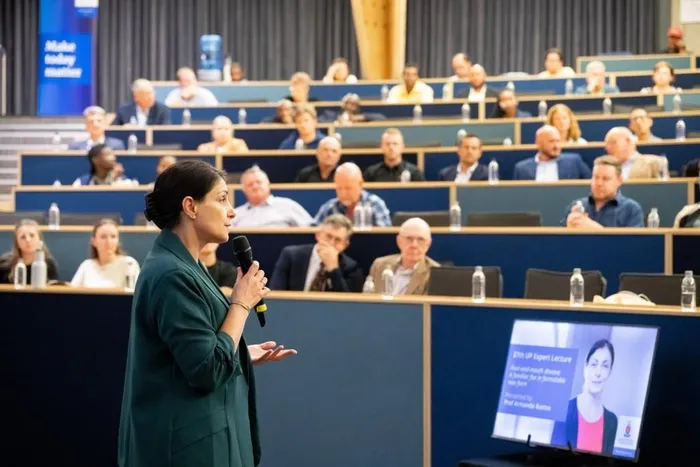
Professor Armanda Bastos, Director of the Hans Hoheisen Research Centre at the University of Pretoria’s Department of Veterinary Tropical Diseases, delivering the 37th UP Expert Lecture at the university’s Future Africa Campus.
Image: SUPPLIED
Turning to the longer-term prognosis for combating FMD in South Africa, Bastos said the road to recovery would be “very, very long”. To regain its former FMD-free status, the country would need to vaccinate 80% of its millions of heads of cattle, representing a massive outlay of resources.
It would also be vital to dramatically increase laboratory capacity for post-vaccination monitoring, as this would add to an already overburdened diagnostic system. Other priorities are to protect FMD-free buffalo from “reverse infection” by cattle, to address FMD in pigs and the slaughter regulations applied to them, and to consider establishing regional approaches to ensure the strategic allocation of vaccines to areas where they will have the greatest impact.
During her presentation, Bastos said one of the “tough” lessons from past and present was that FMD required vigilance, agility and quick and decisive action.
“And this is a really tough lesson: FMD is brutal if you are complacent. You have to move quickly. You have to pick it up quickly; you have to deal with it very, very quickly.”
Most important of all are private-public partnerships (PPPs) that enable agile, rapid and decisive responses, Bastos said. The 5th Quarter research project has shown that by harnessing collective expertise and will, PPPs can deliver rapid results. “We need everyone on board and all hands-on deck, if we are going to beat FMD.”