

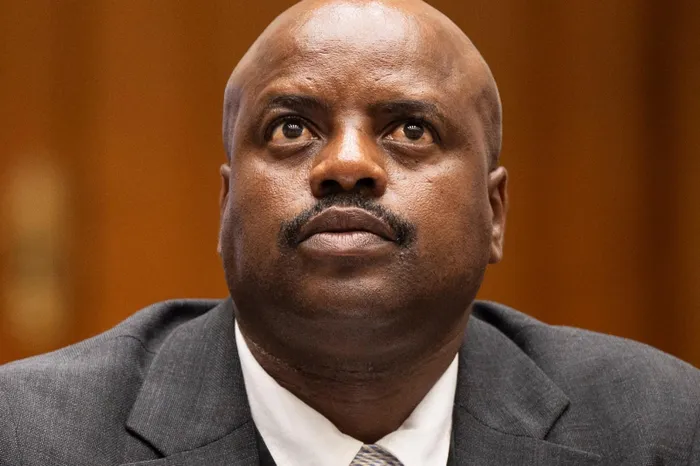
Suspended EMPD Deputy Chief Julius Mkhwanazi has denied involvement in the disposal of Emmanuel Mbense's body, contradicting testimony from Witness D, who claimed Mkhwanazi ordered the body to be dumped in a dam.
Image: Armand Hough / Independent Newspapers
Suspended Ekurhuleni Metro Police Department deputy chief Julius Mkhwanazi has dismissed the testimony of the late Marius van der Merwe, known as Witness D, who testified that Mkhwanazi helped dispose of the body of suspected thief Emmanuel Mbense in 2022.
During his testimony on Wednesday at the Madlanga Commission of Inquiry Mkhwanazi claimed Van der Merwe’s evidence, that he ordered the body be thrown into a river in Brakpan, was untrue.
Van der Merwe, who was shot dead on the driveway of his Brakpan home on December 5, 2025, testified last year that his bakkie was used to transport the body.
He told the commission that when Mbense’s body was being loaded into his bakkie “Julius was still in the yard supervising the whole issue of disposing of the body”.
According to Van der Merwe he was instructed to throw the body into Spaarwater dam and the body sustained no further injuries while in his care.
“I did not place it inside the dam because I was hoping that someone would discover it,” Van der Merwe testified last year.
Evidence leader Advocate Mehlape Sello revisited Van der Merwe's testimony, which implicated Mkhwanazi in Mbense’s death.
Mkhwanazi was pressed on why the late police informer Jaco Hannekom woke him at 2am to witness “a success” after recovering a truck loaded with stolen items.
The commission questioned why Mkhwanazi failed to record any information about the scene when he reported for duty later that morning.
Mkhwanazi told the commission he was angry with Hannekom and “so disappointed” in him for failing to provide anything “tangible”.
Asked who Hannekom meant by “our success”, Mkhwanazi replied: “I didn’t think about that. I just said, ‘Let me wake up and rush’.”
Pressed on why it was necessary to wake up at 2am when the recovered goods would ultimately be booked into SAP 13, Mkhwanazi said: “I just woke because I wanted it to be our success.”
Sello said the success was not recorded in any police file and questioned why Mkhwanazi found that normal.
Justice Mbuyiseli Madlanga said it could have turned out to be nothing, “a damp squib”, yet Mkhwanazi still got up.
Mkhwanazi replied that with Hannekom, most of the time it turned out to be a success.
Sello put it to Mkhwanazi that it was not true that he only went to the scene after Hannekom called him about the alleged success.
Mkhwanazi maintained it was not an EMPD success and explained that this was why it was not recorded as one.
Madlanga said: "I wanted to suggest to you that your evidence is as sparse as it is and it is as senseless as it is. And as Commissioner Baloyi suggests it is as improbable as it is because you did not want to tell us what actually happened and what you actually saw."
Mkhwanazi responded: "I didn't see anything."
Sello said the probable version of events was the one given by Marius van der Merwe in his statement.
Mkhwanazi told the inquiry that the Independent Police Investigative Directorate (IPID) contacted him in 2023, informing him that a person had died and that he, Mkhwanazi, had allegedly issued an instruction to move the body.
Regarding Van der Merwe’s September 2022 statement, Mkhwanazi said the investigating officer testified that Van der Merwe had contradicted himself.
Mkhwanazi denied being the bearded man placed at the scene according to police reservist Alexander Frits' statement.
He told the commission the police force prohibits him from keeping a beard. He added that he had disciplined and charged numerous officers for failing to shave.
Earlier, Mkhwanazi told the commission he knew Hannekom as an informer who worked with security agencies.
He said Hannekom proposed a car reselling business to him, explaining that he used to sell clothes but could no longer do so because of Covid.
Mkhwanazi said he invested R100,000 in a car-reselling deal proposed by Hannekom. He told the commission that he later learned from Hannekom’s wife that Hannekom was involved with drugs, adding that he started doubting the business's prospects.
Sello said there was no proof that Mkhwanazi ever paid Hannekom R100,000 cash to invest in a car repair and resale business.
She suggested that payments Mkhwanazi claimed were reimbursements from Hannekom—R1,600, R15,000, and R65,000 within two months—were, in fact, financial benefits he derived from the hijacking racket.
rapula.moatshe@inl.co.za