

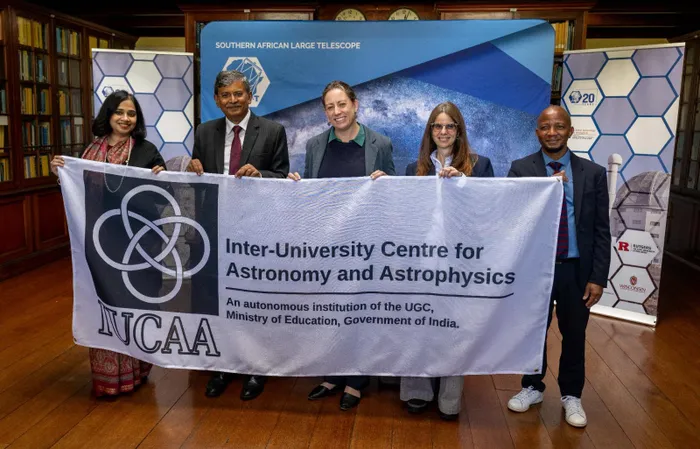
Officials from India and South Africa hold the Inter-University Centre for Astronomy and Astrophysics (IUCAA) banner during the official handover at the South African Astronomical Observatory in Cape Town on May 8.
Image: Henk Kruger / Independent Newspapers
South Africa and India’s long-standing scientific collaboration was further cemented on May 8, as the High Commissioner of India to South Africa, Prabhat Kumar, formally handed over a banner to the South African Astronomical Observatory (SAAO) during a ceremony at the Royal Observatory in Cape Town.
The banner, bearing the name and logo of India’s Inter-University Centre for Astronomy and Astrophysics (IUCAA), will be displayed at the Southern African Large Telescope (SALT), symbolising the growing partnership between the two countries in astronomy and scientific research.
The event, attended by senior representatives from both countries, began with a guided tour of the historic observatory led by engagement officer Shamin Doman, who showcased some of the facility’s scientific heritage, including early telescopes and image-generating instruments used in astronomy’s formative years.
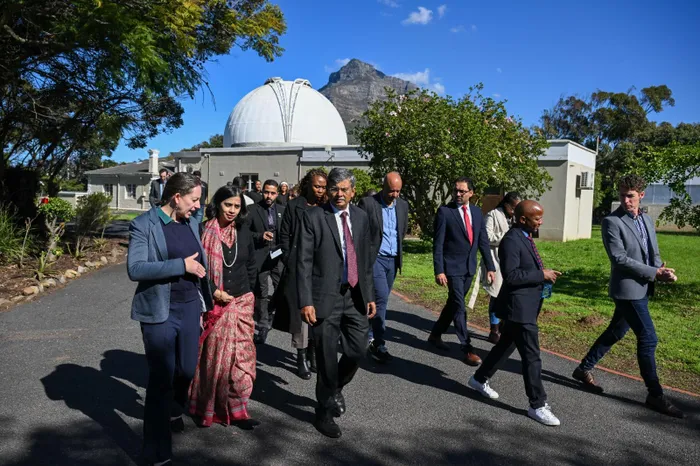
Delegates from India and South Africa are guided through the South African Astronomical Observatory during a tour showcasing historic telescopes and early astronomical instruments in Cape Town on May 8.
Image: Henk Kruger / Independent Newspapers
Speaking during the ceremony, Kumar commended the SAAO for its "exemplary research", adding that the placement of the IUCAA banner was "symbolic of the Government of India’s priority attached to scientific research and innovation".
"Collaborating in science is part and parcel of India’s foreign policy. There is a historical link between India and South Africa, and we must continue to work together. Anything required from the High Commission or Consulate, we are ready to support," Kumar said.
SAAO Managing Director, Rosalind Skelton, reiterated the strength of the partnership, highlighting the achievements of the SALT facility over the past two decades.
"We’re very proud that over its 20-year history, it has really made great strides towards achieving its mission," Skelton said.
"That includes doing cutting-edge science of the southern skies, inspiring society with the wonders of the universe, and developing technological capacity locally and among our partner countries as well."
She added that support from both governments had been critical in advancing the telescope’s capabilities.
"One of the parts that we’re particularly proud of is the technology development that’s taking SALT into its future. At the moment, we’re developing a new camera detector and controller in partnership with Indian collaborators, which we expect to install on the telescope in the coming months. That’s an exciting new chapter for us."
Skelton also pointed to future engagements under the BRICS framework, noting that South African scientists would participate in key astronomy meetings hosted by India later this year.
"We’re looking forward to our visits to India planned for October and November, including the BRICS astronomy working group meeting and the SALT workshop and board meeting," she said.
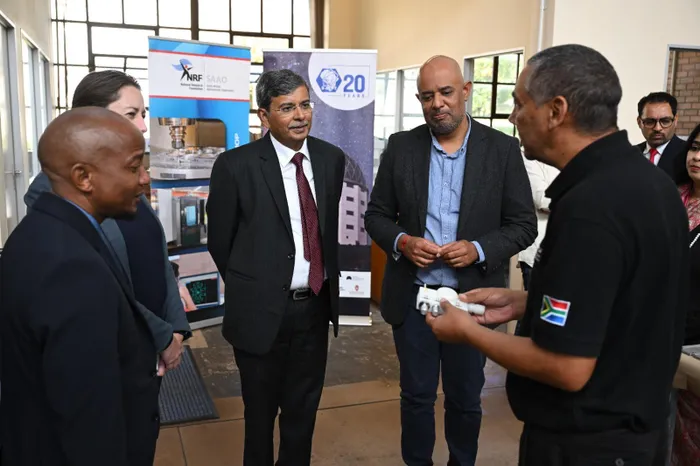
Delegates from India and South Africa engage in discussions during a tour of the South African Astronomical Observatory in Cape Town on May 8.
Image: Henk Kruger / Independent Newspapers
India currently holds the 2026 BRICS chairship, under which a series of astronomy-related engagements are being organised, with the SAAO actively participating.
Also in attendance was India’s Consul General in Cape Town, Ruby Jaspreet, who welcomed the initiative and praised the ongoing collaboration.
"We thank the NRF-SAAO for its close cooperation and commend this initiative to place the Indian banner at SALT," Jaspreet said, adding that the gesture reflects the deepening ties between the two nations in science and innovation.
From the South African government, Tebogo Makoma from the Department of Science, Technology and Innovation highlighted the strategic importance of the partnership.
"We continue to enjoy a mutually beneficial relationship with our Indian counterparts. All of this work is predicated on the agreement signed between the two countries in 1995, and we continue to partner with India as a key player, including within BRICS," Makoma said.
He noted that South Africa participates in multiple BRICS working groups and is committed to supporting India’s leadership during its chairship year.
"We have 13 working groups under BRICS, and we are responsible for ensuring participation and supporting India’s programmes. We’ve already taken part in several successful engagements, and we look forward to supporting the work being done."
He added that cooperation extends beyond astronomy, with joint efforts spanning global science initiatives, including projects linked to Antarctica, Geneva, and France.
lilita.gcwabe@inl.co.za