

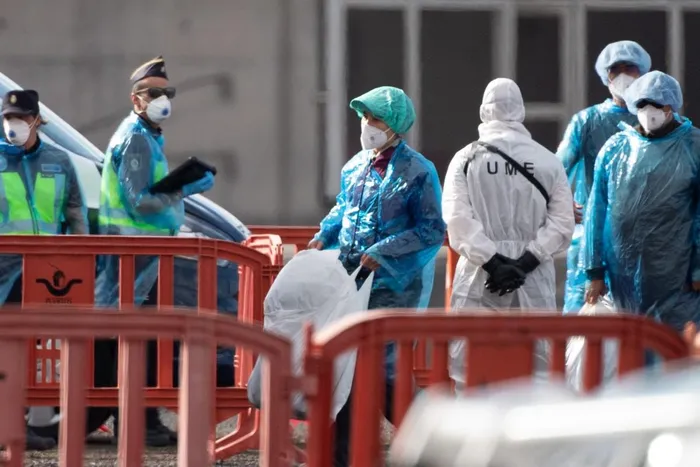
Passengers wearing blue protective suits board a military bus as passengers and crew are evacuated from the Dutch flagged hantavirus-stricken cruise ship MV Hondius at the industrial port of Granadilla de Abona on the island of Tenerife in Spain's Canary Islands on May 10, 2026.
Image: JORGE GUERRERO / AFP
A medical expert has shared some practical advice and answered some of the questions being asked by ordinary people since the recent outbreak of hantavirus aboard a cruise ship and allayed fears among South Africans, emphasising that there was “no outbreak” in the country.
Professor Veronica Ueckermann, Head of Infectious Diseases in the Department of Internal Medicine at the University of Pretoria (UP), said travelling on a normal flight is considered “very low risk”.
“Based on what we currently know about the Andes virus, the risk to fellow passengers on a flight appears to be low,” Ueckermann said in a statement.
“Simply being on the same aircraft, walking past an infected person or sitting at a distance would be considered very low risk. Sitting next to a sick person on a long-haul flight may plausibly carry a low risk, while the highest risk would be repeated close contact, such as caring for someone, touching or sharing cups.”
She said in South Africa, hantavirus is not considered a major public health concern. Confirmed human cases are extremely rare, and the current cases being managed in the country were linked to exposure outside the country, not local transmission. She reiterated what the authorities and other experts have been saying about the virus, that South Africa is not experiencing a hantavirus outbreak.
Reports about a couple of people who had been on the MV Hondius ship recently falling seriously ill and being medically assisted in South Africa, raised fears of another pandemic among members of the public and brought back memories of the Covid-19 outbreak of six years ago.
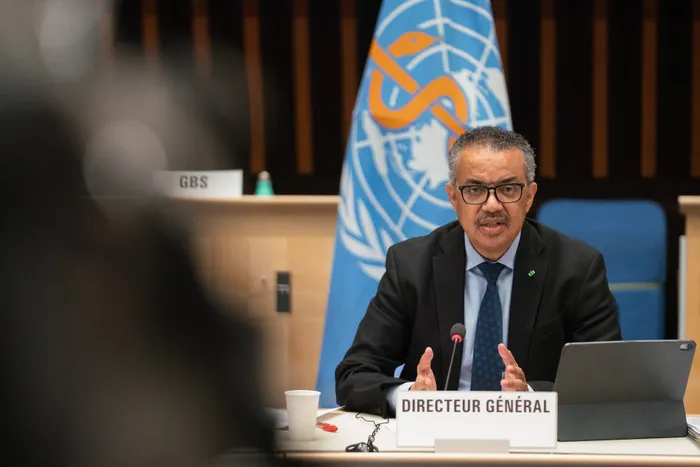
World Health Organisation Director-General Tedros Adhanom Ghebreyesus providing an update on the hantavirus outbreak aboard a cruise ship where he said the global public health risk remains low.
Image: Christopher Black / World Health Organization / AFP
However, the UP professor said hantavirus was not new and did not spread the same way as other respiratory diseases such as influenza and Covid-19. She said hantavirus infections occur after environmental exposure in endemic regions, particularly in enclosed spaces where rodent droppings, urine or saliva have contaminated dust. Sweeping dry droppings in garages, sheds, storage rooms or other poorly ventilated areas may increase the risk of inhaling contaminated particles, she said.
While stressing that hantavirus was not a public health concern in South Africa, she said practical prevention remains important and shared some advice. She said people should avoid sweeping rodent droppings, and instead spray the droppings with disinfectant or diluted bleach, allow the area to soak, wipe it up with paper towels and wash their hands thoroughly afterwards. They should also ventilate enclosed spaces before cleaning, wear gloves and a mask. Food and waste should be stored securely, and rodent entry points should be sealed.
World-renowned South African epidemiologist Professor Salim Abdool Karim also recently reassured the public that the risk of widespread transmission of hantavirus remains low. He told the POST newspaper that the virus was unlikely to spread widely.
“The one on the ship is called the Andean strain from the Andes mountains. That particular strain is quite common in Argentina and Brazil, so that is probably where they picked it up,” he explained.
He said it was “very unlikely” that the virus would cause a pandemic and “people do not need to panic”.
Abdool Karim, who played a key role in the global fight against Covid-19, said hantavirus did not spread efficiently between humans and was already well understood by scientists.