

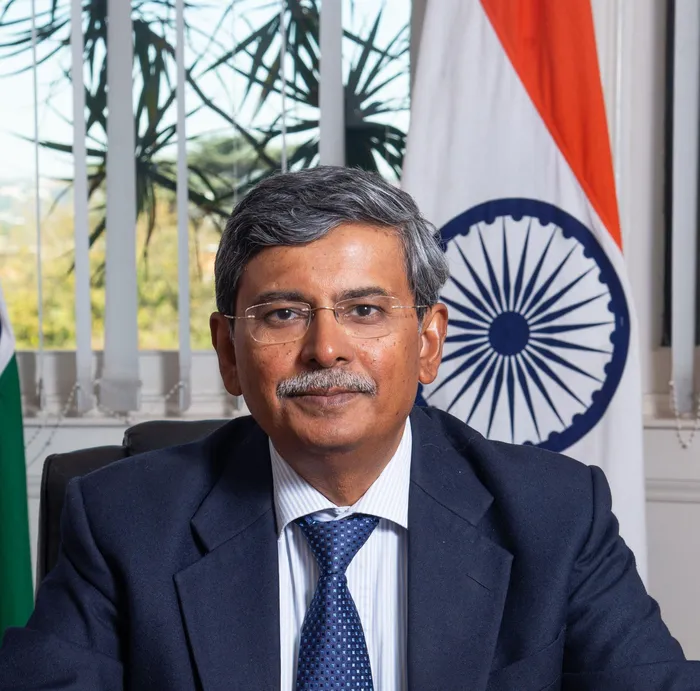
Prabhat Kumar, High Commissioner of India to South Africa and Lesotho, has announced that India will host the fourth India-Africa Forum Summit in New Delhi from 28 to 31 May 2026, aiming to strengthen political, economic, and cultural ties between India and African nations. This summit, themed 'IA Spirit: India Africa Strategic Partnership for Innovation, Resilience and Inclusive Transformation,' promises to shape the future of India-Africa relations.
Image: Supplied
India hopes to build on the existing political, economic and cultural ties it has with Africa as it hosts the fourth India-Africa Forum Summit (IAFS) in New Delhi from 28 to 31 May 2026.
The summit is a key platform to advance India-Africa relations in politics, security, economy, culture, trade, development, and people-to-people connections.
The India-Africa Forum Summit was set up in 2008 as a structured way to strengthen engagement between India and African countries. The fourth edition, IAFS-IV, will be held on 31 May in New Delhi with the African Union Commission. The theme of the summit is “IA Spirit: India Africa Strategic Partnership for Innovation, Resilience and Inclusive Transformation”.
The summit is expected to end with the adoption of the New Delhi Declaration, which will set out key areas for future cooperation. The political part of the summit will happen in three stages: Senior officials’ meeting on 28 May, foreign ministers’ consultations on 29 May, and summit of heads of state and government on 31 May.
Indian High Commissioner Prabhat Kumar said India expects strong African participation. He said India-Africa relations are based on a long history of solidarity, shared goals, and common interests. Speaking at a media conference in Parktown, Johannesburg on Friday, Kumar shared the IAFS schedule and other events planned for the period in India's capital city.
When asked how joint projects in the digital and telecommunications sector, energy, and industry will help create local jobs and develop skills and capacity in Africa despite the continent's divisions, Kumar said India deals with Africa as a bloc through the African Union and AfCFTA. However, most trade still happens between India and individual African countries.
India is also expanding educational ties. Over the past decade, more than 35,000 Africans have received training under the ITEC programme. Over 23,000 African students are currently studying in India.
Other areas of cooperation include:
India’s partnership with Africa follows Agenda 2063 and India’s Viksit Bharat 2047 roadmap. It is guided by 10 principles set out by Prime Minister Narendra Modi in Kampala in June 2018. These focus on capacity-building, local value creation, open markets, technology transfer, cooperation in education, agriculture, and healthcare, and people-centric development.
As a pre-summit event, the Indian Council of World Affairs will hold an international Track-II Academic Conference in New Delhi on 22-23 May. The theme is “Shared Futures, Shared Strength; Expanding India-Africa Partnership”.
The conference will bring together academics, scholars, diplomats, industry leaders, media, and civil society from India and Africa to share ideas and give recommendations for the summit.
On the economic side, India is Africa’s third largest trading partner. Bilateral trade has exceeded $100 billion, and investments have passed $80 billion. India’s championing of Africa's inclusion in the global economy during its G20 presidency led to the African Union becoming a permanent member of the G20 bloc.
The business part of the summit will include plenary sessions, sector discussions, business-to-business meetings, and exhibitions. An India-Africa Business Dialogue and Exhibition will take place from 29-31 May in New Delhi, organised by CII, FICCI, ASSOCHAM, and PHD Chamber of Commerce. India has completed over 200 projects in Africa in areas such as irrigation, power, manufacturing, technology parks, and railways. Cooperation also includes medical assistance, equipment such as ambulances and cancer machines, and disaster relief for countries like Lesotho, Zambia, Malawi, Kenya, and Mozambique.
During Covid-19, India gave medical aid to 32 African nations. African countries were main the beneficiaries of the ‘Vaccine Maitri’ initiative. The Serum Institute of India and South Africa’s Aspen Pharma set up Africa’s first vaccine manufacturing facility in Durban.
In defence, India has trained military personnel from several African countries and helped set up defence institutions in Nigeria, Ethiopia,and Tanzania.
In space, India has provided weather forecasting systems, early warning mechanisms, and precision agriculture tools.
The cultural side will be led by the Indian Council for Cultural Relations. Events in May include an India-Africa Dance and Music Festival on 23 May in New Delhi, a joint artistic workshop from 18-23 May, and the India-Africa Artists Partnership for Public Art for mural projects.
Africa has an Indian diaspora of about 3.5 million people, with half living in South Africa. India sees people-to-people ties as a key part of the partnership. India describes its partnership with Africa as a frank and open consultative process where both sides meet as partners to discuss needs and expectations, and to celebrate their brotherhood and civilisational connection.
The summit aims to create a comprehensive framework for future India-Africa engagement at the Pan-African, regional, and bilateral levels.