

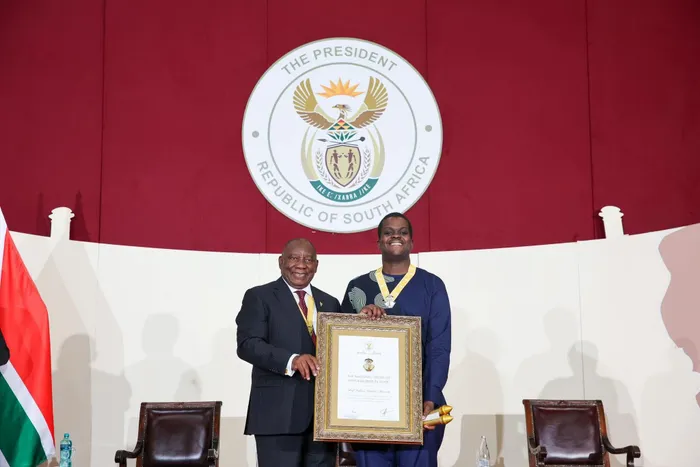
Honoured by President Cyril Ramaphosa during the National Orders ceremony, Professor Vukosi Marivate was recognised for his excellence in the field of artificial intelligence.
Image: GCIS
As South Africa honoured some of its most influential thinkers, artists and innovators in the 2026 National Orders ceremony, two academics from the University of Pretoria (UP) were celebrated as symbols of a country increasingly shaped by both technological innovation and creative imagination.
At the official ceremony in Pretoria on Tuesday, President Cyril Ramaphosa praised recipients for their contributions to democracy, social progress, culture and knowledge production, describing them as individuals helping to strengthen the foundations of the nation.
“Today we honour men and women who have lifted to the sky our greatest aspiration: to build a democratic South Africa founded on equality, justice and dignity for all,” he said.
Among the recipients were UP Professor of Computer Science Vukosi Marivate, who received the Order of Mapungubwe in Silver for his contribution to artificial intelligence and computer science, and performance artist and UP Drama Department lecturer Mr Gavin Krastin, who received the Order of Ikhamanga in Bronze for his contribution to the arts.
The Order of Mapungubwe is one of South Africa’s highest honours, awarded to citizens who have achieved excellence in science, medicine, technology and innovation. The Order of Ikhamanga recognises South Africans who have excelled in the arts, culture, literature, music, journalism and sport.
Although Marivate and Krastin work in vastly different disciplines, both embed themes of representation, inclusion and the centrality of South African voices in shaping the country’s future into their work, the university said in a statement.
One of Africa’s leading voices in artificial intelligence, Marivate said this national recognition was deeply emotional and reflective. “It has been slowly sinking in, and to be completely honest, I have battled with feeling worthy of our nation’s highest recognition for scientific excellence.”.
Rather than viewing the honour as an individual achievement, he describes it as the culmination of years of collaboration between researchers, students, educators and communities committed to building African-centred technological innovation.
“When I look at this milestone, I don’t see an individual achievement. I see a mirror reflecting a vast, beautiful village of researchers, students and community-builders who chose to build a shared vision with me.”
Marivate has become one of Africa’s leading voices in artificial intelligence, particularly through his work advancing African language technologies and inclusive AI systems. His research has contributed to broader conversations around digital sovereignty, ethical AI and the role Africa should play in shaping emerging technologies rather than simply consuming them.
He said a defining moment in his career came when researchers began recognising that African languages, histories and contexts were largely absent from global technological systems.
“Seeing the rapid rise of movements like Masakhane and the Deep Learning Indaba proved that building localised AI tools was not just a niche academic exercise, but a societal necessity,” he said.
Marivate believes Africa cannot afford to remain on the margins of technological development.
“For too long, the narrative has safely tucked Africa away in the future tense. AI in Africa should not be something that just happens to us from the outside. It must empower our youth, protect our digital sovereignty and solve local socioeconomic challenges using our own data.”
He added that institutions such as UP’s Data Science for Social Impact Lab and the African Institute for Data Science and Artificial Intelligence (AfriDSAI) had helped create spaces where students and researchers could transform ambitious ideas into practical impact.
“I want younger scientists to know that our languages, our data and our perspectives are inherently valuable and belong at the cutting edge of global science.”
Speaking on SAfm radio on Wednesday morning, Marivate said he believed in not “speaking down” to people on the continent when it came to technological matters like the internet and AI. Instead, he said they should be involved and asked how they thought things like the internet can be of better use to them.
Asked about the future as far as these technologies are concerned, he expressed optimism as more young people were entering the space and working in research and development in these areas.
“At the same time, yes, computing continues getting cheaper and cheaper … (but) maybe we’re done with the era of cheap data to train machine learning,” he said.
This necessitated a shift in focus towards “new possibilities” or “new things”, like copyright and licensing that may open up opportunities in the AI ecosystem for many people across the continent.
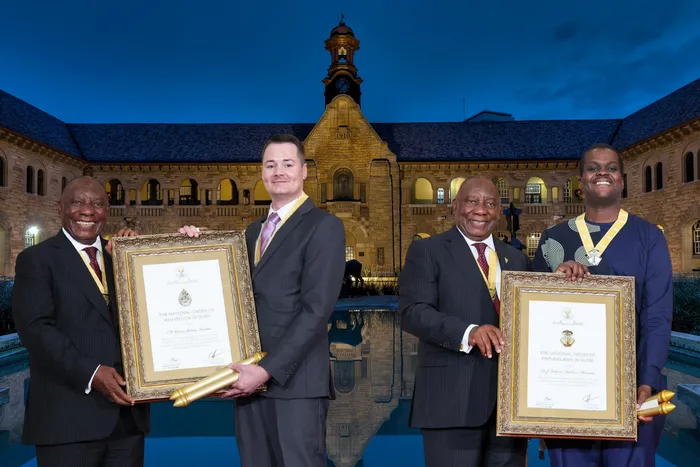
Honoured with National Orders by President Cyril Ramaphosa, Gavin Krastin (left) and Professor Vukosi Marivate (right) were recognised for their excellence in the arts and artificial intelligence.
Image: GCIS
While the computer science and AI professor’s work focuses on ensuring African voices shape the digital future, Krastin’s contribution lies in challenging audiences to rethink identity, society and belonging through experimental performance art.
Krastin described receiving the Order of Ikhamanga as “profoundly humbling”, particularly because he has considered his work to be outside the mainstream.
“Much of my work has existed within spaces that are experimental, marginal and often difficult to sustain, so to have live art, performance and curation recognised in this way by the Presidency feels incredibly meaningful.”
The honour belonged equally to the many collaborators, technicians, students and fellow artists who have contributed to his creative journey over the years, he said.
“It also reaffirmed for me that artistic practice can contribute meaningfully to cultural, intellectual and political conversations in society.”
As a lecturer in UP’s Drama Department, Krastin said teaching has become central to both his artistic and intellectual life.
“There is a constant creative feedback loop between lecturer and student where one is continually exposed to new ideas and perspectives. Teaching keeps me intellectually alert, creatively energised and connected to emerging generations of artists who are reshaping the future of performance in South Africa.”
His work in interdisciplinary live art spaces has consistently challenged conventional approaches to theatre and performance. He believes the arts remain essential in a society still grappling with inequality, historical trauma and questions surrounding identity and belonging.
“I think performance should not only entertain but also provoke thought, create dialogue and open imaginative possibilities for alternative futures. The arts help us rehearse new ways of being together as a society.”
Together, the honours bestowed on Prof Marivate and Mr Krastin reflect a broader vision of South Africa’s future, one shaped not only by scientific innovation and technological progress but also by imagination, creativity and the courage to challenge existing boundaries.
The University of Pretoria said the awards reinforce the institution’s growing role as a hub for both cutting-edge research and cultural innovation, while positioning its academics among the leading voices shaping conversations around technology, identity and social impact in Africa and beyond.