
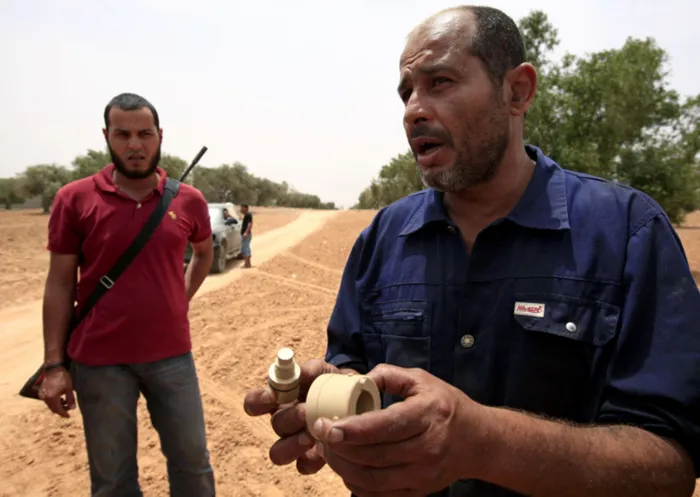
A Libyan rebel fighter displays an anti-personnel mine found near Misrata's western front line, about 25km from the city centre. Muammar Gaddafi's troops have started shelling Misrata from three different zones. A Libyan rebel fighter displays an anti-personnel mine found near Misrata's western front line, about 25km from the city centre. Muammar Gaddafi's troops have started shelling Misrata from three different zones.
Misrata - Thousands of troops loyal to Libyan leader Muammar Gaddafi advanced on the rebel-held western city of Misrata on Wednesday, shelling it from three sides in attacks that killed at least 12 rebels, a rebel spokesperson said.
The offensive followed a lull in Nato bombing of Tripoli on Wednesday, after 24 hours of some of the heaviest bombardments of the Libyan capital since air strikes began in March.
Nato defence ministers met in Brussels on Wednesday, but there were few signs of willingness to intensify their Libya mission, which has so far failed to oust Gaddafi as leader of this oil-producing North African desert state.
The alliance says the bombing aims to protect civilians from the Libyan leader's military, which crushed popular protests against his rule in February, leaving many dead. The conflict has now become a civil war.
“Misrata is under heavy shelling... Gaddafi forces are shelling Misrata from three sides: east, west and south,” rebel spokesperson Hassan al-Misrati told Reuters from inside the besieged town.
“He has sent thousands of troops from all sides and they are trying to enter the city. They are still outside, though.”
Doctors at the Hekmah hospital in central Misrata told Reuters correspondents who visited it that at least 11 people had been killed and 35 wounded, many seriously.
There was no immediate comment from Gaddafi's government.
A rebel fighter, who declined to be named, vowed revenge. “One day soon, God willing, we will be at Bab al-Aziziya (Gaddafi's compound) and we will find Gaddafi and his military forces and we will kill him,” he told Reuters.
With officials like British Foreign Secretary William Hague talking explicitly of Gaddafi being forced out, critics say Nato has gone beyond its United Nations mandate to protect civilians.
Western powers are lining up behind the rebels. Spain's Foreign Minister on a visit to the eastern city of Benghazi on Wednesday said his country now only recognised their National Transitional Council as the representative of the Libyan people.
Rebel spokesperson Kalefa Ali in the Western mountain town of Nalut said the towns of Yafran and Kalaa, which fell to rebels earlier this week, had been shelled by Gaddafi forces.
“Rebels fear that Gaddafi's forces will launch a wide scale offensive in the western mountains as he is doing in Misrata today,” said Ali. “He is putting on a fight and not giving up.”
Juma Ibrahim, a rebel spokesperson in Zintan, said Gaddafi's forces were holding residents in the world heritage-listed old city of Gadamis, 600km southwest of the capital on the Tunisia and Algerian border, after anti-government protests.
Accounts from the mountains and Gadamis could not be independently verified because access for reporters is limited.
Gaddafi troops and the rebels have been deadlocked for weeks, with neither side able to hold territory on a road between Ajdabiyah in the east, which Gaddafi forces shelled on Monday, and the Gaddafi-held oil town of Brega further west.
Rebels control the east of Libya, the western city of Misrata and the range of western mountains near the border with Tunisia. They have been unable to advance on the capital against Gaddafi's better-equipped forces.
Nato sought broader support for the Western bombing campaign in Libya on Wednesday, given that the alliance's air power has been stretched by the latest strikes on Tripoli.
“We want to see increased urgency in some quarters in terms of Libya,” British Defence Minister Liam Fox told reporters in Brussels.
But some Nato allies that have not taken part in the bombing said they would not alter their stance, and Sweden, a non-Nato participant, said it would scale down its role.
Of the 28 Nato allies, only eight, led by Britain and France, have been conducting air strikes on Gaddafi's forces, and a senior US official warned this week that fatigue was beginning to set in among the aircrews already committed.
Nato allies agree Gaddafi must go, but not all view military intervention as the best way to achieve this.
Germany, which opposed the Libyan intervention, said it understood the pressures on Britain and France but would not change its position. Spain said it would not join the mission, despite now recognising the rebels as Libya's representatives. - Reuters